

Fish identification archive / Trumpetfish
Trumpetfish
Aulostomus maculatus
I saw this
Spotted this fish? Share the guide with your dive buddies. Review your caption before posting.
For Instagram, copy the caption and link into your own post or message. Nothing is posted automatically and this does not record a verified sighting.
Fun facts for your next surface interval
- This trumpet has a suction-powered mouth, not a brass section.
- Sometimes the best disguise is another fish: trumpetfish can shadow larger swimmers.
- A head-down pose may be part of the hunting plan, not a bad parking job.
Palm Beach connection
Lake Worth Lagoon / Blue Heron Bridge, Palm Beach County: Verified local record.
Documented regional presence is not a guarantee of an encounter or a measure of how common this fish is at your dive site.
How to recognize this fish
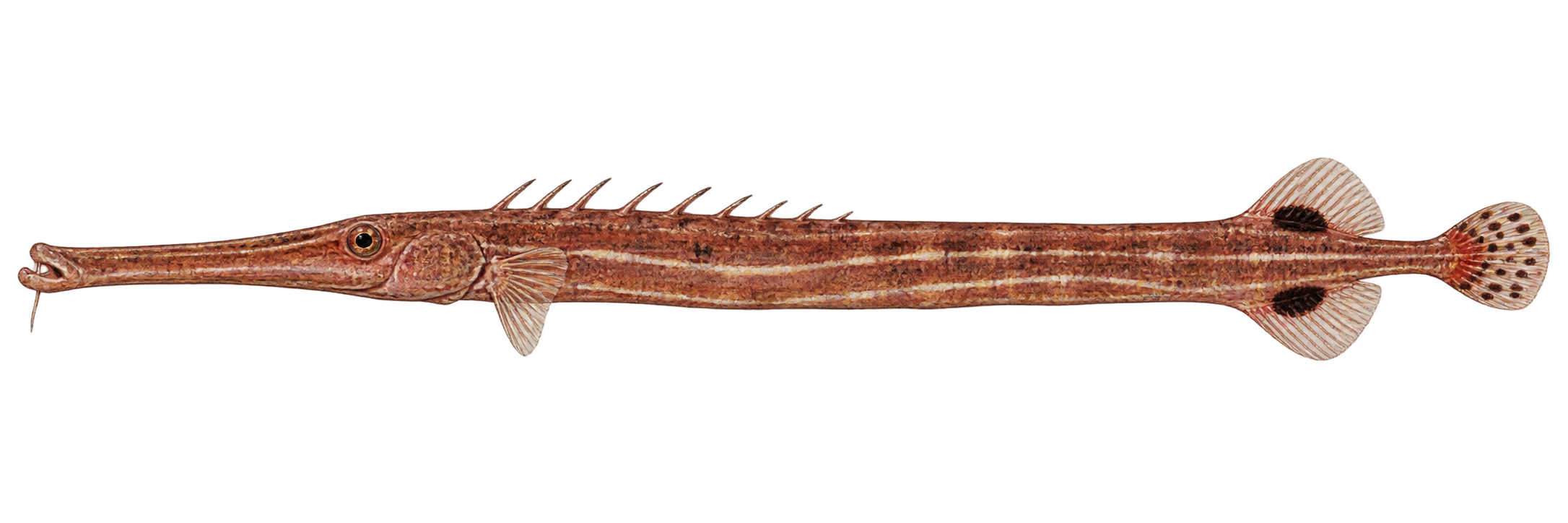
The long tubular snout and extremely slender body make a trumpetfish stand out once you notice it. A small chin barbel and a rounded tail help confirm the identification. The soft dorsal and anal fins sit well back on the body, with separate short spines ahead of the dorsal fin. Brown mottling is common, but yellow and blue-gray individuals belong to the same species.
Size and life stages
About 24 inches is a commonly reported length, while the published maximum is approximately 39 inches. Its narrow profile can make a fairly long fish surprisingly easy to overlook. In a photograph, include the whole animal when possible: an image of just the head misses the tail and fin placement that help distinguish it from other tube-snouted fishes.
Habitat and where to look
Reefs with sea whips and other upright structure provide effective camouflage. Trumpetfish also use weedy areas. Rather than peering only into holes, scan the spaces between vertical growth and notice shapes that do not quite match their surroundings. This is an observation suggestion, not a reason to push aside delicate animals or vegetation to expose a hidden fish.
Range and local context
This western Atlantic species ranges from southern Florida and Bermuda toward northern South America. Verified documentation in Lake Worth Lagoon establishes its local relevance. The record does not tell us which color form you will encounter or whether one will be at a particular site today. Look for anatomy before using color as the deciding feature.
What is on the menu?
Small fishes and crustaceans are taken by ambush. The mouth expands to create suction, so a narrow-looking snout does not mean a diet limited to tiny crumbs. A trumpetfish may wait among upright reef growth or follow a larger fish while seeking an opportunity. Let any hunt unfold naturally instead of moving prey or supplying bait.
Daily habits and behavior
Head-down hovering is a useful behavior to recognize. Trumpetfish can also use larger fishes as moving cover while approaching prey. A still animal should not be assumed to be stuck, sick or in need of assistance. Give it time and space: waiting at a respectful distance often teaches more than swimming directly toward the face.
Mating and the next generation
Courtship can involve changes in color and coordinated movement. FishBase describes separate sexes and eggs released into the water. Do not transfer the seahorse's male pregnancy story to this species: having relatives within the same broader fish order does not mean sharing a brood pouch. An unusual pair of movements is interesting to record without confidently labeling it spawning.
Look-alikes and identification traps
Cornetfishes are another long, tube-snouted possibility, but their tail filament and different body details separate them from a trumpetfish's rounded tail and chin barbel. Needlefishes instead have elongated tooth-bearing jaws rather than a tubular snout. An overall side view is the best starting point; color alone is a poor shortcut for any of these comparisons.
Observe without disturbing
Keep fins and equipment clear of sea fans, whips and sponges while watching. Do not touch the fish or the structure beside it, and do not chase it to produce a color change. Capture a natural pose if conditions allow, then move on without blocking its hunting space. Note the color you actually saw, since one illustration cannot represent every appearance.
Harvest, protection and eating safety
Restricted marine life: live collection only; no spearing
Can it be hunted or harvested?
Trumpetfish is regulated as tropical ornamental marine life, rather than an ordinary food-fishing target. Where collection is lawful, a recreational saltwater fishing license is required unless exempt; fish must be landed and kept alive with suitable aeration or circulation. No species-specific size limit is listed. The daily limit is five of this species within 20 marine-life organisms total. A two-day possession limit also applies.
Florida seasons and areas
No recreational closed months are listed in the FWC marine-life rules reviewed. This does not make every location open: collection is prohibited within the designated Blue Heron Bridge dive-site boundary. Florida marine-life rules also apply in adjacent federal waters, on both coasts. Check park, refuge and Florida Keys sanctuary restrictions before collecting.
Can it be speared?
Prohibited. FWC expressly includes this ornamental-fish family in its no-spearing list.
Is it safe to eat?
Not assessed here as food and not recommended as a food target. Legal live collection is not a finding that a fish is safe to eat. Florida DOH advisories depend on catch location and consumer group; cooking cannot remove all marine toxins.
Before you act: This recreational overview is not permission to collect or spear at your dive site. Confirm the species, date, management area, state or federal waters, gear, licenses and current local closures. A fish illustration cannot establish an identification or guarantee seafood safety.
Official rules and health guidance
- FWC: Recreational Marine Life
- Florida Administrative Code: Marine Life, Chapter 68B-42
- FWC: Saltwater Recreational Licenses and Permits
- NOAA: Florida Keys National Marine Sanctuary Zones
- FWC: Spearing
- Florida Department of Health: Eating Healthy Seafood and Local Advisories
- Florida Department of Health: Seafood Poisoning
Reviewed 2026-11-10. Rules and advisories can change; check the linked authorities before harvesting or eating.
Sources and review
Reviewed 2026-11-10.
Make your next dive happen
Dive With Us
Explore local charters and plan a dive suited to your experience.
View dive calendarTrain With Us
Build your fish identification, buoyancy and diving skills.
Explore trainingTravel With Us
Discover upcoming dive adventures and trip details.
Explore dive travelShop With Us
Browse equipment for your diving and ask our team for help choosing.
Explore dive gearReview current dates, availability, prices, inclusions and requirements on each listing before booking or buying.
Call us now
Ask about fish identification training
Reef Fish Identification
Ask about dates, prerequisites or your next step. An inquiry does not reserve a place. Please provide your own contact details; do not include medical, payment or a child's personal information.
We use these details to respond to your inquiry. This form does not sign you up for marketing.
Explore more with Stuart Scuba
Open Water course options · Advanced Adventure training · Technical training · Professional training · All courses · Local dives · Dive trips · Facebook · Instagram · YouTube
Your surface-interval essentials
Questions for Stuart Scuba? info@stuartscuba.com
Check the Stuart Scuba Weather Center · Play scuba trivia
Weather and wildlife vary. Confirm current conditions, trip requirements and departure details with the operator.
Plan Your Next Dive with Stuart Scuba
Dive With Us
Explore upcoming local charters and choose a dive that fits your experience.
Before you book
Check the individual listing for departure time, requirements and availability.
Travel With Us
Find upcoming dive adventures and start planning your next trip.
Plan your trip
Review dates, inclusions and trip details on the travel calendar.
Stay Connected with Stuart Scuba
 Follow pageShare
YouTube
SubscribeWatch & shareFollow on InstagramView & share post
Follow company news, training updates, and dive stories.
Follow on LinkedInGoogle Reviews
See Stuart Scuba’s current Google rating and review count below. Open the listing in Google Maps to browse customer reviews.



