

Fish identification archive / True Tulip
True Tulip
Fasciolaria tulipa
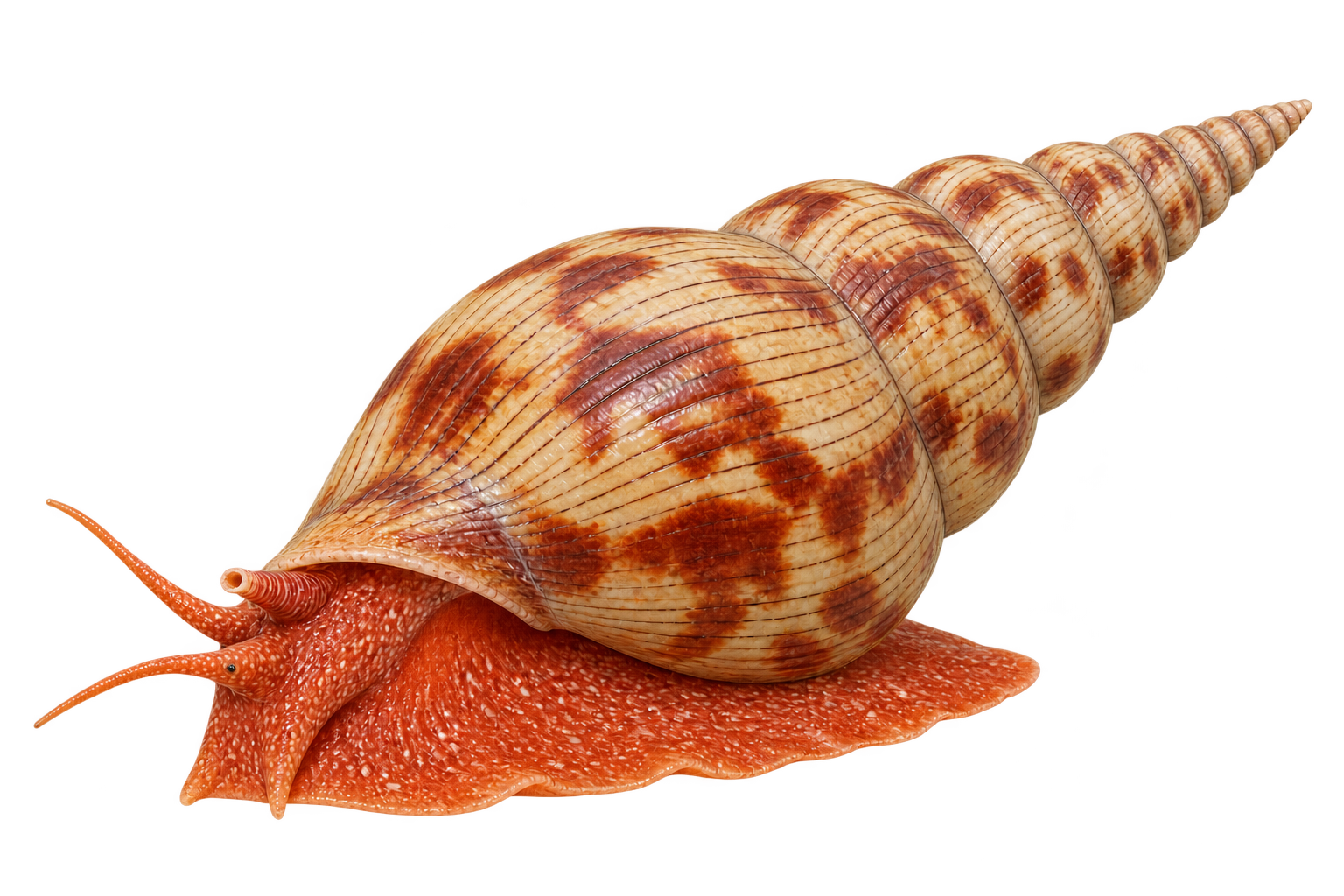
Fun facts for your next surface interval
- Flower name, predator menu: the shell resembles a tulip, but the animal eats other invertebrates.
- Built-in door: a thick operculum closes the shell opening.
- Red carpet underneath: the living animal can be orange, red or dark red.
Florida and local context
Florida, regional occurrence: Bailey-Matthews Southwest Florida specimen account and Kice Island living animal
Documented regional presence is not a guarantee of an encounter or a measure of how common this animal is at your dive site.
How to recognize this animal
The shell is spindle-shaped, with roughly nine rounded whorls, a pointed spire and an elongated front canal. Its relatively smooth surface carries many fine brown spiral lines and variable blotches of cream, orange or darker brown. The living snail may be bright orange to deep red. Check shape and fine pattern together instead of expecting every individual to match one color illustration.
Size and life stages
Bailey-Matthews National Shell Museum reports shell length reaching twenty centimeters, approximately eight inches. That measurement excludes the extended foot and siphon. The animal’s muscular red foot can make the whole crawling snail appear larger. Worn shells lose some surface detail, while juveniles have smaller proportions, so size alone does not distinguish a true tulip from a related snail.
Habitat and where to look
Seagrass bottoms and sand flats are useful search settings. Look for the shell moving on a broad foot, with the head and siphon emerging naturally from the opening. An apparently similar shell occupied by a hermit is a different observation. Take a wider habitat photograph before concentrating on the shell, and leave surrounding grass and sediment untouched.
Range and local context
This western Atlantic species is well documented in Florida. Bailey-Matthews’ Southwest Florida guide includes living animals and egg cases photographed near Marco Island, providing much stronger regional evidence than a shell merely sold in a Florida shop. The profile does not claim that every Palm Beach sand flat supports it or that its abundance is uniform around the state.
What is on the menu?
The true tulip is a predator, feeding on other mollusks and small invertebrates. A handsome shell does not imply an algae-only diet. Its feeding structures are part of a living gastropod concealed within the shell, and a red foot passing another snail is not enough to prove a predation event. Let any interaction unfold without placing animals together.
Daily habits and behavior
The shell’s aperture can be closed by a thick, heavy operculum attached to the animal. This oval structure has pointed ends and is not a second shell valve. The snail moves on a broad muscular foot; it does not walk on jointed legs. Seeing legs instead of a foot indicates a borrowed-shell occupant rather than the tulip itself.
Mating and the next generation
The species produces attached egg cases, and the museum account includes detailed photographs of them with a living female near Marco Island. That links the structures to the animal without requiring a speculative Florida-wide spawning season. A group of capsules alone can be difficult to identify, so include an adult only if it is already naturally present nearby.
Look-alikes and identification traps
Banded tulips are an important comparison: they tend to show a more orderly set of strong dark bands rather than the true tulip’s many fine lines and cloudlike blotches. Horse conchs have different sculpture and proportions. Atlantic tritons have a heavier, more sculptured shell and much shorter front canal. A shell occupied by a hermit must be recorded as an occupant observation.
Observe without disturbing
Photograph the extended animal without turning the shell over or blocking its path. Do not break or collect egg cases for a closer view. Leave empty shells as habitat as well as occupied ones, and confirm local restrictions before considering any collection. An attractive shell, a food-use report or a successful identification never establishes that eating the animal is safe.
Harvest, protection and eating safety
Shell collection conditional; food caution
Florida state waters: licensed live-shell collection may be lawful, with no species-specific annual closed months identified. Lee prohibits harvest and coastal-water possession; Manatee limits harvest and coastal-water possession to two per species. Parks, refuges, sanctuary zones and federal waters need separate checks. Do not treat the statewide allowance as food-safety clearance. FWC describes tulip snails as edible, but a specific open, suitable source and current health guidance must be verified before eating.
This color is a qualified summary, not permission to collect or a guarantee that a particular catch is safe to eat. Read the current rules and health guidance below.
Conditional shell collection; local closures apply
Can it be hunted or harvested?
True Tulip is not among the gastropod groups listed in Florida’s marine-life rule. FWC’s unregulated-species recreational default applies where collection is otherwise lawful: up to 100 pounds or two organisms of this species per person per day, whichever is greater. That is a legal quantity threshold, not a recommendation to collect it. A Florida saltwater fishing license is required for a live sea shell, including shore collection, unless a statutory exemption applies. No species-specific size limit or separate multi-day possession allowance was identified; do not assume a bag can be multiplied by trip length.
Florida seasons and areas
No species-specific annual recreational closed season is listed in the reviewed Florida shell rules. Lee County prohibits harvest of these living mollusks or echinoderms and prohibits possession in or on county Florida waters seaward of mean high water. Manatee County allows no more than two of this species harvested per day and no more than two in possession in or on county Florida waters seaward of mean high water. State and federal parks, wildlife refuges and Florida Keys sanctuary zones may prohibit collection regardless of the statewide default. Western Dry Rocks is closed to all fishing April 1–July 31. These Florida state-water limits are not a blanket authorization for Atlantic or Gulf federal waters; check the exact federal area and landing rules before collection.
Can it be speared?
Neither this snail nor its family appears as a named prohibited species on FWC’s general spearing list. That omission is not a blanket permission: location-specific restrictions, closed areas and lawful collection rules still apply. For example, spearfishing is prohibited within 100 yards of public bathing beaches, commercial or public fishing piers, or a bridge portion where public fishing is allowed, and in numerous park waters. This guide recommends observation rather than spearing a snail.
Is it safe to eat?
FWC identifies tulip snails as edible, but directs consumers to Florida Department of Health guidance and open approved harvesting areas. That is not a guarantee that a particular animal or collection site is safe. Correct identification, current closures, source waters and public-health advice matter; never infer safety from a beautiful shell, legal bag limit or the absence of a named advisory.
Before you act: This recreational overview is not permission to collect or spear at your dive site. Confirm the species, date, management area, state or federal waters, gear, licenses and current local closures. Identification artwork cannot establish an identification or guarantee seafood safety.
Official rules and health guidance
- FWC: Recreational Marine Life requirements and regulated groups
- FWC: Recreational Sea Shell Collecting
- FAC 68B-26.002: Living mollusk and echinoderm definition
- FWC: Western Dry Rocks April–July fishing closure
- FWC: Spearing gear and prohibited areas
- Florida Department of Health: Seafood poisoning
- FWC: Sea Snails and qualified consumption guidance
- FAC 68B-26.004: Exact Lee and Manatee harvest and in-water possession restrictions
Reviewed 2026-11-10. Rules and advisories can change; check the linked authorities before harvesting or eating.
Sources and review
Reviewed 2026-11-10.
Make your next dive happen
Dive With Us
Explore local charters and plan a dive suited to your experience.
View dive calendarTrain With Us
Build your fish identification, buoyancy and diving skills.
Explore trainingTravel With Us
Discover upcoming dive adventures and trip details.
Explore dive travelShop With Us
Browse equipment for your diving and ask our team for help choosing.
Explore dive gearReview current dates, availability, prices, inclusions and requirements on each listing before booking or buying.
Call us now
Ask about marine life identification
Marine Life Identification
Ask about dates, prerequisites or your next step. An inquiry does not reserve a place. Please provide your own contact details; do not include medical, payment or a child's personal information.
We use these details to respond to your inquiry. This form does not sign you up for marketing.
Explore more with Stuart Scuba
Open Water course options · Advanced Adventure training · Technical training · Professional training · All courses · Local dives · Dive trips · Facebook · Instagram · YouTube
Your surface-interval essentials
Questions for Stuart Scuba? info@stuartscuba.com
Check the Stuart Scuba Weather Center · Play scuba trivia
Weather and wildlife vary. Confirm current conditions, trip requirements and departure details with the operator.
Plan Your Next Dive with Stuart Scuba
Dive With Us
Explore upcoming local charters and choose a dive that fits your experience.
Before you book
Check the individual listing for departure time, requirements and availability.
Travel With Us
Find upcoming dive adventures and start planning your next trip.
Plan your trip
Review dates, inclusions and trip details on the travel calendar.
Stay Connected with Stuart Scuba
 Follow pageShare
YouTube
SubscribeWatch & shareFollow on InstagramView & share post
Follow company news, training updates, and dive stories.
Follow on LinkedInGoogle Reviews
See Stuart Scuba’s current Google rating and review count below. Open the listing in Google Maps to browse customer reviews.



