

Fish identification archive / Tripletail
Tripletail
Lobotes surinamensis · Lobotidae
I saw this
Spotted this fish? Share the guide with your dive buddies. Review your caption before posting.
For Instagram, copy the caption and link into your own post or message. Nothing is posted automatically and this does not record a verified sighting.
Identification and lookalikes
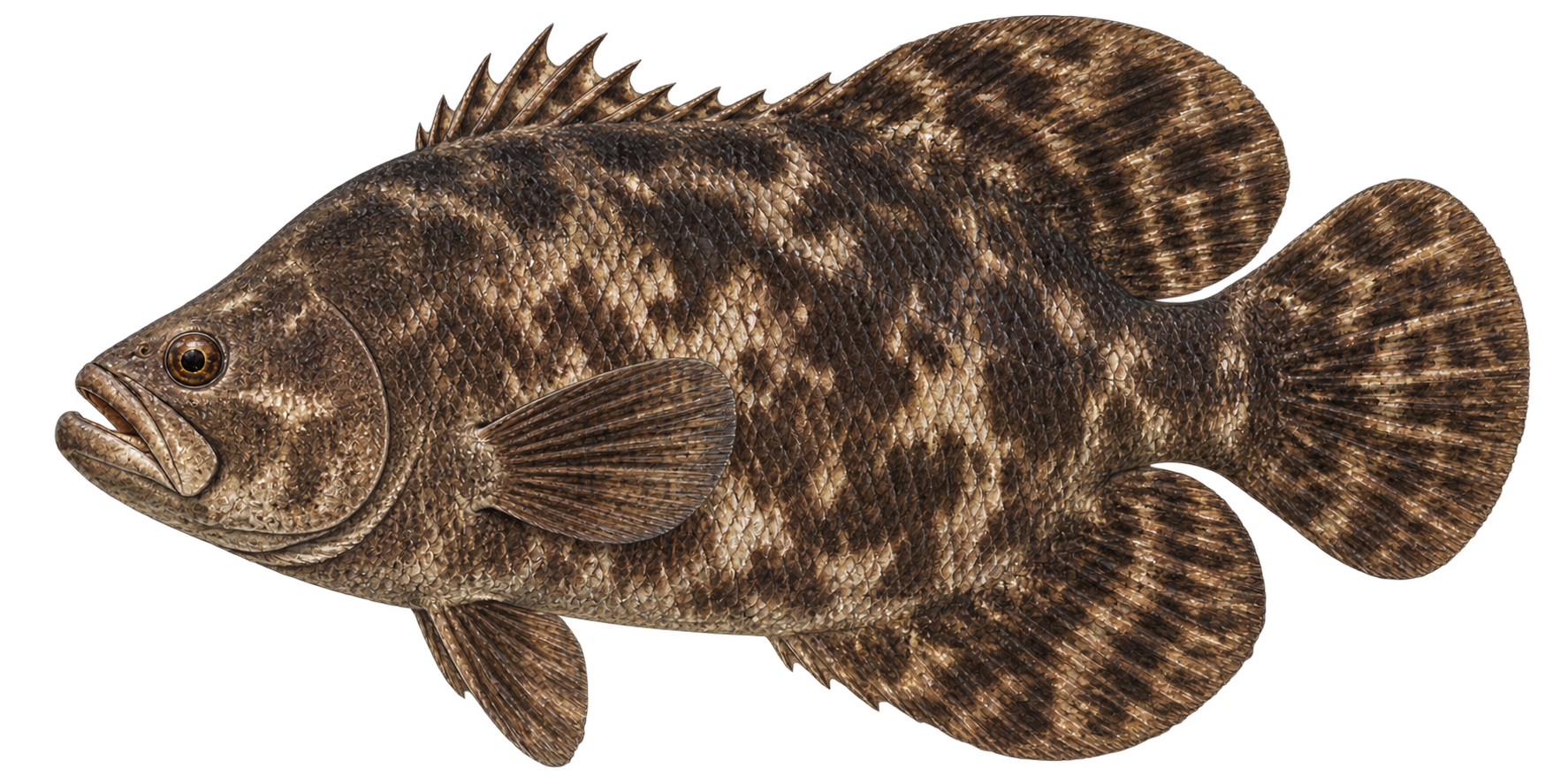
The apparent extra tails are the rounded rear portions of the dorsal and anal fins beside the real tail. A deep body, mottled brown or tan pattern and a concave upper head profile complete the impression. The cheek edge is strongly serrated. Look at fin placement rather than counting rounded shapes: this fish has one tail, not three. FWC species identification Florida Museum species account
Florida habitat and range
Tripletail occur from bays and estuaries into offshore water and often associate with floating objects such as buoys or debris. FWC describes Florida occurrence mainly during spring, summer and fall. The Florida Museum also describes fish near pilings, jetties and wrecks. Suitable habitat does not guarantee a fish beneath any particular marker or at a named dive site. FWC species identification Florida Museum species account
Feeding and reproduction
Tripletail take small fishes and crustaceans, including shrimp and crabs. The museum account describes summer spawning along the Atlantic and U.S. Gulf coasts, with a July–August peak. Larvae go through several developmental stages before acquiring the familiar adult form. Treat that regional timing as biological background rather than a precise local spawning forecast. Florida Museum species account
Size and growth
FWC reports up to 42 inches, while the museum account gives a different upper length and does not resolve the discrepancy. This page therefore avoids presenting either as a settled maximum. Adult size should not be inferred from a nearby buoy: objects vary in dimensions and underwater perspective changes apparent scale. FWC species identification Florida Museum species account
Three facts to remember
- The three-tail effect is a fin arrangement, not spare-tail insurance.
- A floating object can be habitat; a reef is not required.
- The head profile becomes more noticeably concave with age, so younger and older fish need not look identical. FWC species identification Florida Museum species account
Observation and Florida harvest caution
Do not grab a buoy, move debris or corner the fish against a structure to improve a photograph. Watch from a safe position and maintain awareness of boat traffic and lines.
Rules checked November 11, 2026: FWC lists an 18-inch minimum and two fish per person daily, and states that Florida’s rules apply in federal waters. Hook and line is the permitted harvest method; nets and spearing are not allowed. Multiple hooks combined with natural bait and snatching are prohibited. The listed season has no scheduled annual closure, but Biscayne National Park has special provisions. Verify measurement instructions, current rules and your exact location before retaining a fish. FWC current harvest rules
Blue Heron Bridge report
REEF’s Blue Heron Bridge / Phil Foster Park survey report includes Tripletail among species reported at this site. The cumulative volunteer survey record is not a guarantee of a sighting or evidence of current abundance. Blue Heron Bridge (BHB) is a Riviera Beach dive site at Phil Foster Park. Blue Heron Bridge species observation source.
Make your next dive happen
Dive With Us
Explore local charters and plan a dive suited to your experience.
View dive calendarTrain With Us
Build your fish identification, buoyancy and diving skills.
Explore trainingTravel With Us
Discover upcoming dive adventures and trip details.
Explore dive travelShop With Us
Browse equipment for your diving and ask our team for help choosing.
Explore dive gearReview current dates, availability, prices, inclusions and requirements on each listing before booking or buying.
Call us now
Ask about fish identification training
Reef Fish Identification
Ask about dates, prerequisites or your next step. An inquiry does not reserve a place. Please provide your own contact details; do not include medical, payment or a child's personal information.
We use these details to respond to your inquiry. This form does not sign you up for marketing.
Explore more with Stuart Scuba
Open Water course options · Advanced Adventure training · Technical training · Professional training · All courses · Local dives · Dive trips · Facebook · Instagram · YouTube
Your surface-interval essentials
Questions for Stuart Scuba? info@stuartscuba.com
Check the Stuart Scuba Weather Center · Play scuba trivia
Weather and wildlife vary. Confirm current conditions, trip requirements and departure details with the operator.
Plan Your Next Dive with Stuart Scuba
Dive With Us
Explore upcoming local charters and choose a dive that fits your experience.
Before you book
Check the individual listing for departure time, requirements and availability.
Travel With Us
Find upcoming dive adventures and start planning your next trip.
Plan your trip
Review dates, inclusions and trip details on the travel calendar.
Stay Connected with Stuart Scuba
 Follow pageShare
YouTube
SubscribeWatch & shareFollow on InstagramView & share post
Follow company news, training updates, and dive stories.
Follow on LinkedInGoogle Reviews
See Stuart Scuba’s current Google rating and review count below. Open the listing in Google Maps to browse customer reviews.



