

Fish identification archive / Tortuga box crab
Tortuga box crab
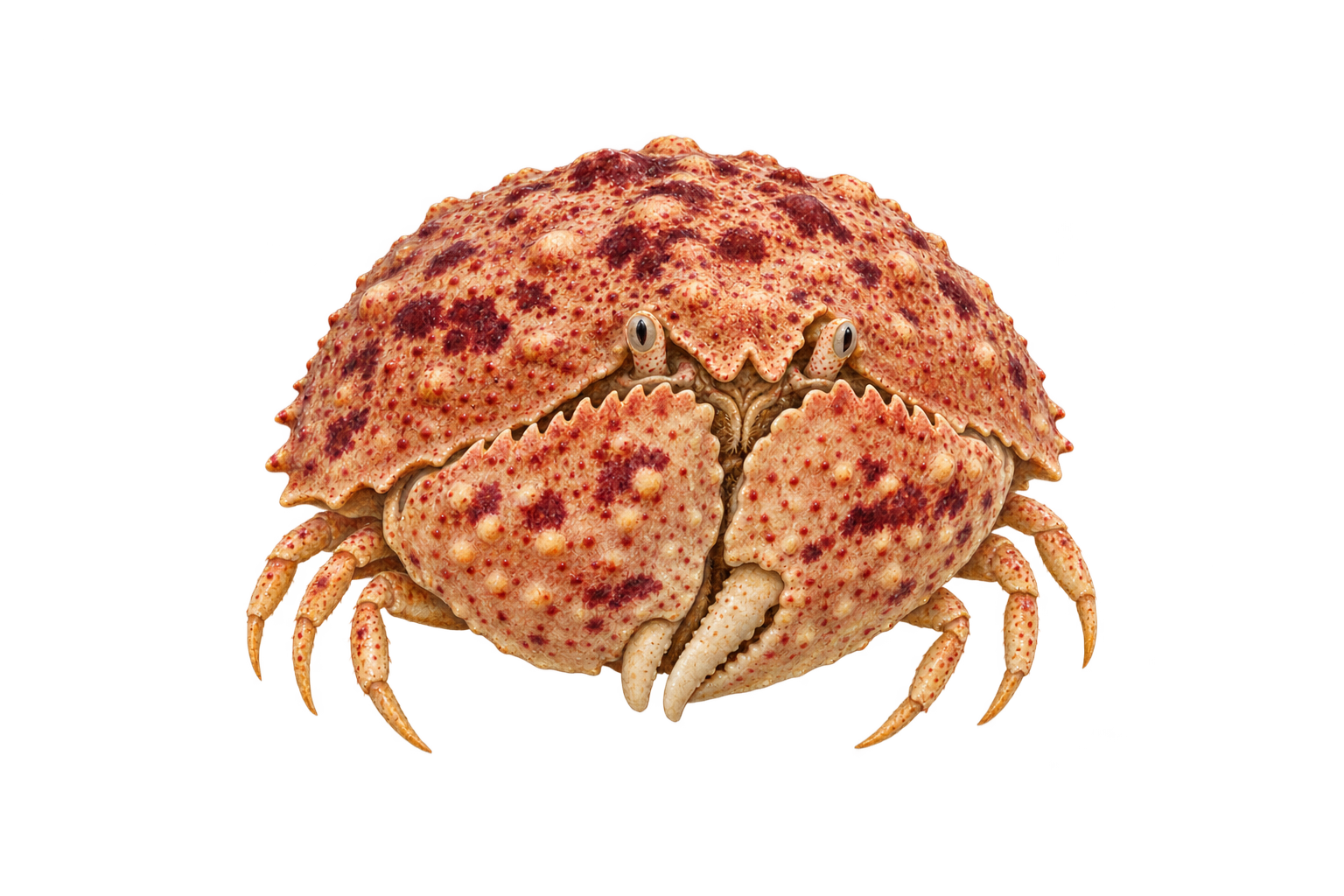
Calappula tortugae
Fun facts for your next surface interval
Florida and local context
Florent Charpin’s species gallery identifies the photographed animal as Calappula tortugae and explicitly captions the photograph Blue Heron Bridge, Florida.
A documented past record does not establish present abundance or guarantee an encounter.
Sources: Florent’s Guide: Tortuga box crab at Blue Heron Bridge
How to recognize this animal
The Tortuga box crab has a domed shell with prominent bumps and grooves, raised eye sockets and toothed extensions at the rear corners. Examine the arrangement of these structures rather than relying on the general “box crab” outline. The scientific diagnosis uses details that may be hidden in a casual underwater photograph. Nodose box crab is another common name for the same animal.
Sources: Williams and Child (1989): southwestern North Atlantic box-crab revision; Florent’s Guide: Tortuga box crab at Blue Heron Bridge
Size and life stages
A measured male in the Williams and Child revision was 35.1 mm long and 44.8 mm across the rear shell projections, about 1.76 inches at that widest measurement. This is a documented specimen, not proof of an absolute maximum. Florent’s Guide prints mutually inconsistent inch and centimeter values, so those figures are not repeated as a reliable size limit.
Sources: Williams and Child (1989): southwestern North Atlantic box-crab revision; Florent’s Guide: Tortuga box crab at Blue Heron Bridge
Habitat and where to look
Published records include offshore bottom collections as well as the species-labeled photographs at Blue Heron Bridge. The local photograph establishes a dive-site occurrence but does not provide a complete habitat survey. Avoid assuming that every sandy patch is suitable habitat, or that offshore depth records describe the depth of the photographed bridge animal.
Sources: Williams and Child (1989): southwestern North Atlantic box-crab revision; Florent’s Guide: Tortuga box crab at Blue Heron Bridge
Range and local context
The scientific revision documents a western Atlantic distribution from North Carolina through Florida, the Gulf of Mexico and parts of the Caribbean to waters off Venezuela. For this guide’s local boundary, the relevant record is the explicit Blue Heron Bridge, Florida caption. That record should remain attached to the identification rather than being replaced by a generic Florida range statement.
Sources: Williams and Child (1989): southwestern North Atlantic box-crab revision; Florent’s Guide: Tortuga box crab at Blue Heron Bridge
What is on the menu?
A reliable species-specific field diet was not established in the reviewed material. Predation on shelled invertebrates is familiar in related box crabs, but it would be misleading to turn that comparison into a confirmed menu for Calappula tortugae. Feeding observations would be useful additions to the record if obtained without baiting or disturbing the animal.
Daily habits and behavior
Research following larvae into juvenile stages shows why a young crab can be difficult to identify: the body changes as it develops. A small crab is not simply a scaled-down adult. For divers, a clear view of the naturally exposed shell is more useful than assigning a name from size alone. Local activity cycles and hiding behavior remain insufficiently documented here.
Sources: Negreiros-Fransozo and colleagues (2007): box-crab megalopa and juvenile development
Mating and the next generation
Researchers collected late larvae near Charleston, South Carolina, and reared them through five juvenile stages to establish their identity. This directly links a water-column larval stage with the later bottom-living crab. It does not establish where the parents lived, how far individual larvae traveled or when the species breeds in Palm Beach County. Local spawning season and fecundity remain unverified.
Sources: Negreiros-Fransozo and colleagues (2007): box-crab megalopa and juvenile development
Look-alikes and identification traps
Other small, bumpy calappid crabs can resemble it, including Cyclozodion tuberatum. The related eastern Pacific Calappula saussurei is a separate species, not an alternative name for this Florida crab. Older records using Calappa tortugae refer to the present species; old broad uses of Calappa angusta require closer checking.
Sources: Williams and Child (1989): southwestern North Atlantic box-crab revision
Observe without disturbing
Leave the animal and surrounding bottom intact. Do not lift a crab to inspect its underside or pull it into a better camera position. Record the named site and date with photographs from naturally available angles. When diagnostic structures cannot be seen, preserve the uncertainty in the sighting record.
Harvest, protection and eating safety
Do not harvest (CC guidance)
CC means conservation and common sense. Leave this animal in place; do not collect, spear, kill or retain it. This is conservation guidance, not a claim that all harvest is legally prohibited. Independent statutory rules and unresolved legal questions remain separate below.
Unknown: exact harvest rules need verification
Precise take allowance, annual season and food suitability for Calappula tortugae remain unestablished. Do not borrow blue-crab, stone-crab, horseshoe-crab or listed ornamental-crab rules. This is an observation-focused listing, not harvest or spearfishing permission. No local-menu evidence is available.
This color is a qualified summary, not permission to collect or a guarantee that a particular animal is safe to eat.
Can it be hunted or harvested?
Calappula tortugae is a box crab in family Calappidae. It is not a blue crab, stone crab, horseshoe crab or one of the enumerated ornamental crabs in the reviewed marine-life list. Do not copy those species’ seasons, claw rules, size limits or five-per-species aquarium limit onto this animal. Florida requires appropriate licensing and lawful gear for recreational take; no species-specific size or numerical take allowance is established here.
Florida seasons and areas
No annual collection season is asserted. The mapped Blue Heron Bridge closure applies to its defined tropical-ornamental categories, and the park has separate sport-fishing restrictions; neither should be generalized into a statewide box-crab rule. Leave this crab in place on local dives. Before any collection elsewhere, confirm the exact taxon, site, state/federal jurisdiction and any protected-area rule with FWC. Monroe County, Gulf waters and Florida Keys sanctuary areas require separate checks.
Can it be speared?
No species-specific spearfishing clearance is supplied. Do not infer one from the separate blue-crab and stone-crab prohibitions or from their absence for box crabs. General location and gear restrictions still apply.
Is it safe to eat?
No edible or safe-to-eat claim and no recipe are provided. Familiar food-crab advice cannot establish the safety of an unidentified or unreviewed box crab. A collection allowance, if one applies, is not food-safety approval.
Palm Beach is Atlantic Florida. Do not transfer Atlantic guidance to the Gulf, Monroe County, or federal waters without checking the applicable rules.
Before you act: Confirm the species, date, exact management area, state or federal waters, gear, licenses and current local closures. A local occurrence record never grants permission to take an animal.
Official rules and health guidance
- FWC recreational marine-life requirements and species list
- Florida Rule 68B-42.001: listed marine-life species
- FWC: default recreational rules for species without specific limits
- Palm Beach County: Phil Foster Park fishing and collection notice
- FWC spearing restrictions
- Florida Department of Health: seafood toxin warnings
- NOAA: Florida Keys sanctuary zones
Reviewed 2026-11-11. Rules and advisories can change; check the linked authorities before acting.
Identification and source cautions
- Species-specific natural diet and local reproductive schedule were not established.
- Do not reproduce Reefguide’s internally inconsistent 2 in/2 cm size field.
- Local record is photographic, not a voucher specimen.
Sources and review
Biology and taxonomy reviewed 2026-11-11. Photographs on cited sites are reference material and are not reproduced here.
Make your next dive happen
Dive With Us
Explore local charters and plan a dive suited to your experience.
View dive calendarTrain With Us
Build your fish identification, buoyancy and diving skills.
Explore trainingTravel With Us
Discover upcoming dive adventures and trip details.
Explore dive travelShop With Us
Browse equipment for your diving and ask our team for help choosing.
Explore dive gearReview current dates, availability, prices, inclusions and requirements on each listing before booking or buying.
Call us now
Ask about marine life identification
Marine Life Identification
Ask about dates, prerequisites or your next step. An inquiry does not reserve a place. Please provide your own contact details; do not include medical, payment or a child's personal information.
We use these details to respond to your inquiry. This form does not sign you up for marketing.
Explore more with Stuart Scuba
Open Water course options · Advanced Adventure training · Technical training · Professional training · All courses · Local dives · Dive trips · Facebook · Instagram · YouTube
Your surface-interval essentials
Questions for Stuart Scuba? info@stuartscuba.com
Check the Stuart Scuba Weather Center · Play scuba trivia
Weather and wildlife vary. Confirm current conditions, trip requirements and departure details with the operator.
Plan Your Next Dive with Stuart Scuba
Dive With Us
Explore upcoming local charters and choose a dive that fits your experience.
Before you book
Check the individual listing for departure time, requirements and availability.
Travel With Us
Find upcoming dive adventures and start planning your next trip.
Plan your trip
Review dates, inclusions and trip details on the travel calendar.
Stay Connected with Stuart Scuba
 Follow pageShare
YouTube
SubscribeWatch & shareFollow on InstagramView & share post
Follow company news, training updates, and dive stories.
Follow on LinkedInGoogle Reviews
See Stuart Scuba’s current Google rating and review count below. Open the listing in Google Maps to browse customer reviews.



