

Fish identification archive / Tiger grouper
Tiger grouper
Mycteroperca tigris
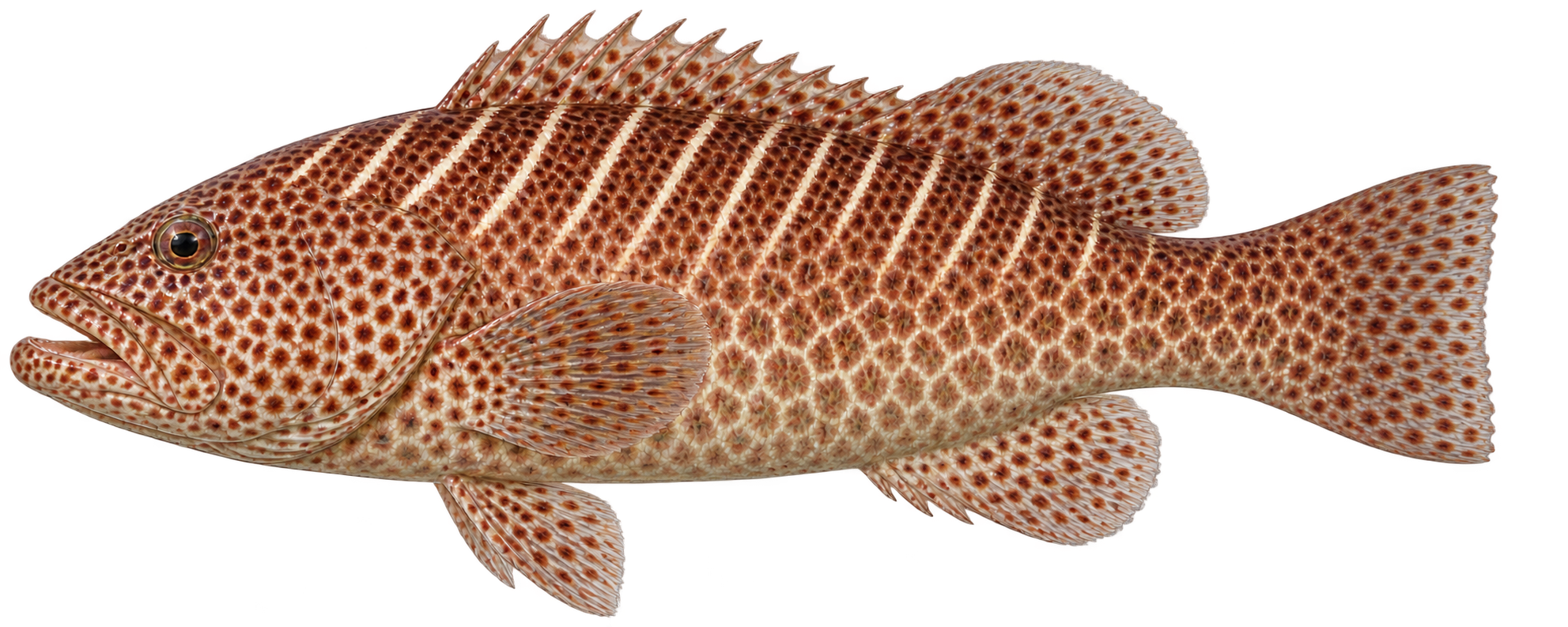
Fun facts for your next surface interval
- Not born in tiger stripes: Yellow juveniles carry a dark side stripe instead of the adult's full tiger-like pattern.
- Stripes with a slant: The adult's pale upper-body bars slant strongly forward.
- Growing into the fins: Projecting fin rays become more apparent in large individuals.
Florida and local context
Reported in REEF diver surveys at Blue Heron Bridge (WPB), Phil Foster Park. Cumulative survey records document occurrence, not a guaranteed encounter or present-day abundance.
Documented regional presence is not a guarantee of an encounter or a measure of how common this animal is at your dive site.
How to recognize this animal
An adult tiger grouper combines a dense covering of reddish-brown to dark brown spots with narrow pale bars that lean strongly forward across the upper body. Smithsonian describes nine to eleven pale bars across the nape and upper sides. Pale lines form a network farther down the body. The pectoral fins may have yellowish outer portions, and the inside of the mouth can be orange. These are supporting features, not reasons to approach or open the mouth.
Size and life stages
The reported maximum is 101 cm, about 40 inches. Large fish may develop projecting rays on the dorsal, anal and tail fins. Small juveniles can look surprisingly different: they are yellow with a dark line running from the snout through the eye along the side, fading before the tail. A juvenile should not be illustrated as a miniature adult with the full diagonal pattern.
Habitat and where to look
Tiger grouper occupy coral and rocky reefs. Smithsonian compiles records from 3 to 135 m, a broad biological range that includes shallow reefs and much deeper settings. Depth does not establish abundance, and the deepest record is not a recommended dive destination. For identification, a fish broadside near reef structure offers a better view of the diagonal pattern than a head-on fish inside a crevice.
Range and local context
The western Atlantic range extends from Bermuda to Brazil. Smithsonian's occurrence list includes Florida Keys records, supporting a regional Keys-inclusive guide entry. A broad range map is not evidence that the species is common at every reef within it. Reported in REEF diver surveys at Blue Heron Bridge (WPB), Phil Foster Park. Cumulative survey records document occurrence, not a guaranteed encounter or present-day abundance.
What is on the menu?
The reviewed species account identifies bony fishes as prey and classifies tiger grouper as carnivores. That supports a fish-eating diet without requiring an invented list of favored local prey. A predator's presence can tell a diver something about the reef community, but it does not show what that individual last ate or whether it is actively hunting.
Daily habits and behavior
A strong pattern can be surprisingly difficult to read when the fish is turning or partly hidden. Note the direction of the pale bars and the dense spots between them. Adult fin extensions may add another clue, but they are age-dependent and should not carry the identification alone. The reviewed sources do not establish a detailed daily activity schedule for this South Florida profile.
Mating and the next generation
Smithsonian records pelagic eggs and a pelagic larval stage. Early development therefore takes place in the water column rather than in a guarded nest on the reef. The sources used here do not establish a Florida spawning season or a local aggregation site. Those details should remain unstated until a species-specific study supports them.
Look-alikes and identification traps
Nassau grouper have broad dark vertical bars and a conspicuous black tail-base saddle. Scamp have fine spots that often cluster into paw-print patterns and an adult tail with pronounced uneven rays. Gag are usually marbled with irregular dark lines. Tiger grouper's pale, strongly oblique upper-body bars over dense spotting are the most useful starting point for separating these fish.
Observe without disturbing
Keep your distance while obtaining a complete side view, and do not induce a mouth-opening display to photograph the orange lining. Avoid cornering a fish against reef structure. If only the head is visible, save the image as an uncertain grouper observation rather than forcing a species name. Leave shelter and any observed reproductive gathering undisturbed.
Harvest, protection and eating safety
Default recreational rules apply; no ordinary managed-grouper season inferred
Yellow means collection or harvest is conditional on current rules and location. It is not permission to harvest or an assurance that the fish is safe to eat.
This color is a qualified summary, not permission to collect or a guarantee that a particular catch is safe to eat. Read the current rules and health guidance below.
Can it be hunted or harvested?
Tiger grouper was removed from Florida species-specific state management in 2016 and South Atlantic federal management in 2012. In Florida waters, the default recreational limit is two fish or 100 pounds per person per day, whichever is more. Do not apply ordinary managed-grouper sizes, aggregates or seasons to this species. A fishing license, lawful gear and area restrictions still apply. This is not unlimited harvest or a food-safety clearance.
Florida seasons and areas
No ordinary managed-grouper January–April season is assigned to tiger. The FWC maps reference naming tiger is inconsistent with its adopted removal history and current managed-species lists and should not be repeated as current law. Check current rules and the exact site: sanctuary and park closures still apply, Western Dry Rocks closes to fishing April 1–July 31, and Biscayne’s designated bonefish area closes March 1–May 31 with its stated continuous-transit exception.
Can it be speared?
Conditionally possible under Florida’s default lawful-gear rules where harvest is legal; not a blanket site permission. The same geographical spearing prohibitions apply, including Monroe County from Long Key north to the Miami-Dade line, relevant park waters and public beach/pier/bridge/jetty buffers. No powerheads, bangsticks or rebreathers.
Is it safe to eat?
Grouper and snapper can carry ciguatera toxin. Cooking, freezing or marinating does not remove it, and smell/taste do not identify it. Avoid head, viscera and roe of reef fish. No blanket safe-to-eat assurance. Consult current Florida DOH advice for the exact fish, capture water and consumer, particularly pregnancy, nursing and children; this guide does not establish a species-specific meal allowance. Legal harvest and normal appearance do not establish food safety.
Blue Heron Bridge is an observation site: marine-life harvest is prohibited within the designated dive-site boundary. A local occurrence record is not permission to collect or spear.
Before you act: This recreational overview is not permission to collect or spear at your dive site. Confirm the species, date, management area, state or federal waters, gear, licenses and current local closures. Identification artwork cannot establish an identification or guarantee seafood safety.
Official rules and health guidance
- FWC adopted rule history: tiger removal
- NOAA 2012 Comprehensive ACL final rule
- FWC default recreational regime
- Current eCFR Appendix A managed-species lists
- FAC reef-fish definitions rule index
- FWC jurisdiction and boundary maps
- NOAA Keys sanctuary zones
- FWC Western Dry Rocks closure
- FWC Biscayne National Park regulations
- FWC spearing restrictions
- Florida DOH fish consumption guidance
- Florida DOH seafood poisoning
Reviewed 2026-11-11. Rules and advisories can change; check the linked authorities before harvesting or eating.
Sources and review
Reviewed 2026-11-11.
Make your next dive happen
Dive With Us
Explore local charters and plan a dive suited to your experience.
View dive calendarTrain With Us
Build your fish identification, buoyancy and diving skills.
Explore trainingTravel With Us
Discover upcoming dive adventures and trip details.
Explore dive travelShop With Us
Browse equipment for your diving and ask our team for help choosing.
Explore dive gearReview current dates, availability, prices, inclusions and requirements on each listing before booking or buying.
Call us now
Ask about marine life identification
Marine Life Identification
Ask about dates, prerequisites or your next step. An inquiry does not reserve a place. Please provide your own contact details; do not include medical, payment or a child's personal information.
We use these details to respond to your inquiry. This form does not sign you up for marketing.
Explore more with Stuart Scuba
Open Water course options · Advanced Adventure training · Technical training · Professional training · All courses · Local dives · Dive trips · Facebook · Instagram · YouTube
Your surface-interval essentials
Questions for Stuart Scuba? info@stuartscuba.com
Check the Stuart Scuba Weather Center · Play scuba trivia
Weather and wildlife vary. Confirm current conditions, trip requirements and departure details with the operator.
Plan Your Next Dive with Stuart Scuba
Dive With Us
Explore upcoming local charters and choose a dive that fits your experience.
Before you book
Check the individual listing for departure time, requirements and availability.
Travel With Us
Find upcoming dive adventures and start planning your next trip.
Plan your trip
Review dates, inclusions and trip details on the travel calendar.
Stay Connected with Stuart Scuba
 Follow pageShare
YouTube
SubscribeWatch & shareFollow on InstagramView & share post
Follow company news, training updates, and dive stories.
Follow on LinkedInGoogle Reviews
See Stuart Scuba’s current Google rating and review count below. Open the listing in Google Maps to browse customer reviews.



