

Fish identification archive / Tarpon
Tarpon
Megalops atlanticus
I saw this
Spotted this fish? Share the guide with your dive buddies. Review your caption before posting.
For Instagram, copy the caption and link into your own post or message. Nothing is posted automatically and this does not record a verified sighting.
Fun facts for your next surface interval
- The silver king has built-in air-breathing assistance: a modified swim bladder.
- Its baby photo would be surprising: early larvae are transparent ribbons.
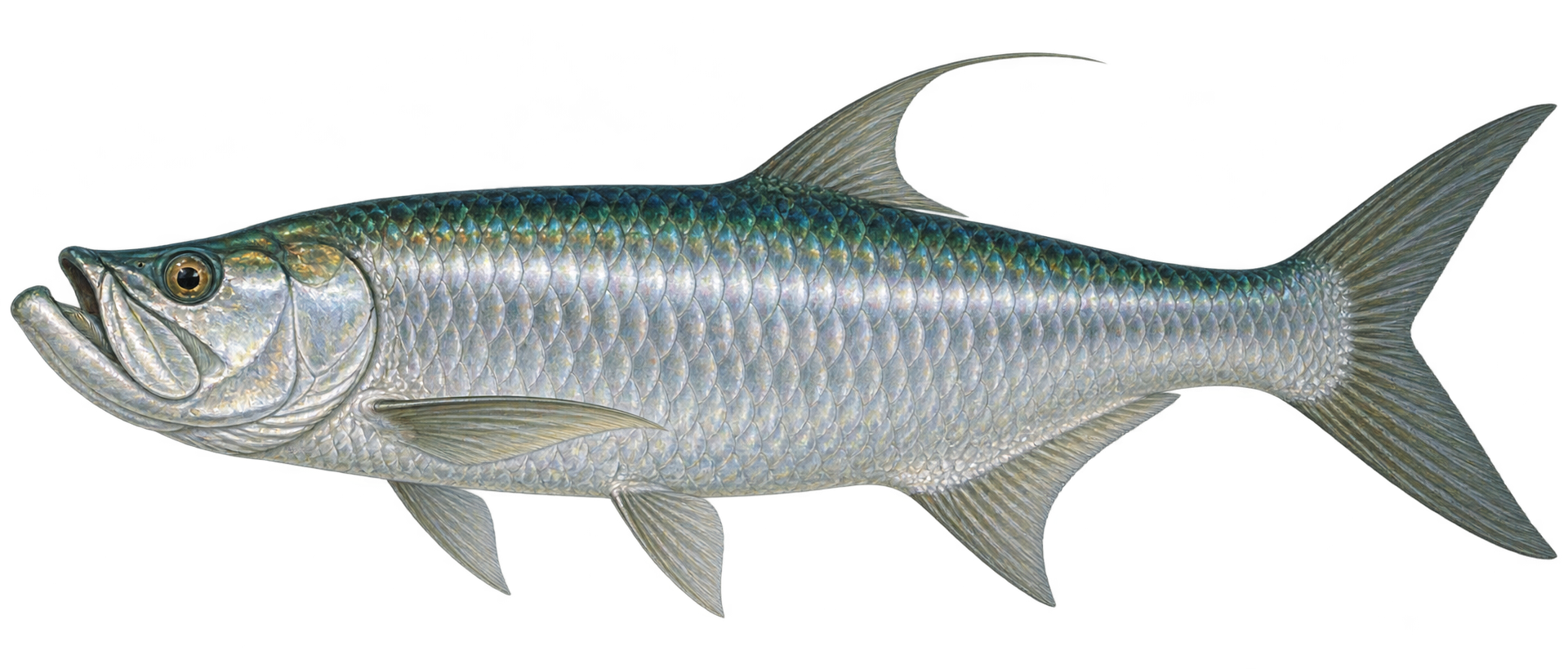
- That trailing dorsal-fin thread is anatomy, not a piece of fishing line.
Palm Beach connection
Lake Worth Lagoon / Blue Heron Bridge, Palm Beach County: Verified local record.
Documented regional presence is not a guarantee of an encounter or a measure of how common this fish is at your dive site.
How to recognize this fish
A tarpon looks as though someone plated a long fish in silver coins. The very large scales, upturned mouth and projecting lower jaw are the strongest first clues. Look for a deeply forked tail and a long thread extending from the rear of its single dorsal fin. A side view helps separate these details from reflections that can hide the outline.
Size and life stages
Large adults can exceed 6 feet, and exceptional females exceed 8 feet. Young tarpon are much smaller and use different sheltered habitats. Do not mistake every small silver fish for a juvenile tarpon: scale size, jaw shape and the dorsal filament still matter. Estimate size conservatively when the animal passes above you or farther away than it initially appears.
Habitat and where to look
Coastal bays, mangrove lagoons and estuaries are important tarpon habitat. They also tolerate freshwater. Their modified swim bladder allows them to take oxygen from swallowed air, helping them use waters where dissolved oxygen is low. For divers, that makes the water column and overhead view worth checking, provided doing so does not compromise buoyancy or awareness of boats.
Range and local context
Atlantic tarpon occupy warm parts of both sides of the Atlantic, including Florida, the Caribbean and the Gulf region. Lake Worth Lagoon has a verified record. That is a local occurrence statement, not an abundance estimate or an invitation to expect a school on every bridge dive. Conditions and seasonal movements can change what a particular outing reveals.
What is on the menu?
Adults eat fishes and crustaceans, including shrimp and crabs. Very young life stages have different feeding needs from the impressive silver adults. Watch any feeding naturally underway without adding bait or trying to create a more dramatic photograph. A mouth-opening image can be useful, but it should never depend on hand-feeding or disturbing an animal.
Daily habits and behavior
A tarpon rolling at the surface may be gulping air. This is normal biology, not automatically a sign of distress. It remains a fish with gills, even though its swim bladder provides an additional route for oxygen uptake. Observe from a distance and avoid positioning yourself between an animal and the surface it needs to reach.
Mating and the next generation
Tarpon spawn at sea, and the early larvae are transparent and ribbonlike rather than miniature silver adults. Later stages enter nursery habitats and transform substantially as they grow. Their reproductive story connects offshore water with sheltered coastal places. You do not need to identify tiny larvae during a recreational dive to appreciate that connection.
Look-alikes and identification traps
Snook have a conspicuous dark stripe along the side and two separate dorsal fins. Ladyfish have a more slender profile and lack the tarpon's combination of giant scales and long dorsal filament. When glare obscures those features, make a note of uncertainty. A clear profile photograph is usually more useful than an isolated flash of silver.
Observe without disturbing
Give passing fish room, keep your hands to yourself, and never chase a school for a photograph. Stay within the agreed dive area instead of following fish toward channels or boat traffic. If sharing a sighting, include the natural behavior you saw and an approximate size, and avoid claims that a fish was tame simply because it passed nearby.
Harvest, protection and eating safety
Protected catch-and-release fishery; narrow record-tag exception
Can it be hunted or harvested?
Tarpon must normally be released. Retention is allowed only with a tarpon tag purchased in advance for pursuit of a Florida state or world record. Only one tag may be purchased per person annually, and vessel, transport and shipment limits are one fish. This is not a routine food-harvest allowance.
Florida seasons and areas
There is no ordinary recreational harvest season. The catch-and-release rule and limited record exception apply in Florida Gulf and Atlantic state and federal waters. Boca Grande Pass has special tackle restrictions, including additional line and breakaway-gear restrictions during April–June.
Can it be speared?
Spearfishing prohibited; hook-and-line only. Snagging and snatch hooking are also prohibited. Tarpon over 40 inches must stay in the water unless being taken under the lawful record-tag exception.
Is it safe to eat?
Not a routine Florida food-harvest species. A consumption table or a fish’s edibility does not override its catch-and-release protection. Release your catch promptly and avoid lifting large tarpon from the water for photographs.
Before you act: This recreational overview is not permission to collect or spear at your dive site. Confirm the species, date, management area, state or federal waters, gear, licenses and current local closures. A fish illustration cannot establish an identification or guarantee seafood safety.
Official rules and health guidance
Reviewed 2026-11-10. Rules and advisories can change; check the linked authorities before harvesting or eating.
Sources and review
Reviewed 2026-11-10.
Make your next dive happen
Dive With Us
Explore local charters and plan a dive suited to your experience.
View dive calendarTrain With Us
Build your fish identification, buoyancy and diving skills.
Explore trainingTravel With Us
Discover upcoming dive adventures and trip details.
Explore dive travelShop With Us
Browse equipment for your diving and ask our team for help choosing.
Explore dive gearReview current dates, availability, prices, inclusions and requirements on each listing before booking or buying.
Call us now
Ask about fish identification training
Reef Fish Identification
Ask about dates, prerequisites or your next step. An inquiry does not reserve a place. Please provide your own contact details; do not include medical, payment or a child's personal information.
We use these details to respond to your inquiry. This form does not sign you up for marketing.
Explore more with Stuart Scuba
Open Water course options · Advanced Adventure training · Technical training · Professional training · All courses · Local dives · Dive trips · Facebook · Instagram · YouTube
Your surface-interval essentials
Questions for Stuart Scuba? info@stuartscuba.com
Check the Stuart Scuba Weather Center · Play scuba trivia
Weather and wildlife vary. Confirm current conditions, trip requirements and departure details with the operator.
Plan Your Next Dive with Stuart Scuba
Dive With Us
Explore upcoming local charters and choose a dive that fits your experience.
Before you book
Check the individual listing for departure time, requirements and availability.
Travel With Us
Find upcoming dive adventures and start planning your next trip.
Plan your trip
Review dates, inclusions and trip details on the travel calendar.
Stay Connected with Stuart Scuba
 Follow pageShare
YouTube
SubscribeWatch & shareFollow on InstagramView & share post
Follow company news, training updates, and dive stories.
Follow on LinkedInGoogle Reviews
See Stuart Scuba’s current Google rating and review count below. Open the listing in Google Maps to browse customer reviews.



