

Fish identification archive / Swordfish
Swordfish
Xiphias gladius · Xiphiidae
I saw this
Spotted this fish? Share the guide with your dive buddies. Review your caption before posting.
For Instagram, copy the caption and link into your own post or message. Nothing is posted automatically and this does not record a verified sighting.
Identification and comparisons
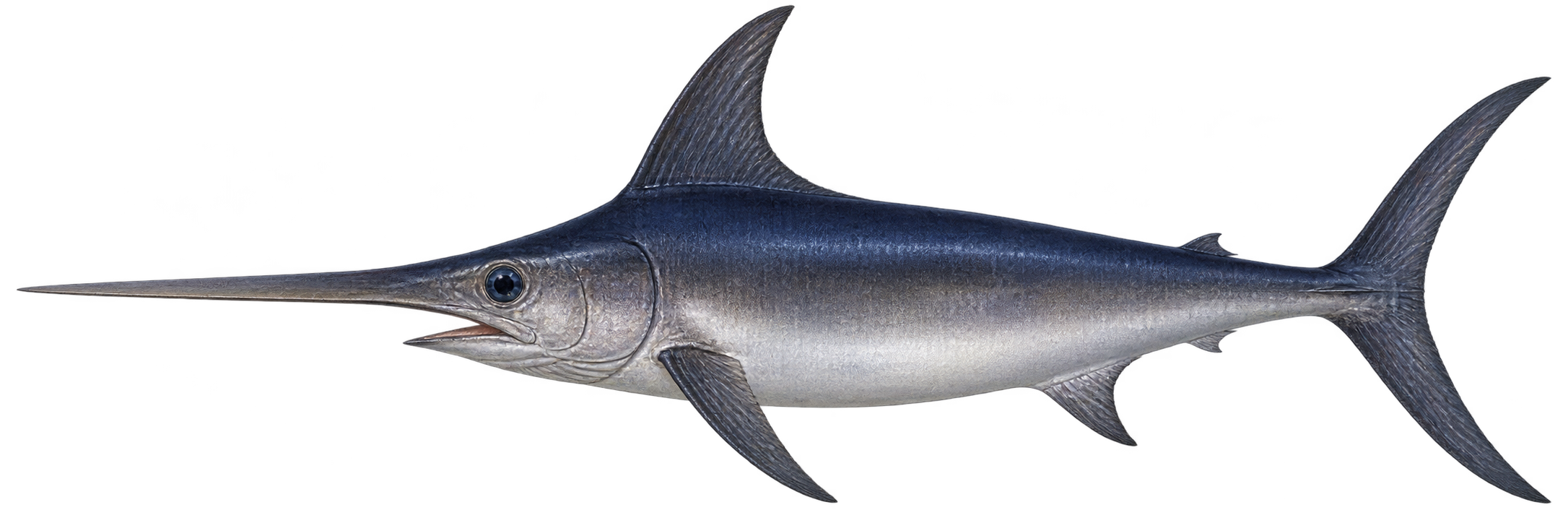
The long, flattened upper bill is the signature feature. A stout body, large eyes, tall first dorsal fin and powerful crescent-shaped tail complete the outline. The bill is flatter than the rounded bill of a marlin. Adult swordfish also lack pelvic fins. A distant surface fin by itself is not sufficient identification, and the animal’s speed and strength make close approaches inappropriate.
Atlantic Florida occurrence
The National Park Service lists this species among fishes reported in Biscayne National Park. That supplies specific Atlantic South Florida occurrence evidence. The historical list does not establish current abundance, a particular reef location or guaranteed sightings on a trip. Biscayne reported-fish list. Swordfish belong in the offshore part of this guide, not among promised shallow-reef encounters.
Biology and size
Swordfish are oceanic travelers associated with the Gulf Stream and a broad range of depths. They eat fishes and squid, using the bill to strike prey. Specialized tissues help warm the eyes and brain during excursions into cold water. Females release eggs in repeated spawning events; NOAA describes spawning off the southeastern United States during April–August, not a verified calendar for any single Palm Beach site. NOAA swordfish biology.
For a whole fish, the relevant recreational measurement is lower-jaw fork length: a straight line from the lower-jaw tip to the tail fork. It excludes the projecting sword. A dramatic bill makes ordinary total length especially easy to confuse with the regulated measurement.
Three things worth noticing
- The sword is an extension of the upper jaw.
- The legal lower-jaw measurement does not start at the sword tip.
- An oceanic predator can make extensive vertical as well as horizontal journeys.
Observation and harvest caution
NOAA currently lists the recreational fishery as open, with a 47-inch lower-jaw fork-length minimum for whole fish. Federal HMS permit requirements apply to federal-water fishing; a trip conducted exclusively in state waters can be exempt from that federal permit requirement. Reporting and retention requirements depend on the applicable rules, permit and vessel type. Check NOAA’s live swordfish rules and FWC guidance before fishing. A regional species profile is not permission to retain a particular catch.
Observe without chasing, touching, feeding or moving the animal. Leave shelter and attached organisms in place, keep fins and equipment clear of the bottom, and let the fish choose its distance. For a useful record, retain the date, location, depth and original photographs. If the distinguishing features are hidden, an uncertain identification is better than a confident but unsupported name.
Current observation and collection guidance
Checked November 12, 2026: NOAA lists the Atlantic recreational swordfish fishery as open, with a 47-inch lower-jaw fork-length minimum for whole fish. HMS Angling permit limits are one per person, up to four per vessel per trip; charter and headboat allowances differ. FWC states the federal HMS permit is required in federal waters, not for state-water-only swordfish fishing. Landings must be reported to NOAA within 24 hours. Verify current permit, vessel, gear and species-onboard restrictions before fishing. Biscayne National Park fish checklist NOAA recreational Atlantic swordfish limits and fishery status FWC billfish and tuna regulations NOAA Atlantic highly migratory species reporting
Make your next dive happen
Dive With Us
Explore local charters and plan a dive suited to your experience.
View dive calendarTrain With Us
Build your fish identification, buoyancy and diving skills.
Explore trainingTravel With Us
Discover upcoming dive adventures and trip details.
Explore dive travelShop With Us
Browse equipment for your diving and ask our team for help choosing.
Explore dive gearReview current dates, availability, prices, inclusions and requirements on each listing before booking or buying.
Call us now
Ask about fish identification training
Reef Fish Identification
Ask about dates, prerequisites or your next step. An inquiry does not reserve a place. Please provide your own contact details; do not include medical, payment or a child's personal information.
We use these details to respond to your inquiry. This form does not sign you up for marketing.
Explore more with Stuart Scuba
Open Water course options · Advanced Adventure training · Technical training · Professional training · All courses · Local dives · Dive trips · Facebook · Instagram · YouTube
Your surface-interval essentials
Questions for Stuart Scuba? info@stuartscuba.com
Check the Stuart Scuba Weather Center · Play scuba trivia
Weather and wildlife vary. Confirm current conditions, trip requirements and departure details with the operator.
Plan Your Next Dive with Stuart Scuba
Dive With Us
Explore upcoming local charters and choose a dive that fits your experience.
Before you book
Check the individual listing for departure time, requirements and availability.
Travel With Us
Find upcoming dive adventures and start planning your next trip.
Plan your trip
Review dates, inclusions and trip details on the travel calendar.
Stay Connected with Stuart Scuba
 Follow pageShare
YouTube
SubscribeWatch & shareFollow on InstagramView & share post
Follow company news, training updates, and dive stories.
Follow on LinkedInGoogle Reviews
See Stuart Scuba’s current Google rating and review count below. Open the listing in Google Maps to browse customer reviews.



