

Fish identification archive / Sunray Venus
Sunray Venus
Macrocallista nimbosa · Veneridae
I saw this
Spotted this marine life? Share the guide with your dive buddies. Review your caption before posting.
For Instagram, copy the caption and link into your own post or message. Nothing is posted automatically and this does not record a verified sighting.
Identification overview
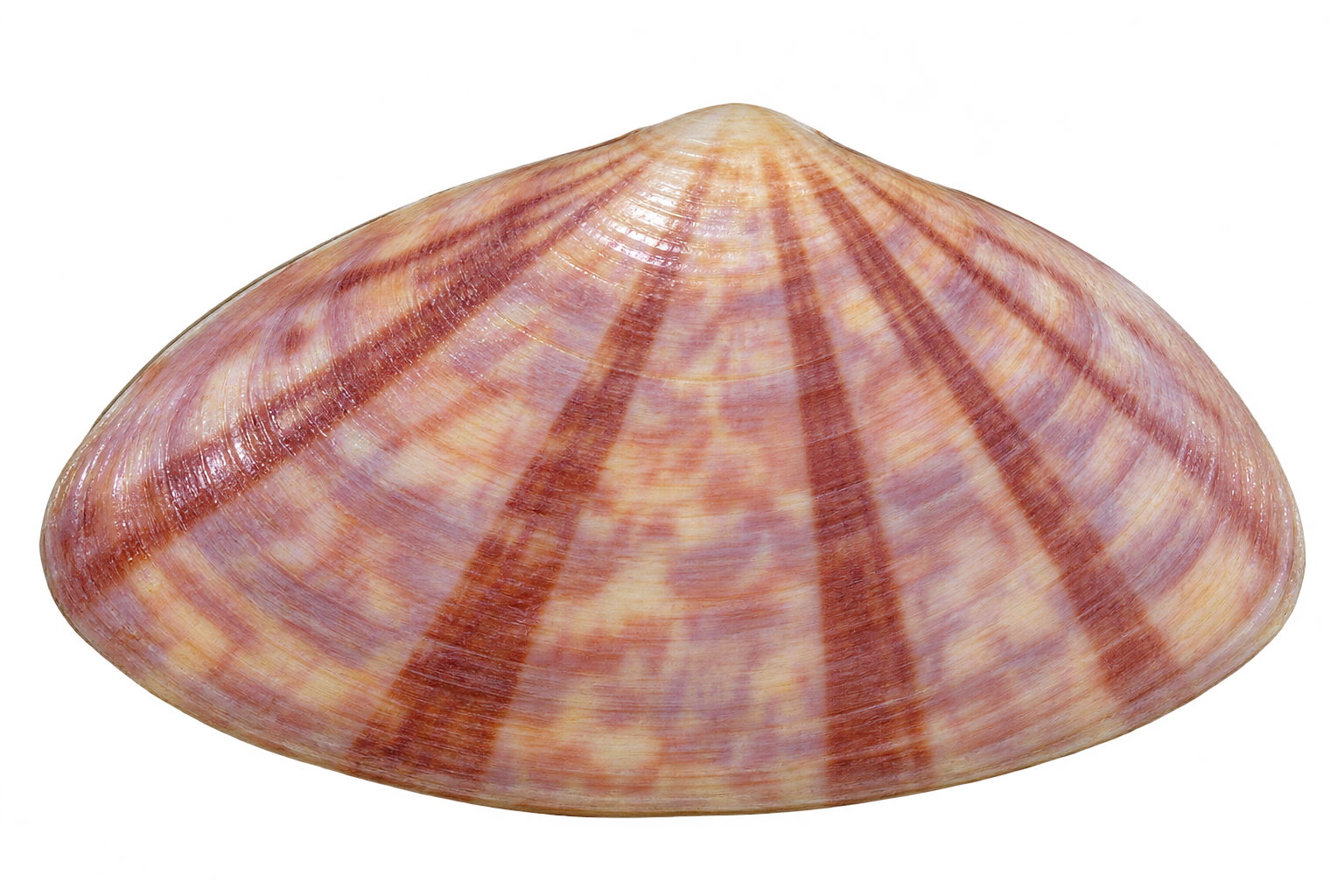
The sunray venus, Macrocallista nimbosa, has an elongated oval shell with a glossy surface and relatively little raised sculpture. Darker rays cross a salmon, gray or purplish background, giving the animal its memorable common name. Compared with a strongly ridged quahog, its outline is longer and its exterior smoother.
Florida context and the limits of a range map
Published accounts include the Atlantic coast and Florida as well as the Gulf. University of Florida researchers have collected living broodstock from natural groups on Florida’s Gulf side and studied the species as a possible aquaculture crop. Florida DEP’s 2014 St. Lucie Inlet Preserve State Park animal inventory also lists this species, providing a dated Atlantic-coast record within the regional corridor.
An official park inventory supports regional inclusion, but it is not a fresh population survey or a promise of common sightings. A broad range statement, a preserved shell and a living animal photographed in place also represent different kinds of evidence. Its ecological setting is sandy bottom rather than exposed coral-reef structure.
Feeding and reproduction
The sunray venus is a suspension-feeding bivalve. In culture research, adults and young were maintained on microalgae. This supports a description of its feeding mode without assigning a precise wild menu or claiming that every particle captured is eaten.
Males and females are separate. Spawning produces larvae that develop in the water before settling and metamorphosing. Hatchery success demonstrates those developmental stages, but a hatchery schedule is not a reliable calendar for spawning at every natural Florida site. Temperature, food and local conditions must not be replaced by an invented universal season.
Identification approach
Start with the long oval outline, subdued sculpture and radiating bands. Compare both exterior and interior views of an already empty shell when available. A sunray pattern is a clue, not a substitute for examining the entire shell. Worn, stained or fragmented shells may not preserve enough information for a confident species identification.
A responsible encounter
Do not dig through a bed or remove a living clam to stage a photograph. Record whether a shell was alive, naturally exposed, empty underwater or washed ashore. This preserves information that an attractive close-up alone cannot provide.
Florida shellfish-area classifications and local collecting restrictions apply independently of identification. A clam being investigated for aquaculture does not make a wild collection legal or safe to eat. Consult current official guidance, respect protected habitats and leave uncertain animals undisturbed.
References
Current Florida collection cautions
Reviewed November 12, 2026. Collecting a shell containing a living organism generally requires a Florida recreational saltwater fishing license. Species rules and park, refuge or sanctuary restrictions apply independently of identification. Leave occupied shells and their habitat undisturbed. FWC requires clams, oysters and mussels to come only from designated approved or conditionally approved shellfish areas that FDACS currently lists as open. Closed waters cannot be harvested. Check the exact area map and daily status; no location is cleared by this profile. This guide gives no harvest permission or assurance that an animal is safe to eat. Official FWC live-shell collection guidance Official FWC oyster and clam rules Official FDACS shellfish classification and status
Make your next dive happen
Dive With Us
Explore local charters and plan a dive suited to your experience.
View dive calendarTrain With Us
Build your fish identification, buoyancy and diving skills.
Explore trainingTravel With Us
Discover upcoming dive adventures and trip details.
Explore dive travelShop With Us
Browse equipment for your diving and ask our team for help choosing.
Explore dive gearReview current dates, availability, prices, inclusions and requirements on each listing before booking or buying.
Call us now
Ask about fish identification training
Reef Fish Identification
Ask about dates, prerequisites or your next step. An inquiry does not reserve a place. Please provide your own contact details; do not include medical, payment or a child's personal information.
We use these details to respond to your inquiry. This form does not sign you up for marketing.
Explore more with Stuart Scuba
Open Water course options · Advanced Adventure training · Technical training · Professional training · All courses · Local dives · Dive trips · Facebook · Instagram · YouTube
Your surface-interval essentials
Questions for Stuart Scuba? info@stuartscuba.com
Check the Stuart Scuba Weather Center · Play scuba trivia
Weather and wildlife vary. Confirm current conditions, trip requirements and departure details with the operator.
Plan Your Next Dive with Stuart Scuba
Dive With Us
Explore upcoming local charters and choose a dive that fits your experience.
Before you book
Check the individual listing for departure time, requirements and availability.
Travel With Us
Find upcoming dive adventures and start planning your next trip.
Plan your trip
Review dates, inclusions and trip details on the travel calendar.
Stay Connected with Stuart Scuba
 Follow pageShare
YouTube
SubscribeWatch & shareFollow on InstagramView & share post
Follow company news, training updates, and dive stories.
Follow on LinkedInGoogle Reviews
See Stuart Scuba’s current Google rating and review count below. Open the listing in Google Maps to browse customer reviews.



