

Fish identification archive / Striped Parrotfish
Striped Parrotfish
Scarus iseri
I saw this
Spotted this marine animal? Share the guide with your dive buddies. Review your caption before posting.
For Instagram, copy the caption and link into your own post or message. Nothing is posted automatically and this does not record a verified sighting.
Fun facts for your next surface interval
- The stripes are not a birth certificate: striped adults can be male or female.
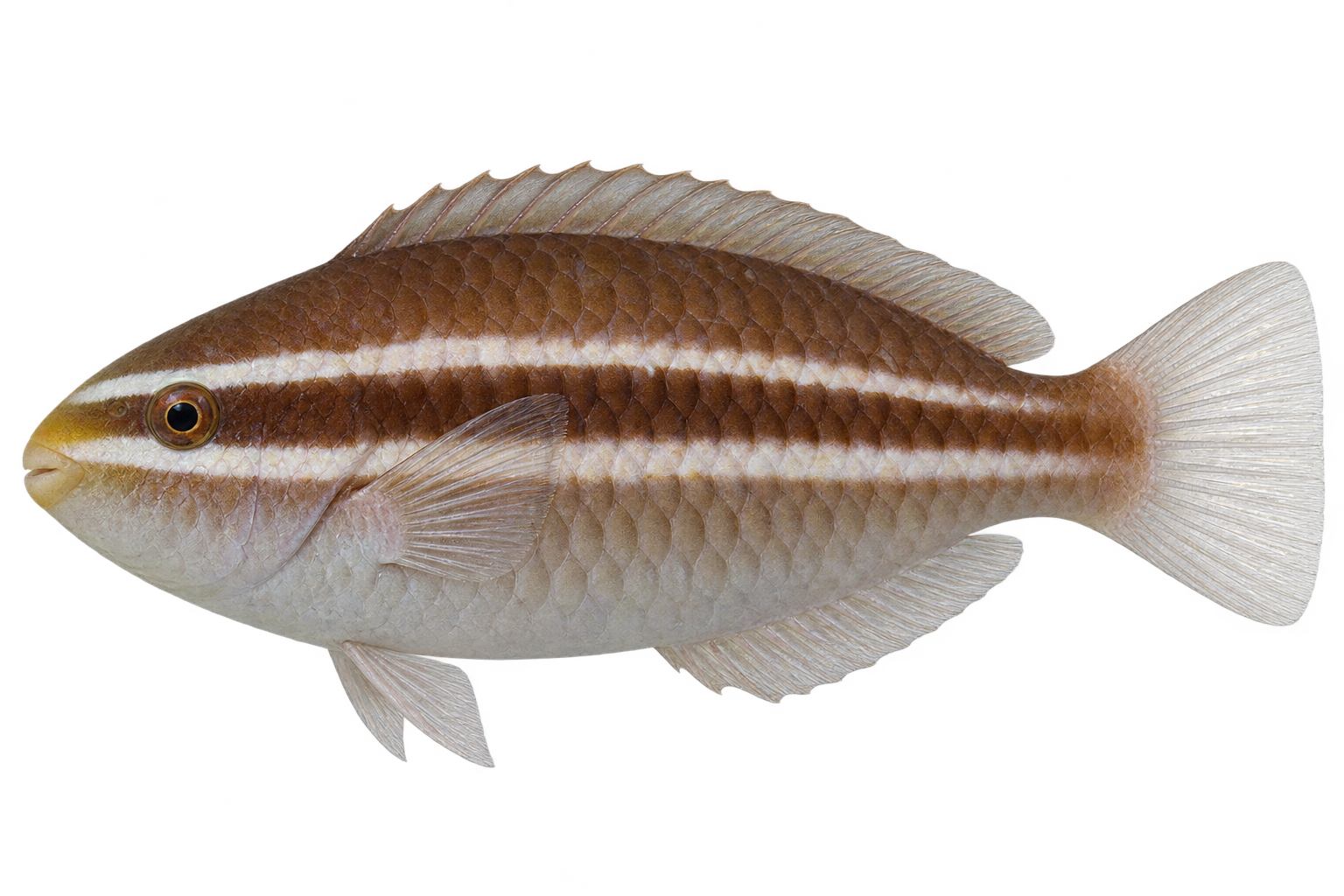
- Clear tail, clearer answer: an almost transparent tail helps separate it from a young princess.
- A botanical tribute swims past: the scientific name honors Paul Erdmann Isert.
Florida and local context
Lake Worth Lagoon / Palm Beach County: Florida Museum checklist has verified striped parrotfish row under legacy spelling Scarus iserti, with observer initials and verified marker. Accepted spelling is Scarus iseri. No local frequency inferred.
Documented regional presence is not a guarantee of an encounter or a measure of how common this animal is at your dive site.
How to recognize this animal
The illustrated initial-phase Striped Parrotfish has a brownish upper body crossed by pale horizontal stripes, a yellowish snout and a clear tail. Terminal males become much more colorful, with blue-green and orange areas and a pinkish lower head and chest. The common name therefore describes one familiar appearance, not every fish you might encounter under this species name.
Size and life stages
FishBase gives a maximum of 35 cm total length and a common length around 18 cm. Small striped individuals can be easy to overlook beside larger reef fishes. Do not confuse a published maximum with a typical dive sighting. A photograph with the entire animal visible is more useful than a tightly cropped image that exaggerates its apparent size.
Habitat and where to look
Shallow clear water, turtle-grass beds, rock and coral habitat are all part of the species' setting. Look where vegetation meets harder structure rather than assuming every parrotfish belongs only on coral. Hold position above the bottom and let a fish move into view. Following it through grass with strong fin kicks makes both observation and identification harder.
Range and local context
Florida Museum's Lake Worth Lagoon inventory records striped parrotfish under the older spelling Scarus iserti, with verification indicated. This guide uses the accepted name Scarus iseri. That establishes regional occurrence, not a guarantee at Blue Heron Bridge or a measure of abundance. Its broader western Atlantic range includes Florida, the Bahamas and the Caribbean.
What is on the menu?
This is a plant-feeding parrotfish, using its beaked mouth to crop food from the bottom. Watch for the repeated bite-and-move pattern rather than expecting it to pursue conspicuous prey. The visible surface is not necessarily the entire meal: a grazing fish encounters very small growth that a diver cannot resolve by eye. Describe the behavior before guessing the ingredients.
Daily habits and behavior
Striped Parrotfish can school. A group may contain individuals that differ in size and appearance, so identify each clearly visible fish rather than automatically applying one label to the whole gathering. Tracking a single animal briefly can help you distinguish its pattern from overlapping neighbors. Let the group choose its own path through the habitat.
Mating and the next generation
The species can change from female to male. FishBase describes terminal males spawning with individual striped females, while sexually mature striped males may spawn in aggregations. Stripes therefore do not prove that a fish is female. This is a particularly useful example of why color phase, biological sex and age should not be treated as interchangeable labels.
Look-alikes and identification traps
Princess Parrotfish are very similar in their striped stages. Look for the striped parrotfish's yellowish snout and clear tail rather than the princess's darker tail edges. If those details are hidden, a tentative identification is the honest choice. Terminal fish require a different comparison, including chest color and the blue rather than pink margins of the tail.
Observe without disturbing
Give feeding fish space, especially in shallow seagrass where disturbed sediment can linger. Avoid kneeling for a low-angle photograph or reaching out to turn an animal. Record the location and whether the fish was solitary or in a group. If the tail is out of frame, keep the sighting provisional until another natural view supplies the missing clue.
Harvest, protection and eating safety
Restricted marine life: live collection only; no spearing
Can it be hunted or harvested?
Florida regulates all parrotfish as live ornamental marine life, not an ordinary food-fishing catch. Recreational collection requires a saltwater fishing license unless exempt, approved gear and suitable life-support equipment. Fish must be landed and kept alive. Maximum length is 12 inches total length. The daily limit is five of this species within 20 marine-life organisms; possession is limited to two days, no more than 10 of this species within 40 total. Recreational sale is prohibited.
Florida seasons and areas
No species-specific recreational closed months are listed in the reviewed marine-life rules. This does not mean collection is permitted at every site. The designated Blue Heron Bridge dive site is closed to marine-life harvest. Check sanctuary zones, parks, refuges and other closures before collecting. Florida marine-life regulations also apply in adjacent federal waters.
Can it be speared?
No. FWC expressly prohibits spearing parrotfish. The allowance for carefully regulated live ornamental collection does not authorize spearfishing or killing one for food.
Is it safe to eat?
Do not treat this species as a food target or as safe to eat. FDA identifies parrotfish among fishes associated with ciguatera poisoning. Appearance, taste and smell cannot establish safety, and cooking or freezing does not remove ciguatoxin. Follow current local health advisories; an identification photograph cannot clear a fish for consumption.
Before you act: This recreational overview is not permission to collect or spear at your dive site. Confirm the species, date, management area, state or federal waters, gear, licenses and current local closures. Identification artwork cannot establish an identification or guarantee seafood safety.
Official rules and health guidance
- FWC: Recreational Marine Life
- Florida Administrative Code: Marine Life, Chapter 68B-42
- FWC: Spearing
- NOAA: Florida Keys Sanctuary Marine Zones
- Florida Department of Health: Seafood Poisoning
- FDA: Seafood-Related Toxin Illnesses
Reviewed 2026-11-10. Rules and advisories can change; check the linked authorities before harvesting or eating.
Sources and review
Reviewed 2026-11-10.
Make your next dive happen
Dive With Us
Explore local charters and plan a dive suited to your experience.
View dive calendarTrain With Us
Build your fish identification, buoyancy and diving skills.
Explore trainingTravel With Us
Discover upcoming dive adventures and trip details.
Explore dive travelShop With Us
Browse equipment for your diving and ask our team for help choosing.
Explore dive gearReview current dates, availability, prices, inclusions and requirements on each listing before booking or buying.
Call us now
Ask about marine life identification
Marine Life Identification
Ask about dates, prerequisites or your next step. An inquiry does not reserve a place. Please provide your own contact details; do not include medical, payment or a child's personal information.
We use these details to respond to your inquiry. This form does not sign you up for marketing.
Explore more with Stuart Scuba
Open Water course options · Advanced Adventure training · Technical training · Professional training · All courses · Local dives · Dive trips · Facebook · Instagram · YouTube
Your surface-interval essentials
Questions for Stuart Scuba? info@stuartscuba.com
Check the Stuart Scuba Weather Center · Play scuba trivia
Weather and wildlife vary. Confirm current conditions, trip requirements and departure details with the operator.
Plan Your Next Dive with Stuart Scuba
Dive With Us
Explore upcoming local charters and choose a dive that fits your experience.
Before you book
Check the individual listing for departure time, requirements and availability.
Travel With Us
Find upcoming dive adventures and start planning your next trip.
Plan your trip
Review dates, inclusions and trip details on the travel calendar.
Stay Connected with Stuart Scuba
 Follow pageShare
YouTube
SubscribeWatch & shareFollow on InstagramView & share post
Follow company news, training updates, and dive stories.
Follow on LinkedInGoogle Reviews
See Stuart Scuba’s current Google rating and review count below. Open the listing in Google Maps to browse customer reviews.



