

Fish identification archive / Striated Frogfish
Striated Frogfish
Antennarius striatus
I saw this
Spotted this fish? Share the guide with your dive buddies. Review your caption before posting.
For Instagram, copy the caption and link into your own post or message. Nothing is posted automatically and this does not record a verified sighting.
Fun facts for your next surface interval
- This angler brings its own fishing rod, attached to its head.
- The shaggy look is skin decoration, not an underwater fur coat.
- Its nursery starts as a floating egg raft rather than a nest on the bottom.
Palm Beach connection
Lake Worth Lagoon / Blue Heron Bridge, Palm Beach County: Verified local record.
Documented regional presence is not a guarantee of an encounter or a measure of how common this fish is at your dive site.
How to recognize this fish
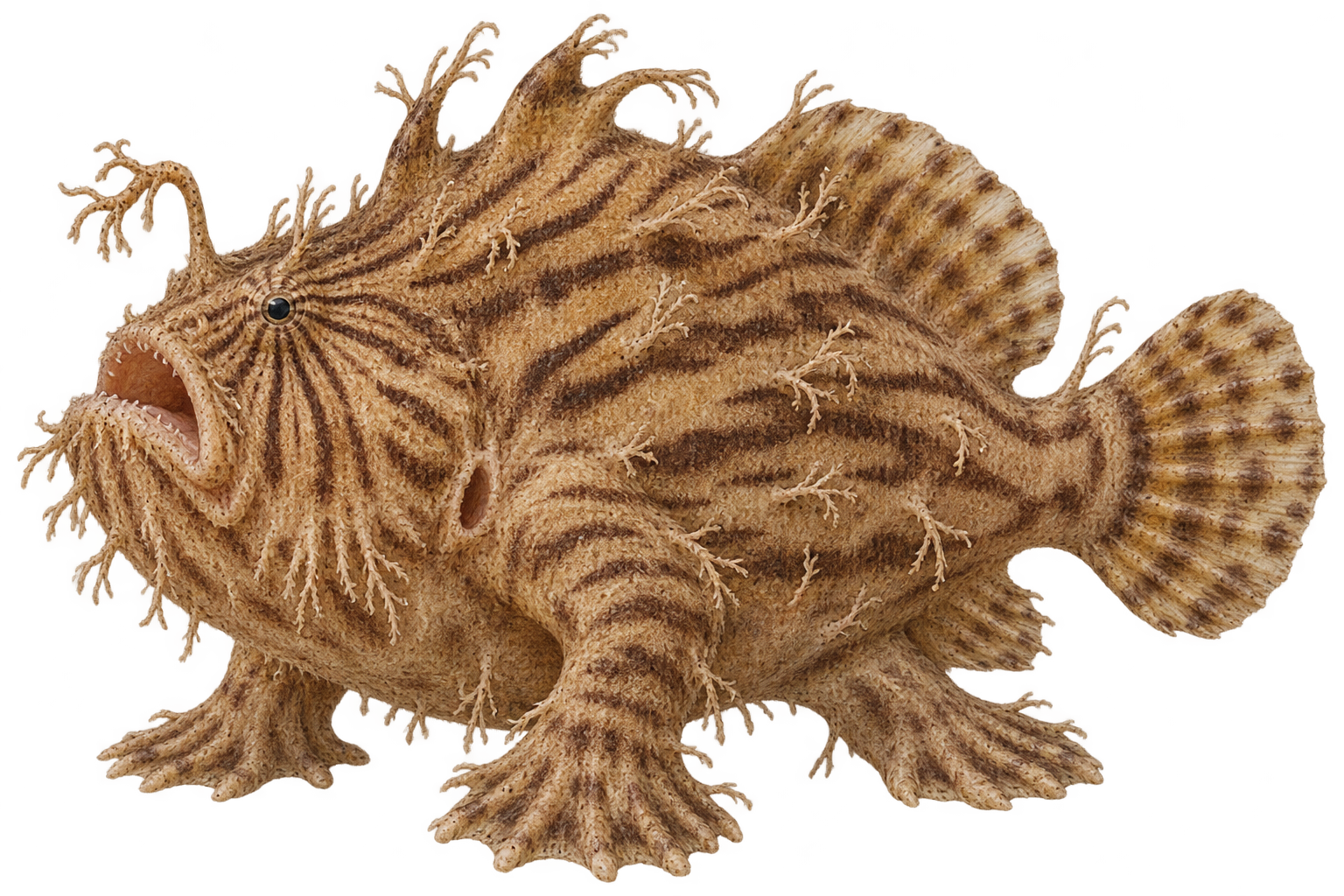
Look for a compact, high-backed fish with an upturned mouth, small eyes and irregular dark streaks. Skin appendages can make it look shaggy, although their extent varies. The decisive feature is the fishing apparatus above the mouth: a short rod ending in wormlike branches. Colors vary widely, so a pale, orange or brown animal can still belong to this species.
Size and life stages
A common reported length is about 4 inches, while the maximum is close to 10 inches. Its compact body can make length hard to judge against a complex background. Note the approximate size without placing an object beside it or manipulating the animal. A scale reference is not worth disrupting a fish that relies so heavily on remaining inconspicuous.
Habitat and where to look
Sand, rubble, rocks and reef habitat can all hold striated frogfish. The useful search technique is to examine shapes and eyes rather than expecting constant movement. Look for a rounded outline that differs subtly from nearby growth. Do not poke an apparent sponge, turn rubble, or sweep vegetation aside to test whether it is alive; uncertainty is better than damage.
Range and local context
The species has a broad distribution that includes the western Atlantic and parts of the Indo-Pacific. Verified Lake Worth Lagoon records make it a genuine local candidate. That evidence does not make a sighting easy or predictable. Camouflage, visibility and the amount of time spent looking can affect whether a fish is noticed on a particular dive.
What is on the menu?
Frogfish are ambush predators of fishes and crustaceans. The lure imitates prey and brings potential food close to a rapidly expanding mouth. Avoid exaggerated claims about an individual fish's swallowing capacity based on appearance alone. Most importantly, never put another animal in front of it to demonstrate a feeding strike or to produce a more dramatic video.
Daily habits and behavior
Lobed fins help the fish brace and move along the bottom. Remaining still is part of its successful hunting strategy, not evidence that it is unable to move. Allow a clear escape route and resist the urge to reposition it for a better background. A brief sequence showing a natural lure movement can be more valuable than a staged portrait.
Mating and the next generation
This egg-laying species releases eggs in a buoyant, ribbonlike gelatinous mass, often called an egg raft. It is not a live-bearing animal. The floating early stage also explains why the next generation is not confined to the exact spot where an adult rests. A pair sitting together is interesting, but it does not by itself prove that spawning is imminent.
Look-alikes and identification traps
Other frogfishes can share a similar outline and variable colors. The lure's structure is more useful than a general impression of hairiness, and a clear photograph may be needed for expert review. Scorpionfishes can also look camouflaged and lumpy, but lack the frogfish's specialized lure. Do not touch either animal while trying to resolve a difficult identification.
Observe without disturbing
Photograph from a respectful distance, keep the bottom undisturbed, and do not surround a resting fish with a crowd of cameras. Never use a pointer to move the lure, lift the fish or create a hunting opportunity. Share the identification only as confidently as the visible evidence supports, and let other divers enjoy the same natural encounter without repositioning the subject.
Harvest, protection and eating safety
Restricted marine life: live collection only; no spearing
Can it be hunted or harvested?
Striated Frogfish is regulated as tropical ornamental marine life, rather than an ordinary food-fishing target. Where collection is lawful, a recreational saltwater fishing license is required unless exempt; fish must be landed and kept alive with suitable aeration or circulation. No species-specific size limit is listed. The daily limit is five of this species within 20 marine-life organisms total. A two-day possession limit also applies.
Florida seasons and areas
No recreational closed months are listed in the FWC marine-life rules reviewed. This does not make every location open: collection is prohibited within the designated Blue Heron Bridge dive-site boundary. Florida marine-life rules also apply in adjacent federal waters, on both coasts. Check park, refuge and Florida Keys sanctuary restrictions before collecting.
Can it be speared?
Not allowed for recreational marine-life collection. The permitted collection methods are nonlethal live-capture methods; spears are not authorized by the marine-life gear rules.
Is it safe to eat?
Not assessed here as food and not recommended as a food target. Legal live collection is not a finding that a fish is safe to eat. Florida DOH advisories depend on catch location and consumer group; cooking cannot remove all marine toxins.
Before you act: This recreational overview is not permission to collect or spear at your dive site. Confirm the species, date, management area, state or federal waters, gear, licenses and current local closures. A fish illustration cannot establish an identification or guarantee seafood safety.
Official rules and health guidance
- FWC: Recreational Marine Life
- Florida Administrative Code: Marine Life, Chapter 68B-42
- FWC: Saltwater Recreational Licenses and Permits
- NOAA: Florida Keys National Marine Sanctuary Zones
- Florida Administrative Code: Marine-life Gear, 68B-42.007
- Florida Department of Health: Eating Healthy Seafood and Local Advisories
- Florida Department of Health: Seafood Poisoning
Reviewed 2026-11-10. Rules and advisories can change; check the linked authorities before harvesting or eating.
Sources and review
Reviewed 2026-11-10.
Make your next dive happen
Dive With Us
Explore local charters and plan a dive suited to your experience.
View dive calendarTrain With Us
Build your fish identification, buoyancy and diving skills.
Explore trainingTravel With Us
Discover upcoming dive adventures and trip details.
Explore dive travelShop With Us
Browse equipment for your diving and ask our team for help choosing.
Explore dive gearReview current dates, availability, prices, inclusions and requirements on each listing before booking or buying.
Call us now
Ask about fish identification training
Reef Fish Identification
Ask about dates, prerequisites or your next step. An inquiry does not reserve a place. Please provide your own contact details; do not include medical, payment or a child's personal information.
We use these details to respond to your inquiry. This form does not sign you up for marketing.
Explore more with Stuart Scuba
Open Water course options · Advanced Adventure training · Technical training · Professional training · All courses · Local dives · Dive trips · Facebook · Instagram · YouTube
Your surface-interval essentials
Questions for Stuart Scuba? info@stuartscuba.com
Check the Stuart Scuba Weather Center · Play scuba trivia
Weather and wildlife vary. Confirm current conditions, trip requirements and departure details with the operator.
Plan Your Next Dive with Stuart Scuba
Dive With Us
Explore upcoming local charters and choose a dive that fits your experience.
Before you book
Check the individual listing for departure time, requirements and availability.
Travel With Us
Find upcoming dive adventures and start planning your next trip.
Plan your trip
Review dates, inclusions and trip details on the travel calendar.
Stay Connected with Stuart Scuba
 Follow pageShare
YouTube
SubscribeWatch & shareFollow on InstagramView & share post
Follow company news, training updates, and dive stories.
Follow on LinkedInGoogle Reviews
See Stuart Scuba’s current Google rating and review count below. Open the listing in Google Maps to browse customer reviews.



