

Fish identification archive / Stoplight Parrotfish
Stoplight Parrotfish
Sparisoma viride
I saw this
Spotted this marine animal? Share the guide with your dive buddies. Review your caption before posting.
For Instagram, copy the caption and link into your own post or message. Nothing is posted automatically and this does not record a verified sighting.
Fun facts for your next surface interval
- Its beak is only the opening act: another set of teeth does the grinding farther back.
- Wardrobe change, same species: the red initial phase can become a green terminal male.
- Beach-making is a messy business: swallowed reef carbonate can return as sand.
Florida and local context
Lake Worth Lagoon / Palm Beach County; also Upper Florida Keys: Florida Museum inventory marks this species verified with named observer initials. NOAA also documents it in Key Largo reef research. These establish occurrence, not local abundance or a guaranteed encounter.
Documented regional presence is not a guarantee of an encounter or a measure of how common this animal is at your dive site.
How to recognize this animal
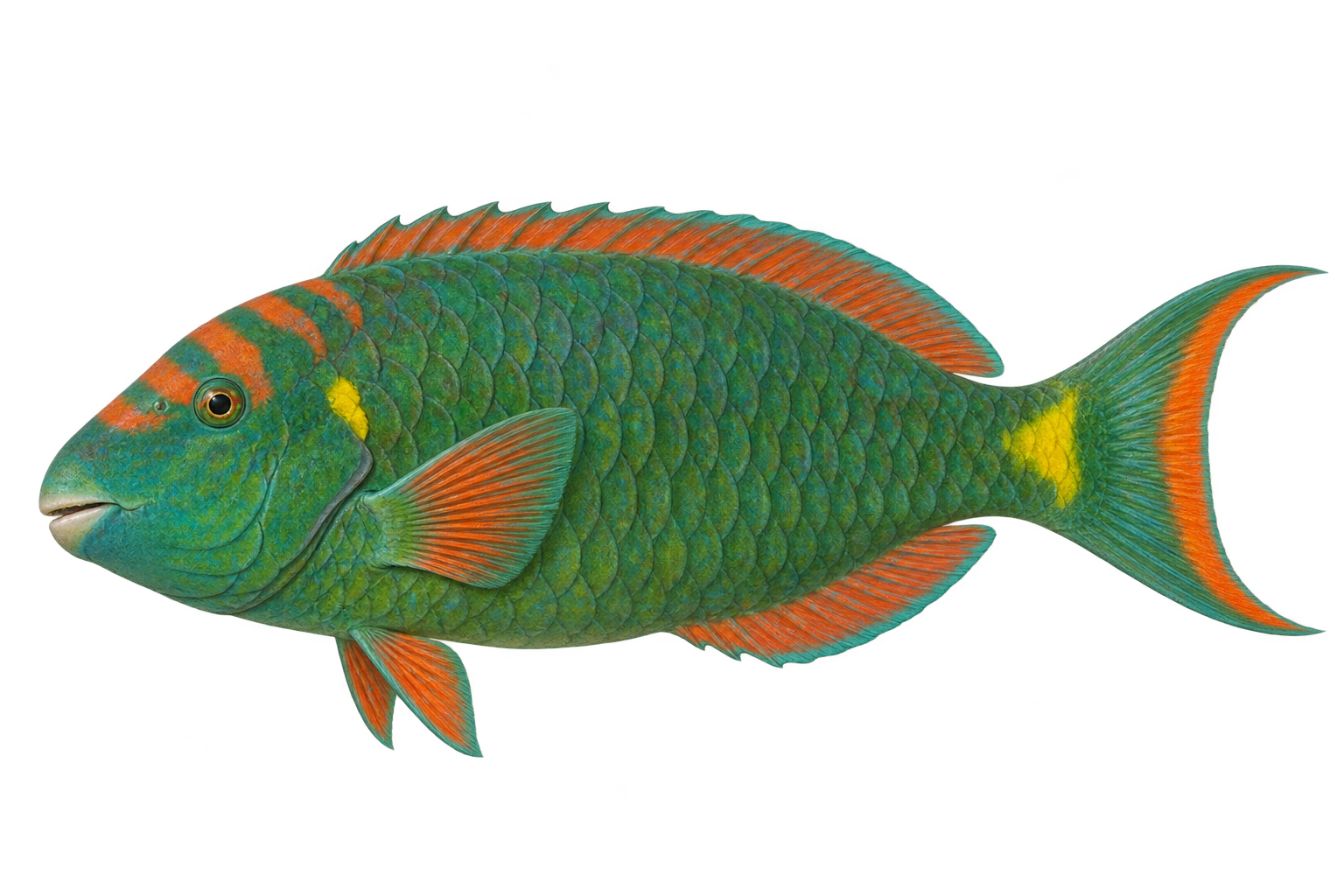
A terminal-phase Stoplight Parrotfish wears green, with warm-colored diagonal markings on the head and a conspicuous yellow patch near the upper gill opening. Another yellow mark sits at the tail base. Initial-phase fish look strikingly different: the underside is red beneath a darker, mottled back. The heavy scales and blunt, beaked face tie these costumes together.
Size and life stages
Published maxima differ: Florida Museum gives about 55 cm, while Smithsonian lists 64 cm. Treat those as reported upper limits, not the expected size of every adult. The tail changes shape as the fish grows, becoming deeply curved in large terminal males. A small fish with a squarer tail should not be rejected on that feature alone.
Habitat and where to look
Look for this reef-associated species over coral and rocky feeding surfaces, including shallow reef habitats. Its working landscape includes places where algae and other small organisms grow on hard material. Rather than scanning only spectacular living coral heads, take time to observe the less dramatic surfaces between them. Those apparently ordinary patches can reveal a busy feeding fish.
Range and local context
Florida Museum verifies Stoplight Parrotfish in its Lake Worth Lagoon fish inventory, and NOAA included the species in Key Largo reef research. These records establish occurrence in Palm Beach County and the upper Florida Keys, not an encounter guarantee or a measure of local abundance. Keep the exact site, date and depth with any sighting of your own.
What is on the menu?
The beak removes material from reef surfaces, and powerful teeth farther back process the mouthful. Algae contribute to the diet; swallowed carbonate can emerge as sand. That makes feeding important to both grazing and the physical reshaping of reef surfaces. A fresh scrape is evidence of a bite, but identifying exactly what was eaten requires more than seeing the fish touch coral.
Daily habits and behavior
This is a daylight feeder. Florida Museum describes pectoral-fin propulsion during ordinary swimming, with the tail providing bursts of speed. Watch the little side fins instead of waiting for a dramatic tail sweep. A fish steadily working from patch to patch offers a better behavioral view than one that has been startled into abandoning its meal.
Mating and the next generation
The species has a complex sexual system: some males develop directly, while others change from female to male. The green terminal phase should therefore not be treated as merely an older version of every red fish. Spawning behavior and color phase are related, but a casual sighting cannot establish an individual's age or complete reproductive history.
Look-alikes and identification traps
Redband Parrotfish can also show warm colors and a conspicuous shoulder mark. For a terminal stoplight, combine the green body, yellow gill-region spot, tail-base mark and head pattern. Compare fish in equivalent phases. Matching a red initial-phase fish to an illustration of a green terminal male is an easy way to talk yourself out of a correct identification.
Observe without disturbing
Hover beside the feeding route rather than directly in front of the mouth. Keep fins, hoses and cameras off the bottom, and never move coral to improve a view. Photograph the whole flank and tail if possible. On a night dive, leave resting fish undisturbed instead of repeatedly lighting or prodding them to produce a daytime pose.
Harvest, protection and eating safety
Restricted marine life: live collection only; no spearing
Can it be hunted or harvested?
Florida regulates all parrotfish as live ornamental marine life, not an ordinary food-fishing catch. Recreational collection requires a saltwater fishing license unless exempt, approved gear and suitable life-support equipment. Fish must be landed and kept alive. Maximum length is 12 inches total length. The daily limit is five of this species within 20 marine-life organisms; possession is limited to two days, no more than 10 of this species within 40 total. Recreational sale is prohibited.
Florida seasons and areas
No species-specific recreational closed months are listed in the reviewed marine-life rules. This does not mean collection is permitted at every site. The designated Blue Heron Bridge dive site is closed to marine-life harvest. Check sanctuary zones, parks, refuges and other closures before collecting. Florida marine-life regulations also apply in adjacent federal waters.
Can it be speared?
No. FWC expressly prohibits spearing parrotfish. The allowance for carefully regulated live ornamental collection does not authorize spearfishing or killing one for food.
Is it safe to eat?
Do not treat this species as a food target or as safe to eat. FDA identifies parrotfish among fishes associated with ciguatera poisoning. Appearance, taste and smell cannot establish safety, and cooking or freezing does not remove ciguatoxin. Follow current local health advisories; an identification photograph cannot clear a fish for consumption.
Before you act: This recreational overview is not permission to collect or spear at your dive site. Confirm the species, date, management area, state or federal waters, gear, licenses and current local closures. Identification artwork cannot establish an identification or guarantee seafood safety.
Official rules and health guidance
- FWC: Recreational Marine Life
- Florida Administrative Code: Marine Life, Chapter 68B-42
- FWC: Spearing
- NOAA: Florida Keys Sanctuary Marine Zones
- Florida Department of Health: Seafood Poisoning
- FDA: Seafood-Related Toxin Illnesses
Reviewed 2026-11-10. Rules and advisories can change; check the linked authorities before harvesting or eating.
Sources and review
Reviewed 2026-11-10.
Make your next dive happen
Dive With Us
Explore local charters and plan a dive suited to your experience.
View dive calendarTrain With Us
Build your fish identification, buoyancy and diving skills.
Explore trainingTravel With Us
Discover upcoming dive adventures and trip details.
Explore dive travelShop With Us
Browse equipment for your diving and ask our team for help choosing.
Explore dive gearReview current dates, availability, prices, inclusions and requirements on each listing before booking or buying.
Call us now
Ask about marine life identification
Marine Life Identification
Ask about dates, prerequisites or your next step. An inquiry does not reserve a place. Please provide your own contact details; do not include medical, payment or a child's personal information.
We use these details to respond to your inquiry. This form does not sign you up for marketing.
Explore more with Stuart Scuba
Open Water course options · Advanced Adventure training · Technical training · Professional training · All courses · Local dives · Dive trips · Facebook · Instagram · YouTube
Your surface-interval essentials
Questions for Stuart Scuba? info@stuartscuba.com
Check the Stuart Scuba Weather Center · Play scuba trivia
Weather and wildlife vary. Confirm current conditions, trip requirements and departure details with the operator.
Plan Your Next Dive with Stuart Scuba
Dive With Us
Explore upcoming local charters and choose a dive that fits your experience.
Before you book
Check the individual listing for departure time, requirements and availability.
Travel With Us
Find upcoming dive adventures and start planning your next trip.
Plan your trip
Review dates, inclusions and trip details on the travel calendar.
Stay Connected with Stuart Scuba
 Follow pageShare
YouTube
SubscribeWatch & shareFollow on InstagramView & share post
Follow company news, training updates, and dive stories.
Follow on LinkedInGoogle Reviews
See Stuart Scuba’s current Google rating and review count below. Open the listing in Google Maps to browse customer reviews.



