

Fish identification archive / Spotted Spiny Lobster
Spotted Spiny Lobster
Panulirus guttatus
I saw this
Spotted this marine animal? Share the guide with your dive buddies. Review your caption before posting.
For Instagram, copy the caption and link into your own post or message. Nothing is posted automatically and this does not record a verified sighting.
Fun facts for your next surface interval
- This is a smaller lobster species, not simply a spotted youngster waiting to become a big Caribbean spiny lobster.
- The reef is its neighborhood: this lobster is a habitat specialist.
- Florida researchers found egg production in every season, so its biological calendar is not limited to summer.
Florida and local context
Florida Keys: Research at Looe Key Reef documents Florida occurrence; no specific Palm Beach record is asserted.
Documented regional presence is not a guarantee of an encounter or a measure of how common this animal is at your dive site.
How to recognize this animal
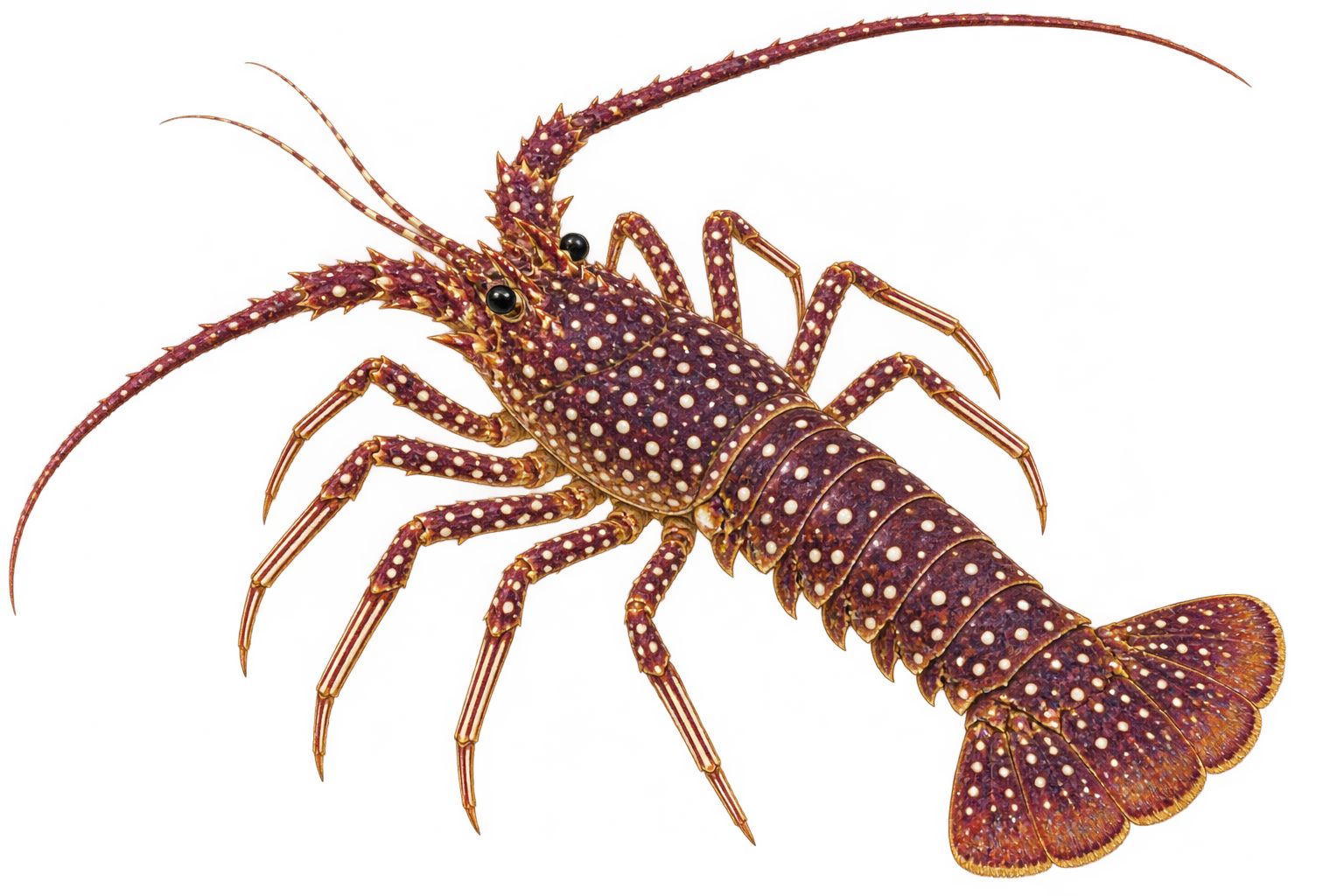
Numerous small white spots cover the darker shell of this compact spiny lobster. It has long antennae and lacks the giant claws of a northern clawed lobster. The dense, relatively even spotting contrasts with the larger paired abdominal spots of Caribbean spiny lobster.
Size and life stages
This species reaches about 20 centimeters in total body length and is appreciably smaller than a large Caribbean spiny lobster. Antennae can make the silhouette look much longer. A small spotted adult should not automatically be identified as a juvenile of its larger relative.
Habitat and where to look
This is a reef specialist, closely associated with coral-reef shelter rather than the broad nursery and adult habitat sequence used by Caribbean spiny lobster. Crevices and shaded reef structure matter. Habitat preference is one of the important ecological differences between the two species. Comparative studies describe a smaller, more habitat-specialized animal than Caribbean spiny lobster, with differences in movement, growth and reproductive output. Those differences help the two species occupy the same broader reef region without using it identically. The Florida Looe Key population study followed animals across multiple years, providing stronger ecological evidence than a single diver sighting.
Range and local context
South Florida lies within its western Atlantic distribution, which includes the Bahamas and Caribbean. Research at Looe Key provides a specific Florida record. That evidence establishes regional presence, not abundance or a reliable encounter location in Palm Beach County.
What is on the menu?
It feeds on small reef-associated invertebrates. Comparative research shows that its feeding ecology and use of habitat differ from those of Caribbean spiny lobster. Two animals that share long antennae and a common name need not fill identical roles on a reef.
Daily habits and behavior
The spotted lobster usually remains closely tied to reef shelter and is most accessible to observers after dark. Its behavior is more localized than the conspicuous movements sometimes seen in Caribbean spiny lobsters. Daytime antennae may be the only visible indication of an occupant.
Mating and the next generation
A Florida study recorded reproduction throughout the year, with a spring-to-early-summer peak. Females carry eggs beneath the abdomen. That biological timing is not a legal fishing season, and the protections for egg-bearing lobsters still matter regardless of the month.
Look-alikes and identification traps
Compare the fine, widespread pale spots with the larger abdominal spots of Panulirus argus. Body size helps only as supporting evidence because young Caribbean spiny lobsters are also small. A clear dorsal or side photograph is more useful than a quick glimpse inside a dark hole.
Observe without disturbing
Keep lights brief and allow the animal to remain in shelter. Do not probe holes or pull a lobster by an antenna. The fishing regulations below distinguish this species from Caribbean spiny lobster rather than assuming the same season and minimum size apply. Dive with Stuart Scuba to explore Florida marine life with an emphasis on careful observation. Ask about current conditions and an appropriate dive plan; wildlife sightings remain unpredictable.
Harvest, protection and eating safety
Egg-bearing lobsters protected; general harvest rules apply
Can it be hunted or harvested?
Spotted spiny lobster is a different species from Panulirus argus. The Caribbean spiny lobster three-inch carapace minimum, six-animal bag and seasonal calendar must not be automatically applied to it. The reviewed Florida rules do prohibit taking or possessing egg-bearing lobsters in its family or stripping their eggs. Outside closed areas, the general recreational limit for an otherwise unregulated species is 100 pounds or two individuals per person per day, whichever is greater. A recreational saltwater fishing license is required unless exempt; a shoreline-only license does not cover collecting while diving. Use non-injuring hand collection or a lawful net; never remove an animal from another person’s trap. Neither this species nor its family appears in the restricted marine-life list, so the aquarium 5-per-species/20-organism limit is not substituted here.
Florida seasons and areas
No species-specific statewide recreational closed season or minimum size was found for this species in the reviewed Florida rules. This does not remove the year-round egg-bearing prohibition. State rules and Florida-adjacent federal restrictions must be checked for the actual trip; a rule written specifically for Panulirus argus is not a rule for every lobster. Park, refuge and Florida Keys sanctuary zones can prohibit collection even where general state rules allow it. Check the exact site and current boundaries before any take.
Can it be speared?
Do not spear. FWC’s recreational spearing guidance lists lobster among prohibited targets. Use non-injuring collection only where otherwise lawful; do not treat a different scientific name as permission to pierce an animal.
Is it safe to eat?
Meat from a legal, correctly identified catch can be eaten when properly handled and thoroughly cooked, but this is not an unconditional safety finding. Keep it cold promptly, avoid raw or undercooked seafood, and do not eat the tomalley or hepatopancreas. Check current local health advisories and personal shellfish-allergy risks. FDA recommends 145°F for most seafood; crabs and lobsters spoil rapidly after death.
Before you act: This recreational overview is not permission to collect or spear at your dive site. Confirm the species, date, management area, state or federal waters, gear, licenses and current local closures. Identification artwork cannot establish an identification or guarantee seafood safety.
Official rules and health guidance
- FWC: Spiny Lobster
- FAC 68B-24.007: egg-bearing lobster prohibition (LII reproduction; effective date checked against official FAC index)
- FAC 68B-24.002: Panulirus argus definition (LII reproduction; effective date checked against official FAC index)
- Florida Administrative Code: Spiny and Slipper Lobster, Chapter 68B-24
- FWC: Recreational Marine Life
- FWC: Saltwater Recreational Licenses and Permits
- NOAA: Current South Atlantic Fishing Regulations
- NOAA: Florida Keys Sanctuary Marine Zones
- FWC: Spearing and Restricted Areas
- FDA: Selecting and Serving Seafood Safely
- Florida Department of Health: Seafood Poisoning
- FAC 68B-42.001: exhaustive restricted marine-life species list (LII reproduction)
Reviewed 2026-11-10. Rules and advisories can change; check the linked authorities before harvesting or eating.
Sources and review
Reviewed 2026-11-10.
Make your next dive happen
Dive With Us
Explore local charters and plan a dive suited to your experience.
View dive calendarTrain With Us
Build your fish identification, buoyancy and diving skills.
Explore trainingTravel With Us
Discover upcoming dive adventures and trip details.
Explore dive travelShop With Us
Browse equipment for your diving and ask our team for help choosing.
Explore dive gearReview current dates, availability, prices, inclusions and requirements on each listing before booking or buying.
Call us now
Ask about marine life identification
Marine Life Identification
Ask about dates, prerequisites or your next step. An inquiry does not reserve a place. Please provide your own contact details; do not include medical, payment or a child's personal information.
We use these details to respond to your inquiry. This form does not sign you up for marketing.
Explore more with Stuart Scuba
Open Water course options · Advanced Adventure training · Technical training · Professional training · All courses · Local dives · Dive trips · Facebook · Instagram · YouTube
Your surface-interval essentials
Questions for Stuart Scuba? info@stuartscuba.com
Check the Stuart Scuba Weather Center · Play scuba trivia
Weather and wildlife vary. Confirm current conditions, trip requirements and departure details with the operator.
Plan Your Next Dive with Stuart Scuba
Dive With Us
Explore upcoming local charters and choose a dive that fits your experience.
Before you book
Check the individual listing for departure time, requirements and availability.
Travel With Us
Find upcoming dive adventures and start planning your next trip.
Plan your trip
Review dates, inclusions and trip details on the travel calendar.
Stay Connected with Stuart Scuba
 Follow pageShare
YouTube
SubscribeWatch & shareFollow on InstagramView & share post
Follow company news, training updates, and dive stories.
Follow on LinkedInGoogle Reviews
See Stuart Scuba’s current Google rating and review count below. Open the listing in Google Maps to browse customer reviews.



