

Fish identification archive / Spotted Soapfish
Spotted Soapfish
Rypticus subbifrenatus
I saw this
Spotted this marine animal? Share the guide with your dive buddies. Review your caption before posting.
For Instagram, copy the caption and link into your own post or message. Nothing is posted automatically and this does not record a verified sighting.
Fun facts for your next surface interval
- Its belly is usually less spotted than its upper body.
- Two small marks at the upper eye are more informative than the total number of body spots.
- Young adults can have narrow yellow edges on their otherwise brown fins.
Florida and local context
Florida Keys region; Palm Beach occurrence not verified in the cited museum checklist: Smithsonian species data report includes Florida Keys-region occurrence coordinates, for example [[24.4525, -81.8808], [24.5458, -81.4075]]. Lake Worth Lagoon row has no verified mark; potential only.
Documented regional presence is not a guarantee of an encounter or a measure of how common this animal is at your dive site.
How to recognize this animal
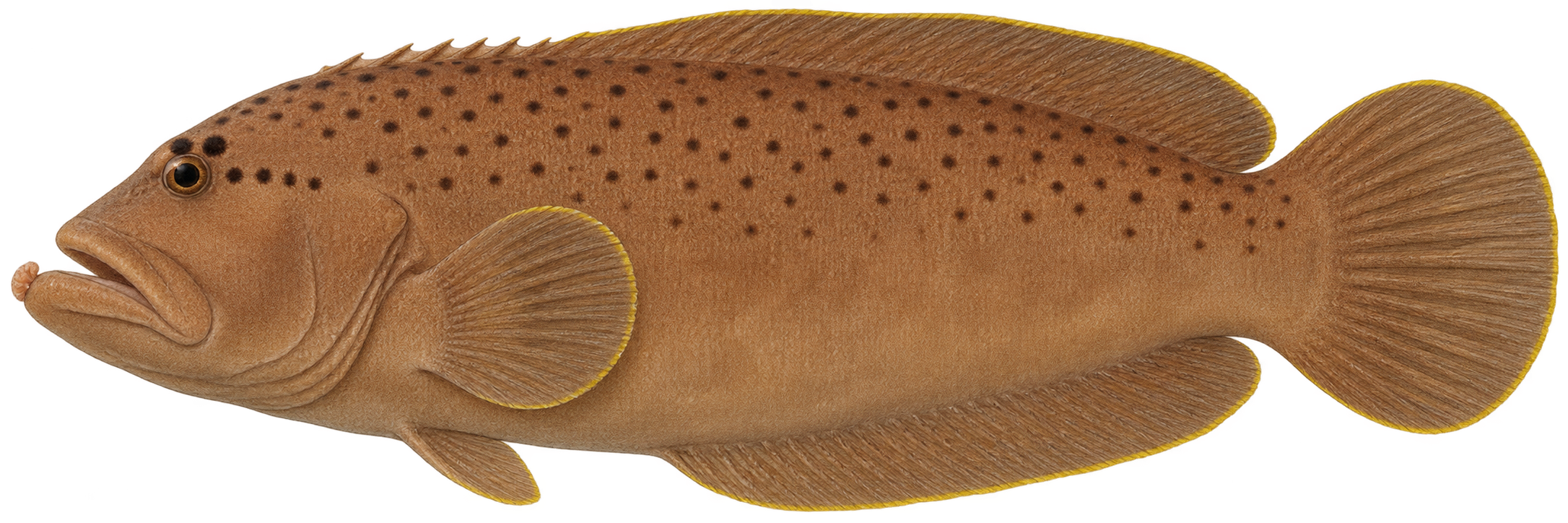
Spotted soapfish have a brown background with dark spots that vary from sparse to numerous. Two marks near the eye are especially useful: one on its upper part, another immediately above and behind it. A short dark stripe or row of larger spots may extend backward from the eye. The belly usually lacks spots.
Size and life stages
The maximum reported length is 18 centimeters, around seven inches. Spot size tends to be relatively smaller in larger fish, so the appearance is not identical across sizes. Young adults may have narrow yellow fin margins. A pale yellow edge is therefore compatible with the species, but the head markings and rounded fleshy fins remain more dependable clues.
Habitat and where to look
Shallow patch reefs, tide pools and spur-and-groove reef formations are documented habitats. Although records extend to 30 meters, the Smithsonian description emphasizes one to two meters as usual depths. This makes shallow structure relevant to a search, not just deeper ledges. A small brown fish among rocks requires patience and good buoyancy rather than moving its cover.
Range and local context
The documented range extends from Bermuda to southern Brazil, with eastern Atlantic records. Smithsonian distribution points document the Florida Keys region. Florida Museum lists this species only as a potential, unverified Lake Worth Lagoon occurrence; it is not a confirmed Palm Beach record in that checklist. This broader Florida inclusion should not be read as a promise of a local encounter.
What is on the menu?
Small fishes and mobile benthic crustaceans make up the listed diet. The lower jaw projects beyond the upper and carries a small fleshy knob. Bands of simple teeth line the mouth, fitting a small predator rather than a grazing fish. Its stationary or slow appearance should not be interpreted as an inability to take mobile prey.
Daily habits and behavior
The body is strongly compressed and the scales are embedded. Dorsal, anal and tail fins look thick and rounded, with the anal lacking spines. The tail normally has no spots, although one or two can occur near its base. This variation makes a perfectly spotless tail a useful tendency, not an absolute rule that overrides other identification features.
Mating and the next generation
The species account lists pelagic eggs and larvae. An adult occupying a tide pool or patch reef does not imply eggs are attached there or guarded beneath a rock. No Florida spawning calendar was verified in the reviewed material. A close pair should therefore be described simply as two observed soapfish unless actual reproductive behavior is recorded.
Look-alikes and identification traps
Greater soapfish have many pale blotches on a darker brown body, reversing the usual contrast of this species. Several other Rypticus also carry spots, and the exact pair of upper-eye marks is important. A photograph limited to the side of the body can leave a genuine identification problem; the head and full tail should be included.
Observe without disturbing
Photograph without lifting stones or pushing the fish from a narrow gap. In very shallow water, even a camera housing or fin can scrape the animal's retreat. A natural side image showing the eye marks, unspotted belly and rounded tail is the goal. Treat uncertain images as Rypticus rather than converting every spotted soapfish into this species.
Harvest, protection and eating safety
Restricted live collection only; no spearing; protected collection areas apply
Can it be hunted or harvested?
Spotted Soapfish (Rypticus subbifrenatus) falls under Florida recreational marine-life rules (marine-life hamlet/seabass category; not a regulated food-grouper species). It is not a blanket statewide no-take species, but food harvest is not authorized under these live-only rules. Where lawful, a saltwater fishing license is required unless exempt, and the fish must be landed and kept alive with adequate circulation or aeration. Limit: five of this species within 20 marine-life organisms per person per day; two-day possession: ten of this species within 40 total. No species-specific statewide size limit is listed. Recreational sale is prohibited.
Florida seasons and areas
No species-specific annual closed months are listed for this live-collection category. Collection is prohibited inside the designated Blue Heron Bridge dive-site boundary, throughout Biscayne National Park and in John Pennekamp Coral Reef State Park for this listed fish/group. Florida marine-life requirements also apply in adjacent federal waters on both coasts. Additional sanctuary, park and refuge zones can prohibit taking. The designated Western Dry Rocks area is closed to all fishing April 1 through July 31 each year.
Can it be speared?
No. Spears are not an authorized recreational method for this live-collection species. Only approved live-collection gear, such as permitted hand-held nets, barrier/drop nets or a slurp gun, may be used where collection is otherwise lawful. An open calendar does not override a protected area or the requirement to keep the animal alive.
Is it safe to eat?
Not a food-harvest species under the applicable live-only rules; this guide does not establish it as safe to eat. Do not treat lawful aquarium collection, small size or lack of a named consumption advisory as food-safety clearance. Florida DOH guidance depends on the fish, capture water and consumer, with extra considerations for children and pregnancy. Cooking does not eliminate all marine toxins.
Before you act: This recreational overview is not permission to collect or spear at your dive site. Confirm the species, date, management area, state or federal waters, gear, licenses and current local closures. Identification artwork cannot establish an identification or guarantee seafood safety.
Official rules and health guidance
- FWC recreational marine-life requirements
- FWC species applicability and Pennekamp restrictions (commercial quantities not used)
- Florida Administrative Code 68B-42.001 current rule index
- FWC Biscayne National Park rules
- NOAA Florida Keys sanctuary zones
- FWC Western Dry Rocks seasonal closure
- Florida Administrative Code 68B-42.007 current gear rule index
- Florida DOH fish-consumption advisories
- Florida DOH seafood poisoning guidance
Reviewed 2026-11-10. Rules and advisories can change; check the linked authorities before harvesting or eating.
Sources and review
Reviewed 2026-11-10.
Make your next dive happen
Dive With Us
Explore local charters and plan a dive suited to your experience.
View dive calendarTrain With Us
Build your fish identification, buoyancy and diving skills.
Explore trainingTravel With Us
Discover upcoming dive adventures and trip details.
Explore dive travelShop With Us
Browse equipment for your diving and ask our team for help choosing.
Explore dive gearReview current dates, availability, prices, inclusions and requirements on each listing before booking or buying.
Call us now
Ask about marine life identification
Marine Life Identification
Ask about dates, prerequisites or your next step. An inquiry does not reserve a place. Please provide your own contact details; do not include medical, payment or a child's personal information.
We use these details to respond to your inquiry. This form does not sign you up for marketing.
Explore more with Stuart Scuba
Open Water course options · Advanced Adventure training · Technical training · Professional training · All courses · Local dives · Dive trips · Facebook · Instagram · YouTube
Your surface-interval essentials
Questions for Stuart Scuba? info@stuartscuba.com
Check the Stuart Scuba Weather Center · Play scuba trivia
Weather and wildlife vary. Confirm current conditions, trip requirements and departure details with the operator.
Plan Your Next Dive with Stuart Scuba
Dive With Us
Explore upcoming local charters and choose a dive that fits your experience.
Before you book
Check the individual listing for departure time, requirements and availability.
Travel With Us
Find upcoming dive adventures and start planning your next trip.
Plan your trip
Review dates, inclusions and trip details on the travel calendar.
Stay Connected with Stuart Scuba
 Follow pageShare
YouTube
SubscribeWatch & shareFollow on InstagramView & share post
Follow company news, training updates, and dive stories.
Follow on LinkedInGoogle Reviews
See Stuart Scuba’s current Google rating and review count below. Open the listing in Google Maps to browse customer reviews.



