

Fish identification archive / Spotted Scorpionfish
Spotted Scorpionfish
Scorpaena plumieri
I saw this
Spotted this fish? Share the guide with your dive buddies. Review your caption before posting.
For Instagram, copy the caption and link into your own post or message. Nothing is posted automatically and this does not record a verified sighting.
Fun facts for your next surface interval
- Hide-and-seek overachiever: its camouflage can conceal it in plain sight.
- Dinner in a whoosh: its mouth works like a sudden vacuum.
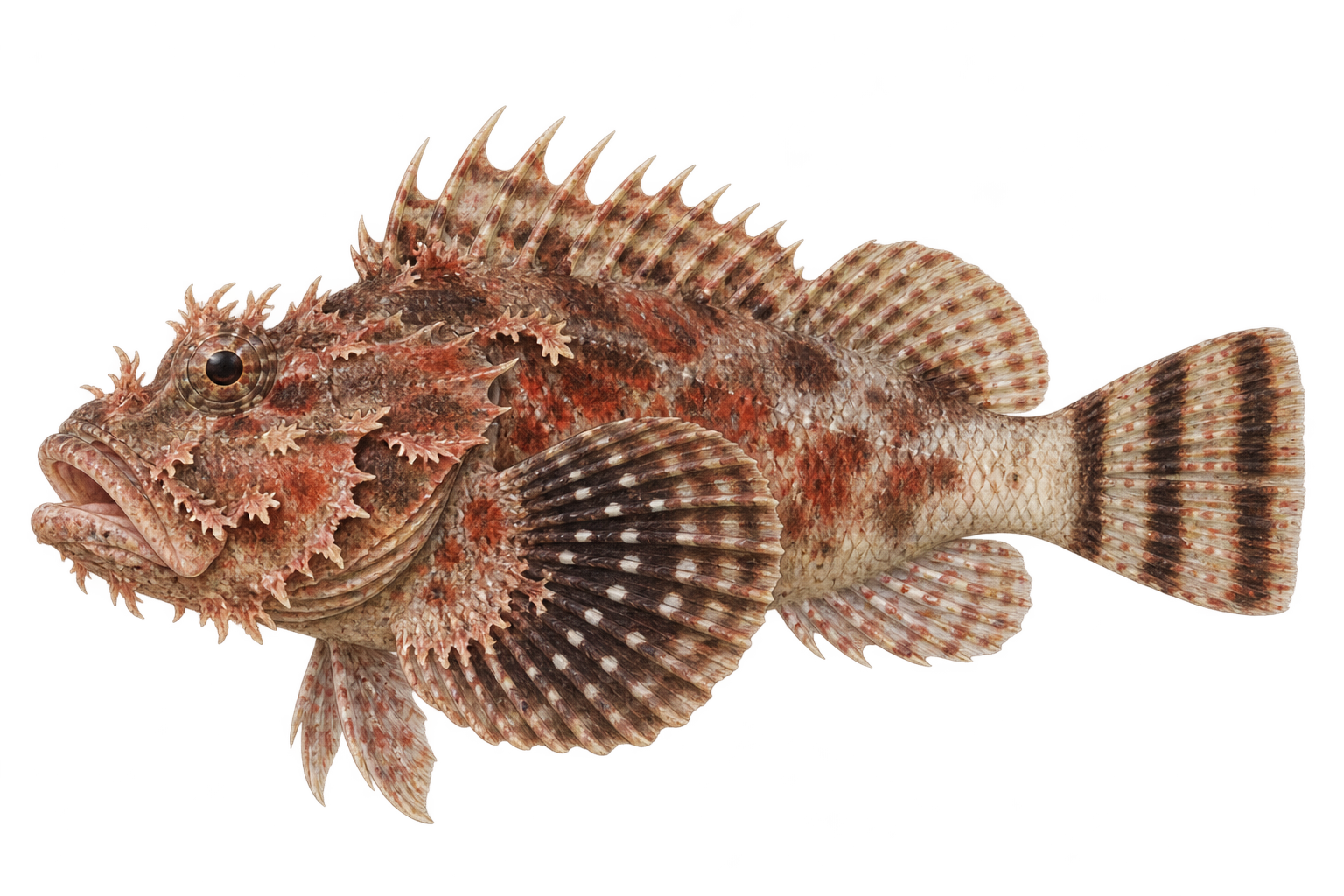
- Secret polka dots: white-spotted inner fins provide a hidden identification clue.
Palm Beach connection
Lake Worth Lagoon / Blue Heron Bridge: Verified species row in Florida Museum local checklist.
Documented regional presence is not a guarantee of an encounter or a measure of how common this fish is at your dive site.
How to recognize this fish
This is a heavy-headed, bottom-resting fish with strong head spines, skin flaps and an irregular mottled pattern. Colors can combine brown, gray, red, green and black, so the disguise changes with the individual. A particularly useful character is the black inner pectoral-fin surface with large pale spots. Those markings may remain hidden while the fish is resting normally.
Size and life stages
Florida Museum gives commonly observed lengths of 18–36 cm and a maximum of 45 cm, also supported by Smithsonian. A smaller camouflaged fish should not be dismissed simply because an adult reference picture looks bulky. Conversely, size alone cannot distinguish every scorpionfish. Record a rough length only when there is a reasonable visual reference, without placing an object next to the fish.
Habitat and where to look
Rocky and coral reefs, rubble and adjoining bottom habitat can all hold the species. Its outline blends with uneven substrate, so an apparently bare rock may deserve a second look before you approach it. Scan for an eye, mouth edge or a fin boundary. Identification is an exercise in patient observation, not in probing crevices with a hand or pointer.
Range and local context
The species occurs in the Atlantic, including Florida and the Caribbean. Its regional presence is specifically established by the verified Lake Worth Lagoon inventory and SDI's Blue Heron Bridge guide. These sources support inclusion as a local identification possibility; they do not imply that every mottled bottom fish at the bridge belongs to this species.
What is on the menu?
Spotted Scorpionfish ambush fishes and crustaceans. A rapid opening of the large mouth creates suction that draws prey in, allowing feeding without a long pursuit. Remaining still is therefore part of a successful hunting strategy rather than evidence that the fish is inactive in an ecological sense. Watch from a respectful distance rather than attempting to trigger a strike.
Daily habits and behavior
Camouflage and stillness are central features of its behavior. The pectoral fins can reveal their contrasting inner pattern when spread, but that display should never be induced for identification. Venom-associated spines provide defense. A fish that remains motionless has not agreed to be touched, and its apparent resemblance to the surrounding rock is precisely why careful buoyancy matters.
Mating and the next generation
Species summaries describe an egg-laying reproductive strategy with eggs and sperm released into the water. Details of natural reproduction are less fully documented than the conspicuous adult anatomy. This page therefore avoids an invented local spawning season, clutch size or parental-care story. A pair resting nearby is not enough evidence to describe a breeding event.
Look-alikes and identification traps
Several local scorpionfishes have mottled bodies and head flaps. The inner pectoral markings, head structure and complete body pattern are more useful than a general 'rock-like' appearance. It is not appropriate to label the animal an Indo-Pacific stonefish merely because it is venomous. If the diagnostic fin surface is concealed, retain a broader identification rather than disturbing the fish.
Observe without disturbing
Never touch, lift, poke or try to make a scorpionfish move. Keep hands and fins off the substrate, and avoid resting a camera beside an animal whose outline you cannot fully see. Photograph from a neutral hover without provoking a fin display. Tell nearby divers where it is with a non-contact signal, leaving both the fish and its cover undisturbed.
Harvest, protection and eating safety
General Florida harvest rules; local restrictions apply
Can it be hunted or harvested?
Spotted scorpionfish is a native fish, not invasive lionfish. Do not apply lionfish’s special license or bag-limit exceptions. It is absent from the restricted ornamental categories reviewed. Where otherwise lawful in Florida state waters, the default recreational limit is two fish or 100 pounds per person daily, whichever is greater; no species-specific statewide size rule was identified. A saltwater license is normally required unless exempt.
Florida seasons and areas
No species-specific statewide recreational closed season was identified in the FWC rules reviewed. Florida state waters extend to 3 nautical miles on the Atlantic side and 9 on the Gulf side. Verify the exact site, federal rules offshore and current sanctuary/park closures before targeting this species.
Can it be speared?
Not named on FWC’s species-specific no-spearing list. Spearing is possible only where otherwise lawful; public beaches, fishing piers, bridges, parts of Monroe County and protected areas have restrictions. A species allowance does not make a dive site legal.
Is it safe to eat?
Use particular caution: venomous dorsal spines can injure handlers. Florida Museum documents consumption and a reported ciguatera case, so this is not a “safe to eat” listing. Check DOH advisories; cooking, freezing and marinating do not remove ciguatoxin. Venom-handling risk and food-toxin risk are different hazards.
Before you act: This recreational overview is not permission to collect or spear at your dive site. Confirm the species, date, management area, state or federal waters, gear, licenses and current local closures. A fish illustration cannot establish an identification or guarantee seafood safety.
Official rules and health guidance
- FWC: Full Rule Text by Species
- FWC: Recreational Marine Life
- Florida Administrative Code: Marine-life Species, 68B-42.001 (Cornell reproduction)
- FWC: Unregulated Species and Default Bag Limit
- FWC: Saltwater Recreational Licenses and Permits
- Florida Museum: Spotted Scorpionfish, Venom and Ciguatera
- FWC: Boundary Maps and Management Zones
- NOAA: Florida Keys National Marine Sanctuary Zones
- NOAA: Gulf Fishing Regulations and Seasonal Closures
- FWC: Spearing
- Florida Department of Health: Seafood Poisoning
- Florida Department of Health: Eating Healthy Seafood and Local Advisories
Reviewed 2026-11-10. Rules and advisories can change; check the linked authorities before harvesting or eating.
Sources and review
Reviewed 2026-11-10.
Make your next dive happen
Dive With Us
Explore local charters and plan a dive suited to your experience.
View dive calendarTrain With Us
Build your fish identification, buoyancy and diving skills.
Explore trainingTravel With Us
Discover upcoming dive adventures and trip details.
Explore dive travelShop With Us
Browse equipment for your diving and ask our team for help choosing.
Explore dive gearReview current dates, availability, prices, inclusions and requirements on each listing before booking or buying.
Call us now
Ask about fish identification training
Reef Fish Identification
Ask about dates, prerequisites or your next step. An inquiry does not reserve a place. Please provide your own contact details; do not include medical, payment or a child's personal information.
We use these details to respond to your inquiry. This form does not sign you up for marketing.
Explore more with Stuart Scuba
Open Water course options · Advanced Adventure training · Technical training · Professional training · All courses · Local dives · Dive trips · Facebook · Instagram · YouTube
Your surface-interval essentials
Questions for Stuart Scuba? info@stuartscuba.com
Check the Stuart Scuba Weather Center · Play scuba trivia
Weather and wildlife vary. Confirm current conditions, trip requirements and departure details with the operator.
Plan Your Next Dive with Stuart Scuba
Dive With Us
Explore upcoming local charters and choose a dive that fits your experience.
Before you book
Check the individual listing for departure time, requirements and availability.
Travel With Us
Find upcoming dive adventures and start planning your next trip.
Plan your trip
Review dates, inclusions and trip details on the travel calendar.
Stay Connected with Stuart Scuba
 Follow pageShare
YouTube
SubscribeWatch & shareFollow on InstagramView & share post
Follow company news, training updates, and dive stories.
Follow on LinkedInGoogle Reviews
See Stuart Scuba’s current Google rating and review count below. Open the listing in Google Maps to browse customer reviews.



