

Fish identification archive / Spotted Moray
Spotted Moray
Gymnothorax moringa
I saw this
Spotted this fish? Share the guide with your dive buddies. Review your caption before posting.
For Instagram, copy the caption and link into your own post or message. Nothing is posted automatically and this does not record a verified sighting.
Fun facts for your next surface interval
- The spotted outfit comes in different densities: some individuals are much darker than others.
- No sleeves required: morays have neither pectoral nor pelvic fins.
- An open mouth can be part of breathing, not a demand for a dental appointment.
Palm Beach connection
Lake Worth Lagoon / Blue Heron Bridge, Palm Beach County: Verified local record.
Documented regional presence is not a guarantee of an encounter or a measure of how common this fish is at your dive site.
How to recognize this fish
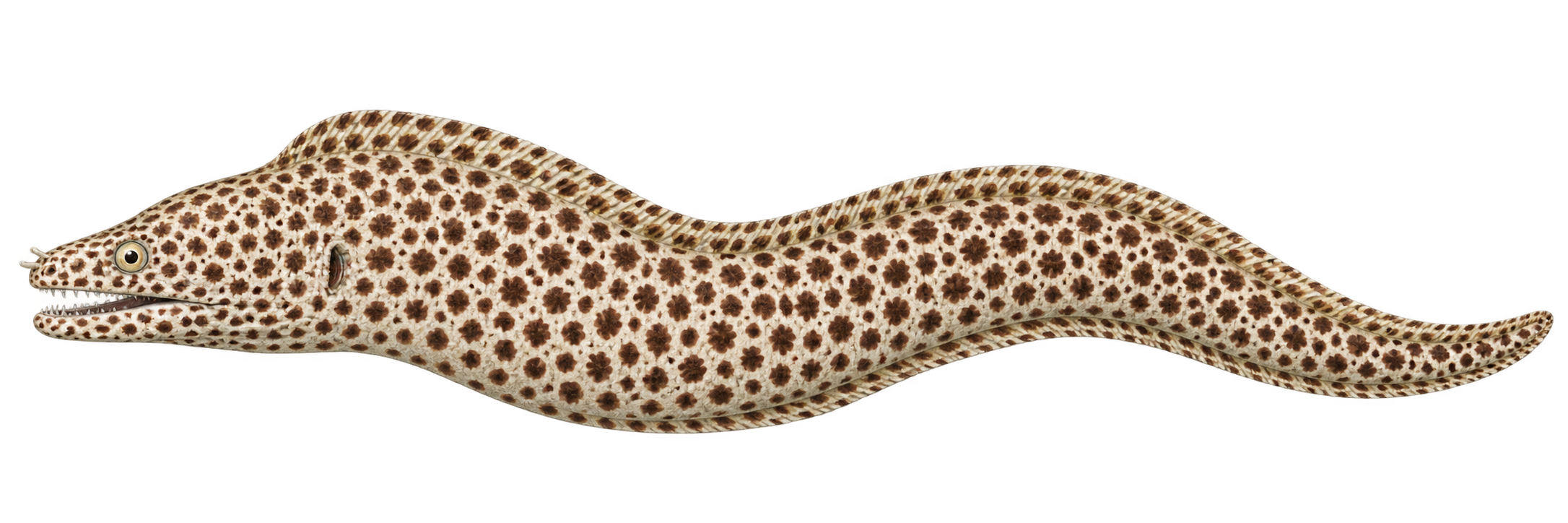
A pale background densely covered with irregular brown or black spots is the first clue. Spot density varies, so some individuals appear much darker than others. The long body tapers into a tail bordered by a continuous finfold, and there are no pectoral or pelvic fins. When only the head is visible, note the pale eye and spotted face without moving closer to inspect the teeth.
Size and life stages
Many spotted morays are under 3 feet long, although much larger records approach or exceed 6 feet. Seeing a head at a crevice entrance gives little reliable information about the concealed body. Record the visible portion instead of inventing a total length. A full-body view, if the fish emerges naturally, can be useful without requiring anyone to disturb its shelter.
Habitat and where to look
Reefs, rubble and seagrass habitats are all used. Shelter matters as much as the broad habitat label, so a careful look at the edge of a hole may reveal an animal missed in an open-water scan. Never reach into that hole or place a camera inside it. There may be additional animals in the crevice that are not visible from outside.
Range and local context
This is a western Atlantic moray found from the southeastern United States through the Caribbean and toward Brazil. Lake Worth Lagoon provides verified local documentation. Regional presence does not mean every spotted eel is this species. Use the form of the body and fins together with markings, and treat a distant or partly obscured identification as provisional.
What is on the menu?
The diet includes fishes, crustaceans and cephalopods. The long, toothed jaws belong to a predator, not an animal that needs food from divers. Do not introduce bait or place fingers close to its mouth. A quiet observation of an eel in shelter can be just as informative as watching it forage, with much less chance of changing its behavior.
Daily habits and behavior
Morays repeatedly open and close their mouths to move water across the gills. An open mouth alone is therefore not proof that the fish is threatening you, although it is never an invitation to approach. Watch from outside its space. Note whether the animal is stationary or moving, and avoid turning a single facial pose into a story about its temperament.
Mating and the next generation
A southeastern United States study found evidence consistent with separate sexes and repeated spawning during an extended season. Its results should not be converted into a guaranteed Palm Beach spawning calendar. Morays have drifting early life stages. For recreational observers, sex and reproductive state are usually uncertain, so describe what the fish did rather than assigning a breeding role from appearance.
Look-alikes and identification traps
Green morays are generally much more uniformly colored. Snake eels can also be spotted, but their body and tail anatomy differ from a moray's conspicuous continuous finfold. A pale spotted head alone may not settle a difficult identification. Photograph the whole visible outline when possible, while accepting that a sheltered fish may never provide all the diagnostic details.
Observe without disturbing
Keep hands and equipment outside crevices, do not feed, and never attempt to coax an eel out. Maintain enough distance that it can retreat or swim away freely. Good buoyancy protects both the reef and you while looking at a low shelter entrance. If sharing the encounter, choose a caption about its spots or behavior rather than encouraging close contact with the mouth.
Harvest, protection and eating safety
Restricted marine life: live collection only; no spearing
Can it be hunted or harvested?
Spotted Moray is regulated as tropical ornamental marine life, rather than an ordinary food-fishing target. Where collection is lawful, a recreational saltwater fishing license is required unless exempt; fish must be landed and kept alive with suitable aeration or circulation. No species-specific size limit is listed. The daily limit is five of this species within 20 marine-life organisms total. A two-day possession limit also applies.
Florida seasons and areas
No recreational closed months are listed in the FWC marine-life rules reviewed. This does not make every location open: collection is prohibited within the designated Blue Heron Bridge dive-site boundary. Florida marine-life rules also apply in adjacent federal waters, on both coasts. Check park, refuge and Florida Keys sanctuary restrictions before collecting.
Can it be speared?
Not allowed for recreational marine-life collection. The permitted collection methods are nonlethal live-capture methods; spears are not authorized by the marine-life gear rules.
Is it safe to eat?
Avoid eating moray eels. Florida DOH specifically identifies moray eel as a ciguatera-risk reef fish. Ciguatoxin cannot be detected by normal taste, smell or appearance and is not removed by cooking, freezing or marinating. Live-collection permission is not food-safety clearance.
Before you act: This recreational overview is not permission to collect or spear at your dive site. Confirm the species, date, management area, state or federal waters, gear, licenses and current local closures. A fish illustration cannot establish an identification or guarantee seafood safety.
Official rules and health guidance
- FWC: Recreational Marine Life
- Florida Administrative Code: Marine Life, Chapter 68B-42
- FWC: Saltwater Recreational Licenses and Permits
- NOAA: Florida Keys National Marine Sanctuary Zones
- Florida Administrative Code: Marine-life Gear, 68B-42.007
- Florida Department of Health: Seafood Poisoning
Reviewed 2026-11-10. Rules and advisories can change; check the linked authorities before harvesting or eating.
Sources and review
Reviewed 2026-11-10.
Make your next dive happen
Dive With Us
Explore local charters and plan a dive suited to your experience.
View dive calendarTrain With Us
Build your fish identification, buoyancy and diving skills.
Explore trainingTravel With Us
Discover upcoming dive adventures and trip details.
Explore dive travelShop With Us
Browse equipment for your diving and ask our team for help choosing.
Explore dive gearReview current dates, availability, prices, inclusions and requirements on each listing before booking or buying.
Call us now
Ask about fish identification training
Reef Fish Identification
Ask about dates, prerequisites or your next step. An inquiry does not reserve a place. Please provide your own contact details; do not include medical, payment or a child's personal information.
We use these details to respond to your inquiry. This form does not sign you up for marketing.
Explore more with Stuart Scuba
Open Water course options · Advanced Adventure training · Technical training · Professional training · All courses · Local dives · Dive trips · Facebook · Instagram · YouTube
Your surface-interval essentials
Questions for Stuart Scuba? info@stuartscuba.com
Check the Stuart Scuba Weather Center · Play scuba trivia
Weather and wildlife vary. Confirm current conditions, trip requirements and departure details with the operator.
Plan Your Next Dive with Stuart Scuba
Dive With Us
Explore upcoming local charters and choose a dive that fits your experience.
Before you book
Check the individual listing for departure time, requirements and availability.
Travel With Us
Find upcoming dive adventures and start planning your next trip.
Plan your trip
Review dates, inclusions and trip details on the travel calendar.
Stay Connected with Stuart Scuba
 Follow pageShare
YouTube
SubscribeWatch & shareFollow on InstagramView & share post
Follow company news, training updates, and dive stories.
Follow on LinkedInGoogle Reviews
See Stuart Scuba’s current Google rating and review count below. Open the listing in Google Maps to browse customer reviews.



