

Fish identification archive / Spotted Eagle Ray
Spotted Eagle Ray
Aetobatus narinari
I saw this
Spotted this fish? Share the guide with your dive buddies. Review your caption before posting.
For Instagram, copy the caption and link into your own post or message. Nothing is posted automatically and this does not record a verified sighting.
Fun facts for your next surface interval
- Crunch time, not a shark grin: its teeth form broad crushing plates rather than rows of blades.
- Mind the measuring tape: that long tail makes total length very different from wing-to-wing disc width.
- Matching outfits, different species: Atlantic and Indo-Pacific spotted eagle rays are now recognized separately.
Palm Beach connection
Lake Worth Lagoon / Blue Heron Bridge: Verified species row in Florida Museum local checklist.
Documented regional presence is not a guarantee of an encounter or a measure of how common this fish is at your dive site.
How to recognize this fish
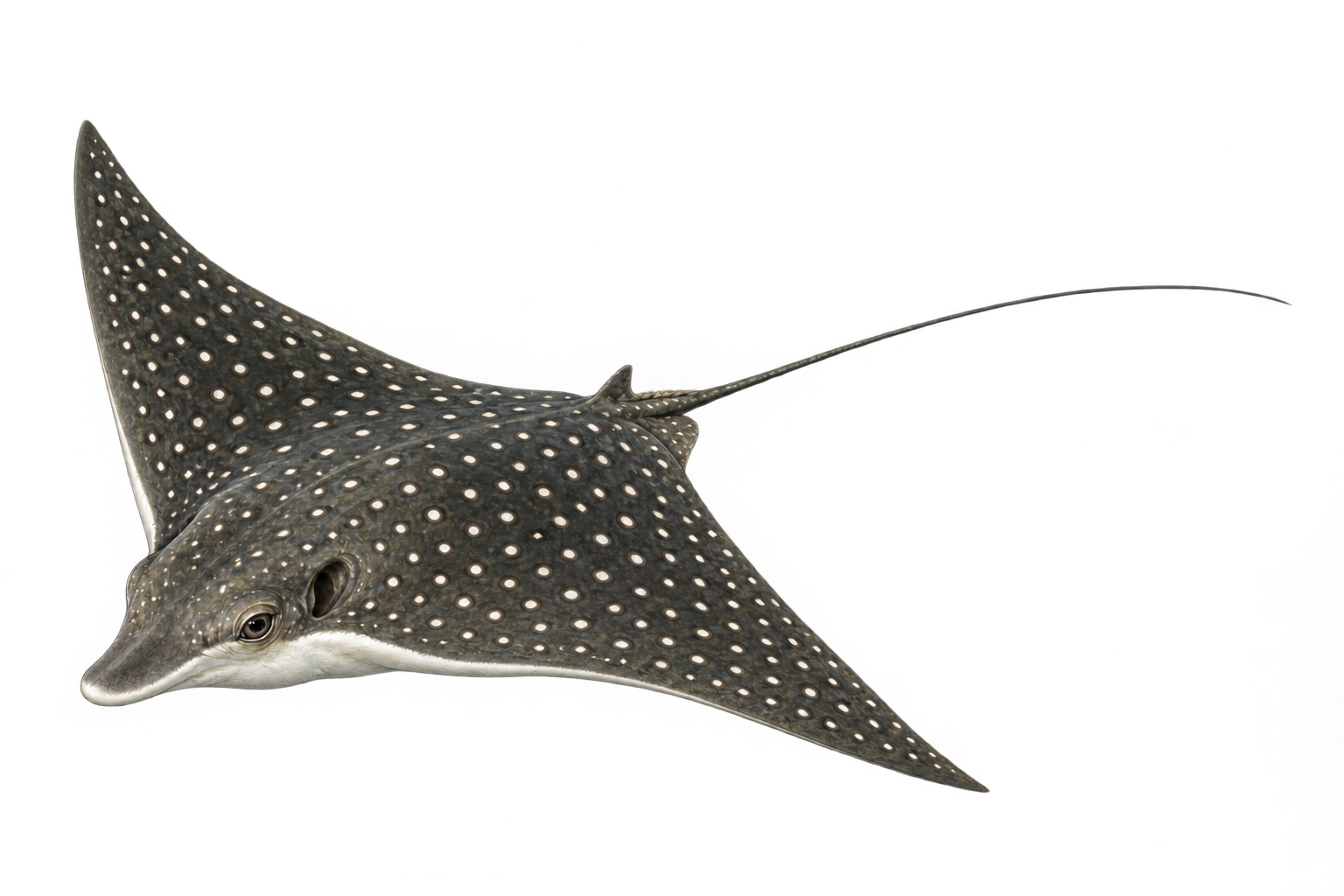
A dark upper surface scattered with pale spots, pointed pectoral wings and a projecting duck-like snout make this ray distinctive. The tail is exceptionally long and slender. Its head projects ahead of the wing-shaped disc, unlike the nearly circular outline of a yellow stingray. Try to see the head and tail as well as the attractive spotted pattern.
Size and life stages
Use disc width, measured across the wings, when comparing sizes. An Atlantic-focused research review reports large females around 2.3 m across, with males reaching smaller maximum widths in the records summarized. Total length is a different measurement because it includes the long tail. Old global species accounts can mix measurements from rays now assigned to different species.
Habitat and where to look
Coastal feeding grounds include seagrass habitats, beaches and inlets near reefs. The ray is not confined to lying on the bottom: it can swim above it and move between habitat patches. For identification, scan the water column as well as the substrate. A distant silhouette may reveal the wing shape before the spots become visible.
Range and local context
This account treats Aetobatus narinari as an Atlantic species in Aetobatidae. Indo-Pacific spotted eagle rays belong to Aetobatus ocellatus, and the former worldwide species concept should not be used to describe local range. The Lake Worth Lagoon checklist documents regional presence, without promising an encounter or showing how frequently rays pass a particular Palm Beach site.
What is on the menu?
Hard-shelled bottom animals are important prey. Broad tooth plates crush food such as mollusks, and the snout helps investigate the sediment. Feeding can bring the mouth close to the bottom even though the animal often swims above it. Do not confuse this behavior with the open-water filter feeding associated with manta and devil rays.
Daily habits and behavior
Watch the pectoral wings propel the animal as it travels, then notice any change in posture near feeding ground. Reports include solitary animals and groups, so a single ray need not be separated from a permanent school. Keep your observation descriptive: traveling, turning or probing the bottom is more defensible than assigning a motive to every movement.
Mating and the next generation
Females give birth to live pups rather than leaving egg cases on the seabed. Modern Atlantic-focused literature summarizes small litters, commonly within a range of one to five, after approximately a year of gestation. These figures carry natural variation. They should not be combined indiscriminately with older reproductive accounts assembled before the spotted eagle ray complex was separated.
Look-alikes and identification traps
An unspotted cownose ray lacks the same constellation of pale back markings, and its head shape differs. Manta and devil rays have conspicuous paired head lobes rather than this projecting snout. For a poor photograph, prioritize several visible traits over one bright patch. Geography is also essential when evaluating an image labeled simply as a spotted eagle ray.
Observe without disturbing
Give the ray an open travel corridor and avoid swimming directly into its path. Do not pursue it, crowd a feeding animal, touch its wings or approach the spine-bearing tail. Keep clear of the seabed when taking photographs. If it passes beyond comfortable viewing range, let the encounter end instead of turning a brief sighting into a chase.
Harvest, protection and eating safety
Protected; recreational harvest prohibited
Can it be hunted or harvested?
Do not keep this ray. FWC identifies spotted eagle ray as prohibited from harvest in both state and federal waters. This is a species-specific ban, not the default rule for other rays. A recreational fishing license does not create a food-harvest allowance.
Florida seasons and areas
No recreational harvest season. The prohibition applies throughout the year; a seasonal opening for some other ray or fish does not apply to spotted eagle ray. Check the linked FWC species page rather than treating a general ray category as authority.
Can it be speared?
Spearfishing prohibited. FWC expressly includes spotted eagle ray on its no-spearing list.
Is it safe to eat?
Not a recreational food-harvest species: keeping spotted eagle ray for a meal is prohibited. FDA’s “skate” mercury category does not establish food safety for spotted eagle ray. Protection from harvest and seafood safety are separate questions; an apparent resemblance to an edible species is not permission to retain this ray.
Before you act: This recreational overview is not permission to collect or spear at your dive site. Confirm the species, date, management area, state or federal waters, gear, licenses and current local closures. A fish illustration cannot establish an identification or guarantee seafood safety.
Official rules and health guidance
Reviewed 2026-11-10. Rules and advisories can change; check the linked authorities before harvesting or eating.
Sources and review
Reviewed 2026-11-10.
- Documented Palm Beach regional occurrence
- OBIS: Aetobatus narinari taxonomy
- Frontiers in Marine Science: Atlantic Eagle Ray Age and Growth
- Florida Museum: Spotted Eagle Ray anatomy
- Georgia Aquarium: Spotted Eagle Ray feeding anatomy
- Seattle Aquarium: Distinction between Atlantic and Indo-Pacific eagle rays
Make your next dive happen
Dive With Us
Explore local charters and plan a dive suited to your experience.
View dive calendarTrain With Us
Build your fish identification, buoyancy and diving skills.
Explore trainingTravel With Us
Discover upcoming dive adventures and trip details.
Explore dive travelShop With Us
Browse equipment for your diving and ask our team for help choosing.
Explore dive gearReview current dates, availability, prices, inclusions and requirements on each listing before booking or buying.
Call us now
Ask about fish identification training
Reef Fish Identification
Ask about dates, prerequisites or your next step. An inquiry does not reserve a place. Please provide your own contact details; do not include medical, payment or a child's personal information.
We use these details to respond to your inquiry. This form does not sign you up for marketing.
Explore more with Stuart Scuba
Open Water course options · Advanced Adventure training · Technical training · Professional training · All courses · Local dives · Dive trips · Facebook · Instagram · YouTube
Your surface-interval essentials
Questions for Stuart Scuba? info@stuartscuba.com
Check the Stuart Scuba Weather Center · Play scuba trivia
Weather and wildlife vary. Confirm current conditions, trip requirements and departure details with the operator.
Plan Your Next Dive with Stuart Scuba
Dive With Us
Explore upcoming local charters and choose a dive that fits your experience.
Before you book
Check the individual listing for departure time, requirements and availability.
Travel With Us
Find upcoming dive adventures and start planning your next trip.
Plan your trip
Review dates, inclusions and trip details on the travel calendar.
Stay Connected with Stuart Scuba
 Follow pageShare
YouTube
SubscribeWatch & shareFollow on InstagramView & share post
Follow company news, training updates, and dive stories.
Follow on LinkedInGoogle Reviews
See Stuart Scuba’s current Google rating and review count below. Open the listing in Google Maps to browse customer reviews.



