

Fish identification archive / Spotfin Butterflyfish
Spotfin Butterflyfish
Chaetodon ocellatus
I saw this
Spotted this marine animal? Share the guide with your dive buddies. Review your caption before posting.
For Instagram, copy the caption and link into your own post or message. Nothing is posted automatically and this does not record a verified sighting.
Fun facts for your next surface interval
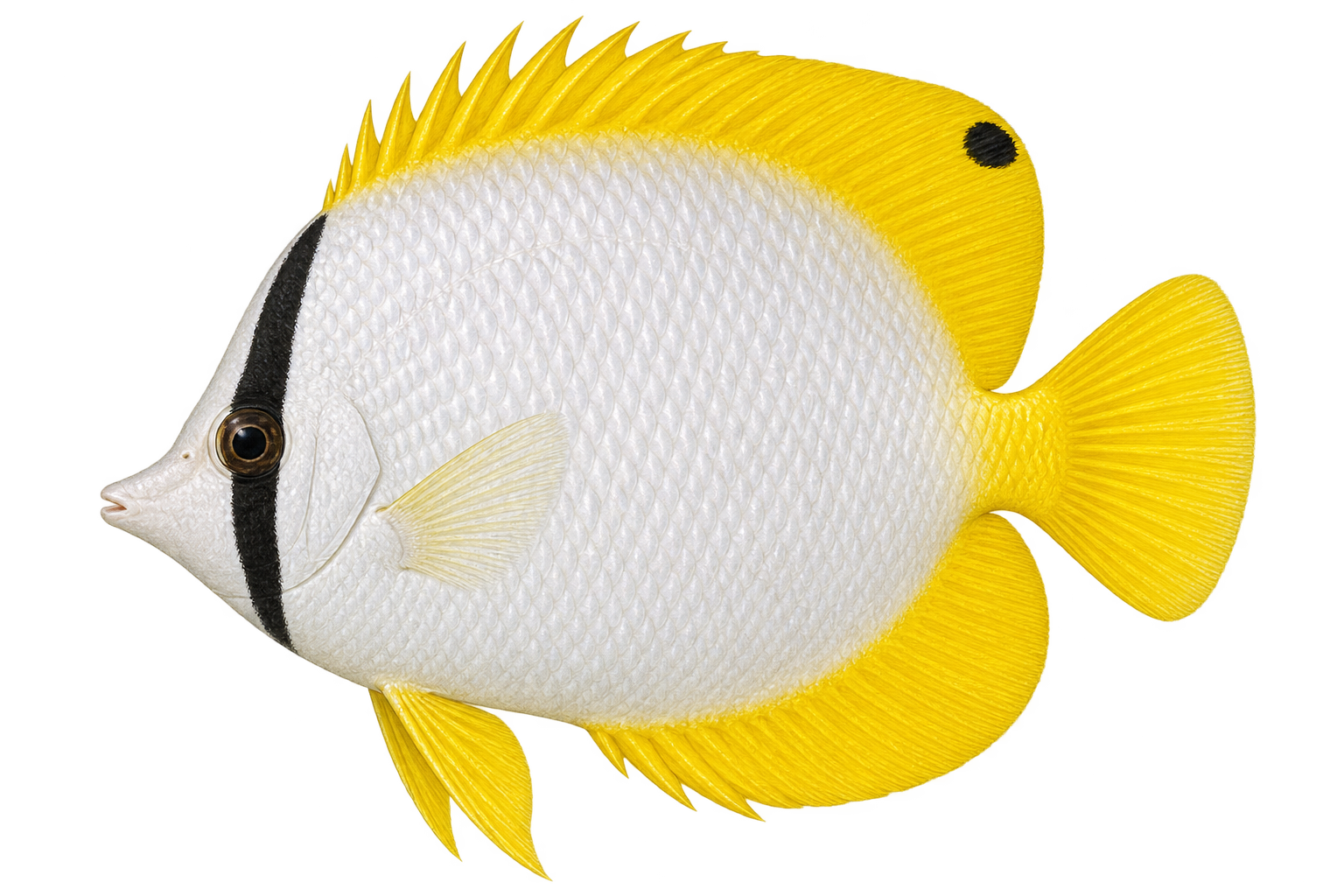
- The clue is in the corner: its namesake black spot sits at the rear of the dorsal fin.
- Different outfit after dark: body bands can become conspicuous at night.
- Some youngsters travel north without booking a ticket: currents can carry early stages far beyond the tropical core.
Florida and local context
Lake Worth Lagoon, Palm Beach County: Verified observation mark in Florida Museum regional fish checklist; no abundance or encounter guarantee inferred.
Documented regional presence is not a guarantee of an encounter or a measure of how common this animal is at your dive site.
How to recognize this animal
A white body, yellow fins and a black eye bar make the adult Spotfin Butterflyfish easy to notice. Look closely for its small black spot at the upper rear corner of the soft dorsal fin. The body is a compressed oval disk, with a short pointed mouth and rounded tail. The position of that little dorsal spot matters more than its size.
Size and life stages
The species reaches around 20 cm, with Florida Museum describing many fish between roughly 8 and 15 cm. Juveniles have an additional dark rear body bar that can confuse comparisons with other butterflyfishes. Judge age-related pattern differences before ruling out an identification. A small fish is not necessarily an adult in miniature, even when the yellow fins are already obvious.
Habitat and where to look
Adults use reefs and adjoining sandy areas; juveniles occur in seagrass beds. The species may feed over open sand rather than staying pressed against a coral head. Watch the reef edge and the quieter bottom beyond it. Keep your own fins high, because a cloud of disturbed sediment can hide both the fish and its feeding behavior.
Range and local context
Florida Museum specifically describes occurrence on Florida's shallow reefs and verifies Spotfin Butterflyfish in Lake Worth Lagoon. Its wider western Atlantic distribution includes the Gulf of Mexico and Caribbean. Northern summer sightings can involve young fish transported by currents, rather than a permanent local population. Neither the regional checklist nor a broad range map guarantees a sighting today.
What is on the menu?
Small invertebrates provide food, including tube worms and anemones. Fine teeth and a small protrusible mouth help the fish reach feeding spots. A diver can watch repeated short inspections and bites without needing to approach closely. When describing a feeding photograph, avoid calling every animal on the bottom coral; attached invertebrates include many other groups.
Daily habits and behavior
Pairs and small groups are reported, and daytime feeding gives way to a different appearance at night, when dark bands can become more visible. That changing pattern is a useful reminder that illustrations show a particular appearance, not every possible state. Photograph the fish in its natural light and record whether the encounter was by day or night.
Mating and the next generation
The species has pelagic eggs and larvae. Florida Museum's account explicitly notes uncertainty about direct spawning observations, even while describing typical butterflyfish courtship. This guide therefore does not present a detailed local spawning calendar as established fact. Seeing two adults together is interesting, but it does not prove that eggs are being released or that a seasonal event has begun.
Look-alikes and identification traps
Reef Butterflyfish have a stronger dark rear-body bar; adult Spotfins instead show the small dorsal-corner spot and largely plain white flank. Banded Butterflyfish have conspicuous broad bars, while Foureyes carry a large ringed spot on the rear body. Juveniles need extra care. Compare the entire pattern, especially whether a dark mark belongs to a fin or the body beneath it.
Observe without disturbing
Give a feeding pair room to move between sand and reef. Do not block its route, touch nearby animals or use food to bring it closer. A patient side view should show the dorsal spot, eye bar and yellow tail together. On a Stuart Scuba dive, keep the encounter within your planned depth and let identification remain uncertain when the key mark is hidden.
Harvest, protection and eating safety
Restricted marine life: live collection only; spearing prohibited
Can it be hunted or harvested?
Spotfin Butterflyfish is regulated ornamental marine life, not an ordinary food-fishing target. Recreational collection requires the appropriate saltwater license unless exempt, lawful marine-life gear, and landing and keeping the fish alive in adequately aerated or circulating water. Only fish from 1 to 4 inches total length may be retained. The daily limit is five of this species within 20 marine-life organisms total; the two-day possession limit is ten of this species within 40 total. Recreational sale is prohibited.
Florida seasons and areas
No species-specific recreational closed months are listed in the reviewed marine-life rules. This is not permission to collect anywhere: the designated Blue Heron Bridge dive site is closed to marine-life harvest. Florida marine-life rules also apply in adjacent federal waters. Check sanctuary zones, parks, refuges and current local closures before any collection.
Can it be speared?
Prohibited. FWC expressly includes butterflyfish among ornamental reef fishes that may not be harvested by spearing. Live ornamental collection is a separate, restricted activity, not an exception allowing a spear.
Is it safe to eat?
No species-specific Florida consumption-safety clearance was verified. Do not treat live-collection status as permission or evidence that this fish is safe to eat. Ciguatoxin cannot be removed by cooking or freezing. FDA/EPA mercury-based meal advice is not a ciguatera clearance for an individual reef fish.
Before you act: This recreational overview is not permission to collect or spear at your dive site. Confirm the species, date, management area, state or federal waters, gear, licenses and current local closures. Identification artwork cannot establish an identification or guarantee seafood safety.
Official rules and health guidance
- FWC: Recreational Marine Life
- FWC: Spearing
- Florida Administrative Code: Marine Life Chapter 68B-42
- NOAA: Florida Keys Sanctuary Marine Zones
- Florida Department of Health: Seafood Poisoning
- FDA/EPA: Advice about Eating Fish
Reviewed 2026-11-10. Rules and advisories can change; check the linked authorities before harvesting or eating.
Sources and review
Reviewed 2026-11-10.
Make your next dive happen
Dive With Us
Explore local charters and plan a dive suited to your experience.
View dive calendarTrain With Us
Build your fish identification, buoyancy and diving skills.
Explore trainingTravel With Us
Discover upcoming dive adventures and trip details.
Explore dive travelShop With Us
Browse equipment for your diving and ask our team for help choosing.
Explore dive gearReview current dates, availability, prices, inclusions and requirements on each listing before booking or buying.
Call us now
Ask about marine life identification
Marine Life Identification
Ask about dates, prerequisites or your next step. An inquiry does not reserve a place. Please provide your own contact details; do not include medical, payment or a child's personal information.
We use these details to respond to your inquiry. This form does not sign you up for marketing.
Explore more with Stuart Scuba
Open Water course options · Advanced Adventure training · Technical training · Professional training · All courses · Local dives · Dive trips · Facebook · Instagram · YouTube
Your surface-interval essentials
Questions for Stuart Scuba? info@stuartscuba.com
Check the Stuart Scuba Weather Center · Play scuba trivia
Weather and wildlife vary. Confirm current conditions, trip requirements and departure details with the operator.
Plan Your Next Dive with Stuart Scuba
Dive With Us
Explore upcoming local charters and choose a dive that fits your experience.
Before you book
Check the individual listing for departure time, requirements and availability.
Travel With Us
Find upcoming dive adventures and start planning your next trip.
Plan your trip
Review dates, inclusions and trip details on the travel calendar.
Stay Connected with Stuart Scuba
 Follow pageShare
YouTube
SubscribeWatch & shareFollow on InstagramView & share post
Follow company news, training updates, and dive stories.
Follow on LinkedInGoogle Reviews
See Stuart Scuba’s current Google rating and review count below. Open the listing in Google Maps to browse customer reviews.



