

Fish identification archive / Spot
Spot
Leiostomus xanthurus · Sciaenidae
I saw this
Spotted this fish? Share the guide with your dive buddies. Review your caption before posting.
For Instagram, copy the caption and link into your own post or message. Nothing is posted automatically and this does not record a verified sighting.
What to look for
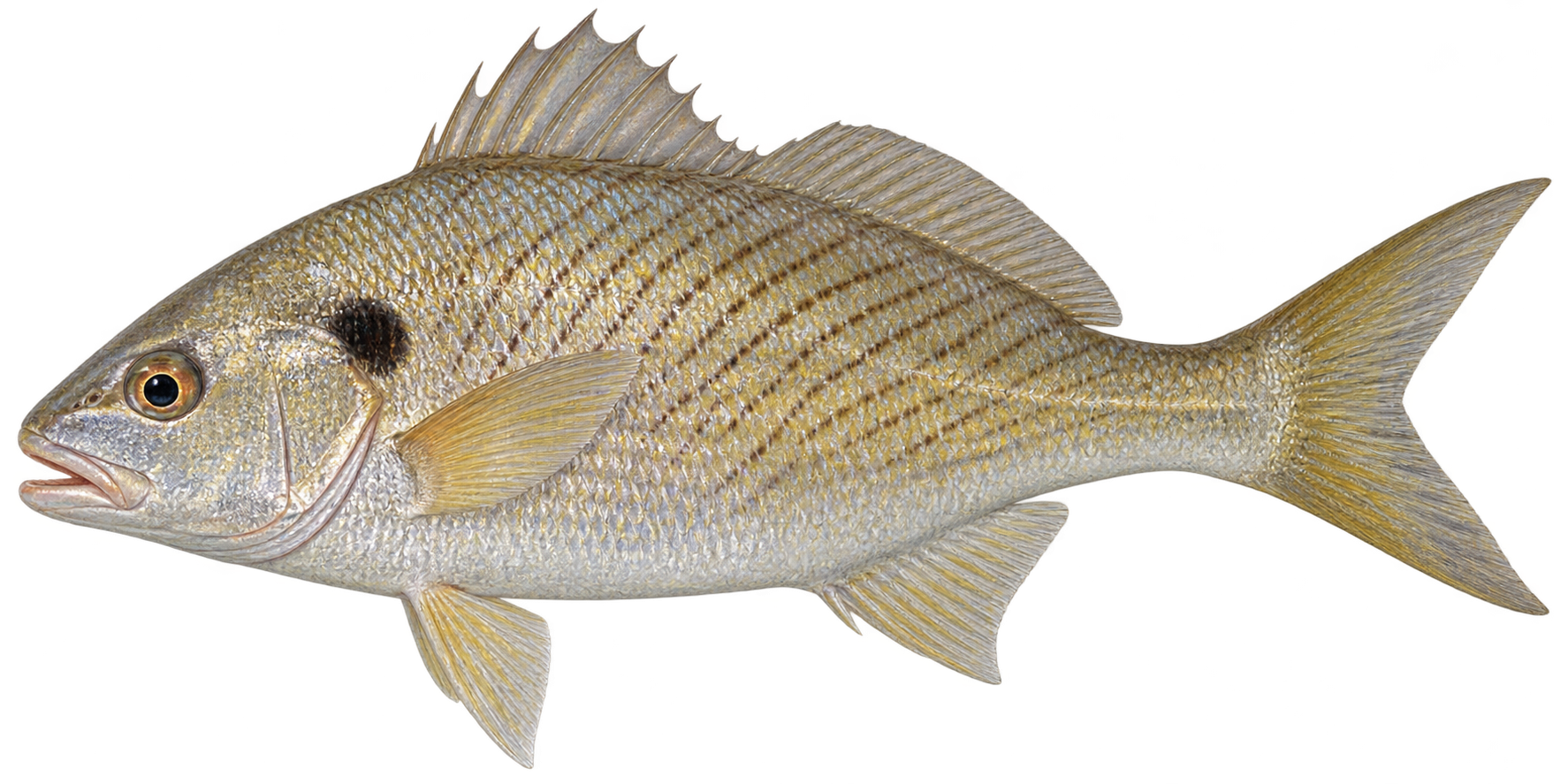
Spot have a conspicuous dark mark just behind the gill cover, brassy sides and a series of slanting dark lines across the upper body. Their forked tail is particularly useful: FWC identifies spot as Florida’s only drum with that tail shape. Atlantic croaker can look similar, so include the tail and shoulder in an identification photograph rather than cropping to the body color. FWC spot identification
The shoulder mark is not a red drum’s tail-base spot. Position is part of the diagnosis. Color and contrast may vary with light and water conditions, so record the whole combination of body shape, markings and tail.
Range and life history
Spot are coastal fishes that also use estuaries. Florida Museum notes that they enter nearshore rivers, creeks and canals. They belong in a regional coastal guide, but that does not make them a routine reef-dive encounter throughout the entire Vero Beach–Key Largo corridor. Their presence in Florida is not evidence of current abundance at a named Palm Beach site. Florida Museum spot overview
They feed on small invertebrates and organic material associated with the bottom. Adults move offshore to reproduce. A NOAA-hosted Gulf atlas describes spawning in the cooler part of the year; this is regional evidence, not an exact southeast Florida spawning calendar. Young stages connect offshore spawning grounds with coastal nursery habitat. NOAA-hosted spot life-history atlas
FWC lists a length reaching 14 inches without specifying total or fork length. Use that as a broad size reference only. It should not be converted into a precise measurement claim from a photograph.
Three memorable details
- Its short name points to a real feature: the dark shoulder mark.
- Among Florida drums, the forked tail is an unusually helpful clue.
- The breeding grounds are offshore even though much of the familiar habitat is coastal: one species uses more than one neighborhood.
Observation and harvest caution
Watch without stirring sediment or disturbing the bottom to expose prey. A small fish still deserves a clear escape route and an undisturbed nursery.
Rules checked November 12, 2026: FWC lists 50 spot per person daily in Atlantic state waters from Nassau through Miami-Dade counties, excluding Monroe. Monroe falls under the Gulf-state category, with a 100-pound daily allowance per person. The page lists no minimum size and year-round seasons, but gear, licenses and local closures still apply. Do not substitute the generic unregulated-fish rule. FWC spot and Atlantic croaker regulations
Blue Heron Bridge report
REEF’s Blue Heron Bridge / Phil Foster Park survey report includes Spot among species reported at this site. The cumulative volunteer survey record is not a guarantee of a sighting or evidence of current abundance. Blue Heron Bridge (BHB) is a Riviera Beach dive site at Phil Foster Park. Blue Heron Bridge species observation source.
Make your next dive happen
Dive With Us
Explore local charters and plan a dive suited to your experience.
View dive calendarTrain With Us
Build your fish identification, buoyancy and diving skills.
Explore trainingTravel With Us
Discover upcoming dive adventures and trip details.
Explore dive travelShop With Us
Browse equipment for your diving and ask our team for help choosing.
Explore dive gearReview current dates, availability, prices, inclusions and requirements on each listing before booking or buying.
Call us now
Ask about fish identification training
Reef Fish Identification
Ask about dates, prerequisites or your next step. An inquiry does not reserve a place. Please provide your own contact details; do not include medical, payment or a child's personal information.
We use these details to respond to your inquiry. This form does not sign you up for marketing.
Explore more with Stuart Scuba
Open Water course options · Advanced Adventure training · Technical training · Professional training · All courses · Local dives · Dive trips · Facebook · Instagram · YouTube
Your surface-interval essentials
Questions for Stuart Scuba? info@stuartscuba.com
Check the Stuart Scuba Weather Center · Play scuba trivia
Weather and wildlife vary. Confirm current conditions, trip requirements and departure details with the operator.
Plan Your Next Dive with Stuart Scuba
Dive With Us
Explore upcoming local charters and choose a dive that fits your experience.
Before you book
Check the individual listing for departure time, requirements and availability.
Travel With Us
Find upcoming dive adventures and start planning your next trip.
Plan your trip
Review dates, inclusions and trip details on the travel calendar.
Stay Connected with Stuart Scuba
 Follow pageShare
YouTube
SubscribeWatch & shareFollow on InstagramView & share post
Follow company news, training updates, and dive stories.
Follow on LinkedInGoogle Reviews
See Stuart Scuba’s current Google rating and review count below. Open the listing in Google Maps to browse customer reviews.



