

Fish identification archive / Spanish Hogfish
Spanish Hogfish
Bodianus rufus
I saw this
Spotted this marine animal? Share the guide with your dive buddies. Review your caption before posting.
For Instagram, copy the caption and link into your own post or message. Nothing is posted automatically and this does not record a verified sighting.
Fun facts for your next surface interval
- A first job in cleaning: juveniles remove parasites from larger fishes.
- A career change comes with growth: adults focus on larger bottom-dwelling prey.
- The menu needs hardware: strong canine teeth and throat plates help handle tough meals.
Florida and local context
Lake Worth Lagoon, Palm Beach County, Florida: Florida Museum verifies Bodianus rufus in Lake Worth Lagoon.
Documented regional presence is not a guarantee of an encounter or a measure of how common this animal is at your dive site.
How to recognize this animal
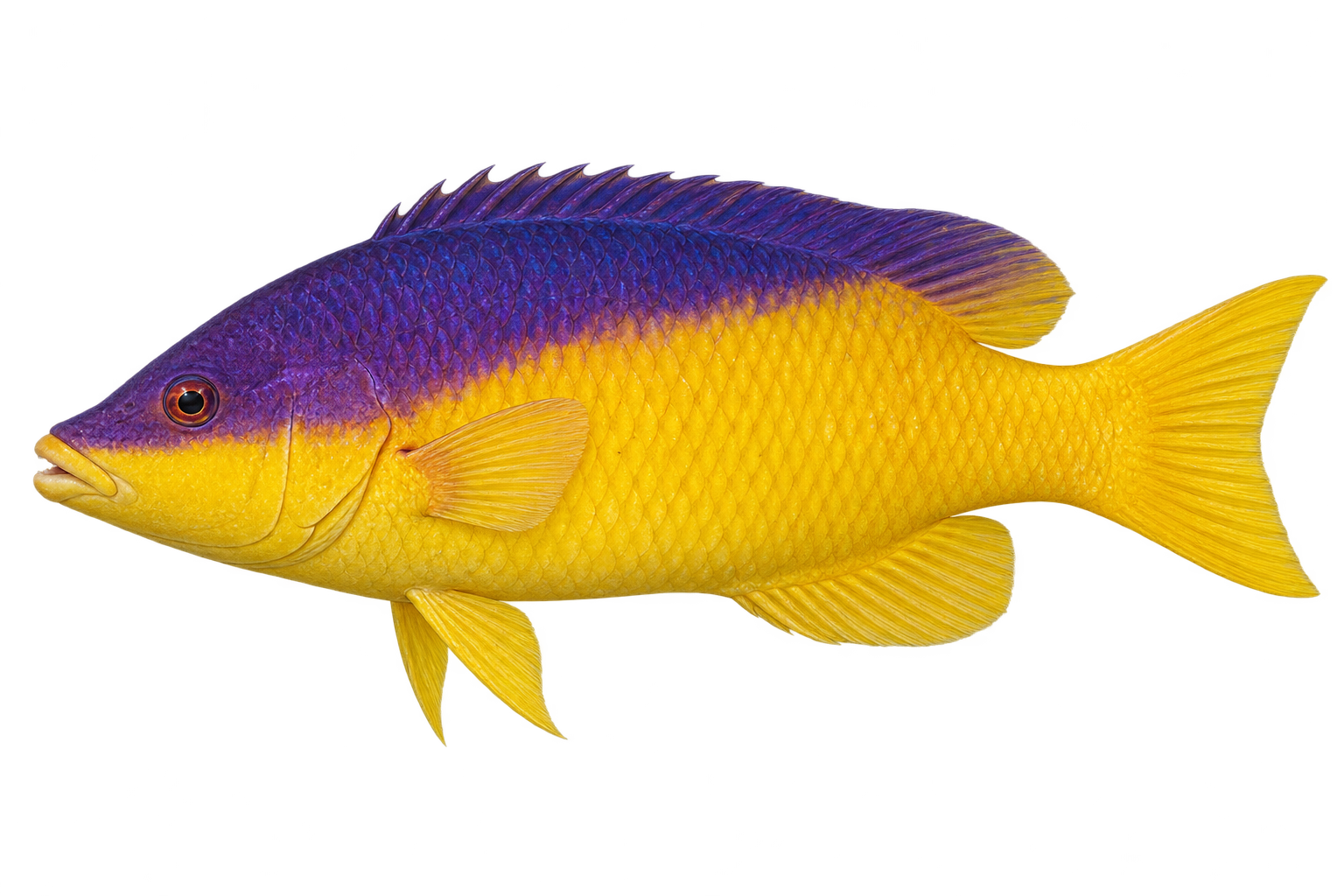
Spanish Hogfish is a robust, colorful wrasse with a pointed snout, thick lips and large scales. Adults are mostly yellow, with a blue-gray, purple or reddish upper front body and dorsal region. Young fish have a more sharply divided dark front and yellow rear. The continuous dorsal fin lacks the dramatic trailing spines associated with the larger food fish commonly called hogfish.
Size and life stages
The species can reach about 50 cm, although many observed fish are smaller. Published accounts often describe adults in the 20–40 cm range. Young cleaners are much smaller and show a different balance of dark and yellow. Use size and color phase together, but do not interpret an adult-sized drawing as a legal collection size or a guarantee about local fish.
Habitat and where to look
It inhabits coral and rocky reefs and also uses neighboring seagrass habitat. Juveniles can occupy cleaning areas around coral heads. A worthwhile search follows a fish's activity: a youngster near another fish may be cleaning, while an adult inspecting the bottom may be looking for prey. Avoid moving closer merely because the fish appears busy and less likely to leave.
Range and local context
Spanish Hogfish occurs in the western Atlantic, including southern Florida, the Gulf of Mexico and the Caribbean, extending to Brazil. Florida Museum verifies the species in Lake Worth Lagoon. This provides a documented Palm Beach County connection without implying it is equally frequent in every habitat. The geographic record is stronger than a promise about a specific dive or season.
What is on the menu?
Adults eat bottom-associated invertebrates, including crustaceans, mollusks, worms and echinoderms. Strong teeth and grinding structures help process tougher prey. Juveniles can obtain food by cleaning other fishes. The difference is a useful reason to watch rather than generalize: a small cleaner and a larger adult working the bottom are performing different jobs within the same species.
Daily habits and behavior
Spanish Hogfish is active during daylight. Young cleaners may attract clients with movements around a coral head, while adults spend more time investigating feeding surfaces. A larger fish pausing near a juvenile is not necessarily a hunting attempt. Give the interaction space and let its direction become clear instead of interrupting to get the two fishes into a closer photograph.
Mating and the next generation
This wrasse can change from female to male during its life. Spawning produces eggs that develop in open water rather than in a guarded nest. Social circumstances influence the sex-changing system, but a diver should not assign sex from size alone. A regional account of reproductive timing also does not establish a dependable Palm Beach spawning appointment.
Look-alikes and identification traps
The ordinary Hogfish, Lachnolaimus maximus, has a more pronounced snout and distinctive elongated front dorsal spines. Its harvest rules are not the rules for Spanish Hogfish. Spotfin Hogfish is another colorful Bodianus and has a different distribution of red, white and yellow markings. Start with the purple-and-yellow layout, then confirm the head and fin outline before choosing a name.
Observe without disturbing
Leave cleaning interactions undisturbed and avoid touching the coral head that provides their setting. Do not hand-feed an adult or turn over rubble to expose prey. Photograph the phase naturally present, keeping the entire dorsal outline visible when possible. If a young fish retreats into cover, wait at a respectful distance or move on rather than repeatedly drawing it back out.
Harvest, protection and eating safety
Restricted marine life: live collection only; no spearing
Can it be hunted or harvested?
Spanish Hogfish is regulated live ornamental marine life, not an ordinary food-fishing target. Spanish Hogfish has a 2–8-inch total-length slot; the rules for food-fish Hogfish (Lachnolaimus maximus) do not apply. A saltwater fishing license is required unless exempt. Fish must be landed and kept alive with adequate aeration or circulating water. Daily limit: five of this species within 20 marine-life organisms; possession: ten within 40. Recreational sale is prohibited.
Florida seasons and areas
No recreational closed months are listed for this species in the reviewed marine-life rules. Collection is prohibited within the designated Blue Heron Bridge dive site. Florida marine-life rules also apply in adjacent federal waters. Sanctuary no-take zones and other park or refuge restrictions can close otherwise eligible areas; check the exact site before collecting.
Can it be speared?
No. Spanish Hogfish is subject to marine-life live-landing and allowable-gear rules; spears are not authorized collection gear. Do not transfer the spearing permissions for Lachnolaimus maximus to this species.
Is it safe to eat?
This live-collection classification is not an eating-safety approval. No species-specific Florida consumption clearance was verified. Do not assume a fish is safe because it is small, colorful or absent from an advisory chart. Marine toxins can cause illness despite cooking; consult current local health guidance rather than using this identification page as permission to eat it.
Before you act: This recreational overview is not permission to collect or spear at your dive site. Confirm the species, date, management area, state or federal waters, gear, licenses and current local closures. Identification artwork cannot establish an identification or guarantee seafood safety.
Official rules and health guidance
- FWC: Recreational Marine Life
- Florida Administrative Code: current Marine Life chapter 68B-42
- FWC: Saltwater Recreational Licenses
- NOAA: Florida Keys Sanctuary Regulations
- Florida Administrative Code: Marine Life Gear 68B-42.007
- Florida Department of Health: Eating Healthy Seafood
- Florida Department of Health: Seafood Poisoning
- FDA/EPA: Advice about Eating Fish
Reviewed 2026-11-10. Rules and advisories can change; check the linked authorities before harvesting or eating.
Sources and review
Reviewed 2026-11-10.
Make your next dive happen
Dive With Us
Explore local charters and plan a dive suited to your experience.
View dive calendarTrain With Us
Build your fish identification, buoyancy and diving skills.
Explore trainingTravel With Us
Discover upcoming dive adventures and trip details.
Explore dive travelShop With Us
Browse equipment for your diving and ask our team for help choosing.
Explore dive gearReview current dates, availability, prices, inclusions and requirements on each listing before booking or buying.
Call us now
Ask about marine life identification
Marine Life Identification
Ask about dates, prerequisites or your next step. An inquiry does not reserve a place. Please provide your own contact details; do not include medical, payment or a child's personal information.
We use these details to respond to your inquiry. This form does not sign you up for marketing.
Explore more with Stuart Scuba
Open Water course options · Advanced Adventure training · Technical training · Professional training · All courses · Local dives · Dive trips · Facebook · Instagram · YouTube
Your surface-interval essentials
Questions for Stuart Scuba? info@stuartscuba.com
Check the Stuart Scuba Weather Center · Play scuba trivia
Weather and wildlife vary. Confirm current conditions, trip requirements and departure details with the operator.
Plan Your Next Dive with Stuart Scuba
Dive With Us
Explore upcoming local charters and choose a dive that fits your experience.
Before you book
Check the individual listing for departure time, requirements and availability.
Travel With Us
Find upcoming dive adventures and start planning your next trip.
Plan your trip
Review dates, inclusions and trip details on the travel calendar.
Stay Connected with Stuart Scuba
 Follow pageShare
YouTube
SubscribeWatch & shareFollow on InstagramView & share post
Follow company news, training updates, and dive stories.
Follow on LinkedInGoogle Reviews
See Stuart Scuba’s current Google rating and review count below. Open the listing in Google Maps to browse customer reviews.



