

Fish identification archive / Spanish Grunt
Spanish Grunt
Haemulon macrostoma
I saw this
Spotted this marine animal? Share the guide with your dive buddies. Review your caption before posting.
For Instagram, copy the caption and link into your own post or message. Nothing is posted automatically and this does not record a verified sighting.
Fun facts for your next surface interval
- Its black-and-silver stripes sit above a surprisingly dark belly.
- Sea urchins appear on this grunt’s menu alongside crustaceans.
- Older guides spell the scientific name macrostomum; the current catalog uses macrostoma.
Florida and local context
Florida regional range; potential Lake Worth Lagoon occurrence: Florida occurrence is documented by the linked species references. The Lake Worth Lagoon checklist includes this species but leaves the Verified cell blank; its lagoon occurrence is treated here as potential, not confirmed.
Documented regional presence is not a guarantee of an encounter or a measure of how common this animal is at your dive site.
How to recognize this animal
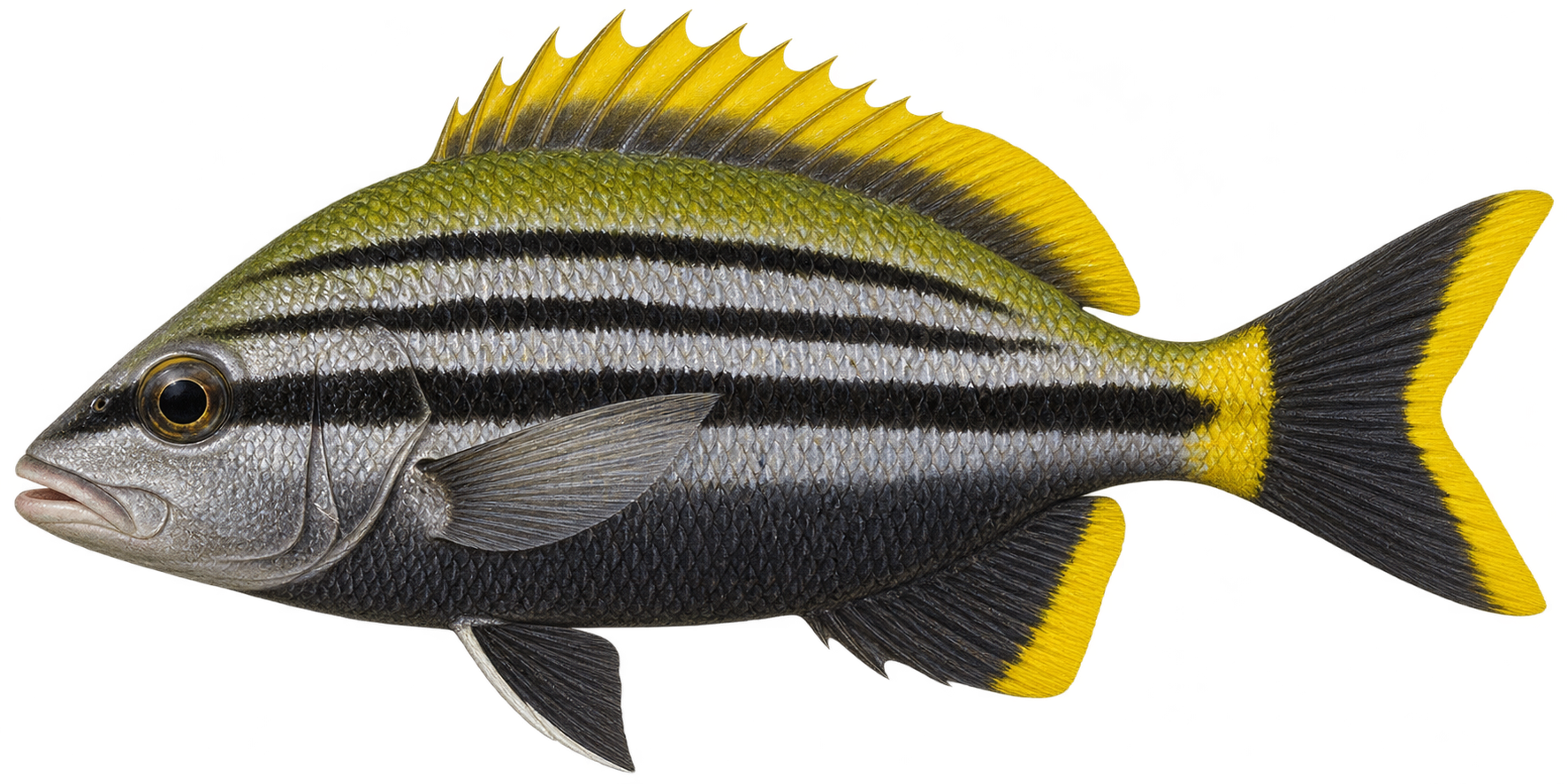
Spanish grunts have a dramatically divided color pattern. Several strong black stripes cross the silvery upper body, while the lower half becomes very dark. Yellow-green along the upper back and broad yellow margins on the dark tail and anal fin add contrast. The thickest stripe passes through the eye, and a yellow saddle sits above the tail base.
Size and life stages
Adults can reach about 18 inches, or 45 centimeters. Young fish carry three dark stripes, with the middle stripe converging on the lower one toward the tail. The dark tail-base mark is wedge-shaped. Because the dark lower body develops with growth, a juvenile should not be rejected simply because it lacks the adult's striking black belly.
Habitat and where to look
Clear-water reefs and hard-bottom areas are the principal habitats. Published records span roughly 1 to 99 meters, encompassing both shallow reef settings and depths well beyond ordinary recreational dives. FishBase describes dense schools. Look for the striped body pattern within a group, rather than deciding that every grunt sharing the same shelter must be the same species.
Range and local context
The documented range includes southern Florida, Bermuda and the Caribbean; the current taxonomic catalog extends it south to Brazil. The Lake Worth Lagoon checklist includes Spanish grunt without a Verified mark. Its Florida occurrence supports inclusion in this regional guide, while the lagoon entry remains potential rather than confirmed evidence for a particular Palm Beach dive site.
What is on the menu?
Crustaceans and sea urchins are recorded prey. This is a bottom-associated animal feeder, even though a resting school may appear suspended above the reef. Its feeding role differs from an algae-grazing fish with a similar dark-and-yellow appearance. Seeing the fish near an urchin does not by itself establish predation; actual biting or handling would be better evidence.
Daily habits and behavior
Dense schooling can make the contrasting stripes resemble a single moving pattern. Adult coloration remains recognizable when several fish overlap, but the yellow tail edges are easiest to check on an individual at the school margin. Schooling is documented behavior; it is not a promise of large groups at every Florida site or in every season.
Mating and the next generation
Spanish grunts are egg layers, with distinct pairing reported during breeding and pelagic eggs and larvae in the species references. The adults' reef association therefore differs from the habitat of their earliest life stages. The sources reviewed do not establish a dependable Palm Beach spawning calendar, so no month-by-month reproductive claim is added here.
Look-alikes and identification traps
Black margates are deep-bodied and dark-finned but show a broad vertical dark band instead of the Spanish grunt's strong horizontal stripes. Cottonwicks have a dark upper-back stripe and black tail pattern on a much paler body. The accepted spelling is Haemulon macrostoma; older records using macrostomum are retained as a synonym, not a second species.
Observe without disturbing
Stay outside a school's shelter route and frame one fish broadside when possible. Include the belly, tail edge and upper-back saddle in your photograph because each contributes to identification. Do not chase fish into a darker crevice to obtain contrast. Log uncertainty if only a striped head was visible or the fin margins were hidden.
Harvest, protection and eating safety
Harvest may be allowed; limits and site restrictions apply
Can it be hunted or harvested?
In Florida state waters this species is subject to the default recreational limit of two fish or 100 pounds per person per day, whichever is greater, unless a special area rule applies. No statewide species-specific minimum size is listed in the reviewed rules. Use lawful gear and hold the required saltwater fishing license unless exempt. “Unregulated” does not mean unrestricted or permission to harvest at a dive site. In Biscayne National Park, all grunts count toward the 10-fish per-person aggregate for listed species; other species-specific limits still apply. Transit through the park above that aggregate is prohibited.
Florida seasons and areas
No species-specific annual Florida state-water closed months were identified in the reviewed rules. That is not an all-waters opening: park, sanctuary, refuge and other site closures can apply, and federal rules must be checked for the coast and trip. Verify the actual fishing location and current notices before taking fish.
Can it be speared?
Potentially yes where otherwise lawful: this species is not on FWC’s no-spearing list. Size, bag, area and gear rules still apply. Spearfishing is prohibited within 100 yards of a public swimming beach, a commercial or public fishing pier, or a bridge portion where public fishing is allowed, and in additional listed areas. No powerheads, bangsticks or rebreathers. This is not permission to spear at Blue Heron Bridge or another dive site.
Is it safe to eat?
No unconditional safe-to-eat claim can be made. Check Florida DOH guidance for the exact fish and catch area, including mercury advice for children and people who are pregnant or may become pregnant. Legal harvest does not establish food safety, and cooking is not a reliable way to eliminate all naturally occurring marine toxins. Do not transfer a consumption table for white grunt to this different grunt species.
Before you act: This recreational overview is not permission to collect or spear at your dive site. Confirm the species, date, management area, state or federal waters, gear, licenses and current local closures. Identification artwork cannot establish an identification or guarantee seafood safety.
Official rules and health guidance
- FWC default recreational bag and legal gear
- FWC recreational marine-life rules
- Florida marine-life rule text mirror; checked against official index
- FWC Biscayne National Park exceptions
- FWC spearing species and location restrictions
- Florida DOH current fish-consumption advisory portal
- Florida DOH seafood-poisoning guidance
- FDA advice about eating fish
- FWC saltwater recreational licensing
Reviewed 2026-11-10. Rules and advisories can change; check the linked authorities before harvesting or eating.
Sources and review
Reviewed 2026-11-10.
Make your next dive happen
Dive With Us
Explore local charters and plan a dive suited to your experience.
View dive calendarTrain With Us
Build your fish identification, buoyancy and diving skills.
Explore trainingTravel With Us
Discover upcoming dive adventures and trip details.
Explore dive travelShop With Us
Browse equipment for your diving and ask our team for help choosing.
Explore dive gearReview current dates, availability, prices, inclusions and requirements on each listing before booking or buying.
Call us now
Ask about marine life identification
Marine Life Identification
Ask about dates, prerequisites or your next step. An inquiry does not reserve a place. Please provide your own contact details; do not include medical, payment or a child's personal information.
We use these details to respond to your inquiry. This form does not sign you up for marketing.
Explore more with Stuart Scuba
Open Water course options · Advanced Adventure training · Technical training · Professional training · All courses · Local dives · Dive trips · Facebook · Instagram · YouTube
Your surface-interval essentials
Questions for Stuart Scuba? info@stuartscuba.com
Check the Stuart Scuba Weather Center · Play scuba trivia
Weather and wildlife vary. Confirm current conditions, trip requirements and departure details with the operator.
Plan Your Next Dive with Stuart Scuba
Dive With Us
Explore upcoming local charters and choose a dive that fits your experience.
Before you book
Check the individual listing for departure time, requirements and availability.
Travel With Us
Find upcoming dive adventures and start planning your next trip.
Plan your trip
Review dates, inclusions and trip details on the travel calendar.
Stay Connected with Stuart Scuba
 Follow pageShare
YouTube
SubscribeWatch & shareFollow on InstagramView & share post
Follow company news, training updates, and dive stories.
Follow on LinkedInGoogle Reviews
See Stuart Scuba’s current Google rating and review count below. Open the listing in Google Maps to browse customer reviews.



