

Fish identification archive / Southern Stingray
Southern Stingray
Hypanus americanus
I saw this
Spotted this marine animal? Share the guide with your dive buddies. Review your caption before posting.
For Instagram, copy the caption and link into your own post or message. Nothing is posted automatically and this does not record a verified sighting.
Fun facts for your next surface interval
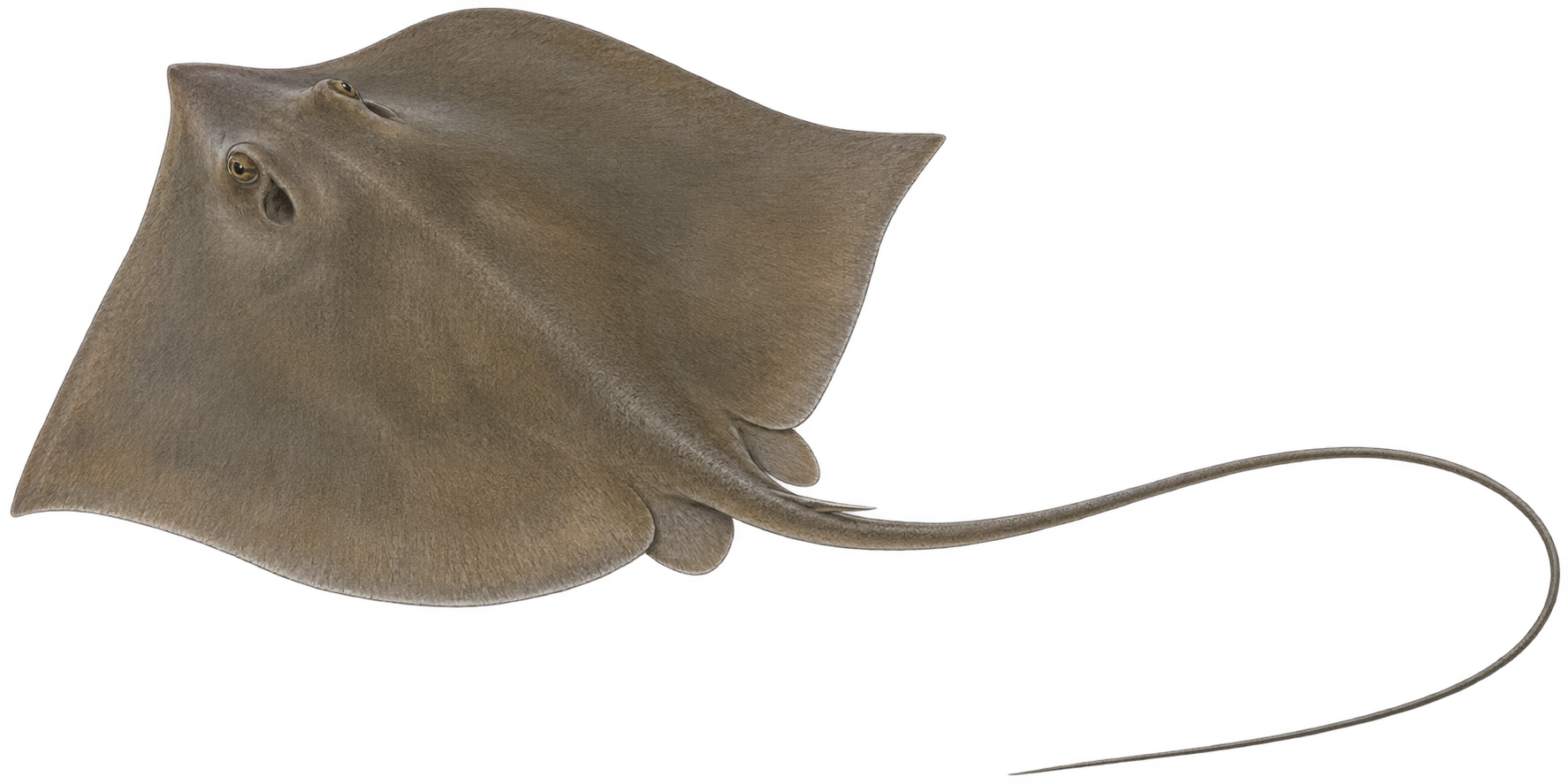
- Those broad wings are enlarged pectoral fins joined to the body.
- Breathing openings behind the eyes let it take in water while resting on the sand.
- Young develop inside the mother, receiving uterine milk after their initial yolk supply.
Florida and local context
Florida marine waters; broader Florida scope: FWC documents the species in Florida waters. The Lake Worth Lagoon checklist lists the older name Dasyatis americana without a verified mark; no Palm Beach frequency claim is made.
Documented regional presence is not a guarantee of an encounter or a measure of how common this animal is at your dive site.
How to recognize this animal
The southern stingray has a broad, angular, diamond-shaped disc with a plain brown, olive-gray or gray upper surface. Its eyes and breathing openings sit on top; the mouth and gill slits are underneath. A long, slender tail extends behind the disc and carries a defensive spine. The wings are enlarged pectoral fins joined to the head and body, not separate limbs.
Size and life stages
Size is best described by disc width, measured from wingtip to wingtip, rather than by a tail-inclusive length. Large females may reach around 5 feet across; some references report up to 6.5 feet, or 2 meters. Females become larger than males. These are species-level upper sizes, not a claim about the average ray seen on a Florida dive.
Habitat and where to look
Sandy or silty flats, seagrass areas and sand beside reefs provide feeding and resting habitat. A ray may settle partly beneath a thin layer of sediment, leaving its outline difficult to see. Scan the bottom before approaching a sandy patch. During a dive, good buoyancy is safer and less disruptive than kneeling where an animal may be concealed.
Range and local context
Southern stingrays occur in the western Atlantic, including Florida, the Gulf of Mexico and the Caribbean. This profile uses that Florida-wide distribution. The Lake Worth Lagoon checklist includes the former name Dasyatis americana without an explicit verified mark, so it is not used here to claim a confirmed local sighting. Distribution and encounter frequency are different kinds of information.
What is on the menu?
Crustaceans, mollusks, worms and small fishes are among its prey. The ray searches the bottom using sensory information that includes weak electrical signals from animals in the substrate. Feeding can leave disturbed patches or pits in sand. Watch from outside its route rather than following close behind or exposing buried prey to prolong a feeding event.
Daily habits and behavior
Water can enter through the spiracles behind the eyes while the ray rests on the bottom, allowing breathing without relying on water taken through a buried mouth. Its tail spine is a defensive structure. Do not crowd the tail or assume a resting ray is unaware of you. Leave a clear escape route and let it choose whether to remain.
Mating and the next generation
Southern stingrays give birth to live young. Developing embryos first use yolk and later receive nourishing secretions from the mother's uterus, often described as uterine milk. Litter size varies, with reports commonly including two to ten young. That reproductive method is different from the external egg cases produced by skates, despite the animals' superficially similar flattened shapes.
Look-alikes and identification traps
Atlantic stingrays are generally smaller and have rounder disc corners with a more strongly projecting snout. Southern stingrays have the broader angular diamond outline. Spotted eagle rays have distinct white spotting, a different head and a different swimming silhouette. Compare disc shape and markings rather than identifying every plain brown ray by its location or apparent size alone.
Observe without disturbing
Do not feed, ride, touch or chase a ray. Keep enough room for its whole disc and long tail to pass without contact with a diver or camera. In shallow wading areas, follow local guidance for avoiding concealed rays. The separate harvest section addresses legal distinctions; identification and lawful possession still do not establish that a ray is safe to eat.
Harvest, protection and eating safety
Harvest allowed under default limits; not a protected manta or eagle ray
Can it be hunted or harvested?
FWC lists Southern Stingray as an unregulated recreational species, meaning no species-specific state size or bag rule, not unlimited take. In Florida state waters the default is two fish or 100 pounds per person daily, whichever is more. A saltwater license is required unless exempt. Identify the ray positively: this permission does not apply to protected manta rays or spotted eagle rays.
Florida seasons and areas
No annual species-specific harvest closure is listed by FWC for this ray in Florida state waters. Do not treat that as permission in every park, refuge or federal protected area. Local closures still apply, including Biscayne National Park’s mapped bonefish pre-spawning area, closed to fishing and fish possession March 1–May 31 with a properly stowed continuous-transit exception. Check Florida Keys sanctuary zones before fishing. Western Dry Rocks’ designated one-square-mile area is closed to all fishing April 1–July 31 annually.
Can it be speared?
Allowed only where spearfishing is lawful and the fish meets all size, bag and seasonal rules. Florida exclusions include within 100 yards of public swimming beaches, fishing piers and bridges open to fishing, the specified jetty buffer, state-park waters, and Monroe County from Long Key north to the Miami-Dade line. Florida prohibits powerheads and rebreathers under its spearing rules. Check sanctuary and other site restrictions before entering the water.
Is it safe to eat?
Legal harvest is not a food-safety clearance. No species-specific Florida meal limit for southern stingray was verified here, so do not borrow the Atlantic or bluntnose stingray limits. Check Florida DOH guidance for the exact species and location before deciding to eat one. FDA/EPA advises its pregnancy, breastfeeding and child audiences to eat only one serving and no other fish that week when locally caught fish has no advisory. Chill promptly and cook to 145°F. Avoid handling the sharp defensive tail spine.
Before you act: This recreational overview is not permission to collect or spear at your dive site. Confirm the species, date, management area, state or federal waters, gear, licenses and current local closures. Identification artwork cannot establish an identification or guarantee seafood safety.
Official rules and health guidance
- FWC southern stingray identification and regulatory category
- FWC default recreational limits and gear
- FWC species and location restrictions on spearing
- FWC recreational saltwater licenses and exemptions
- FWC Biscayne National Park limits and closed areas
- NOAA Florida Keys sanctuary zones
- Florida DOH seafood-consumption guidance
- Florida DOH location-specific fish-advisory search
- FDA safe seafood handling and cooking
- FDA/EPA advice for pregnancy, breastfeeding and children
- FWC Western Dry Rocks seasonal closure
Reviewed 2026-11-10. Rules and advisories can change; check the linked authorities before harvesting or eating.
Sources and review
Reviewed 2026-11-10.
- Florida occurrence evidence
- Florida Museum: Southern Stingray
- Species biology, taxonomy or Florida occurrence reference
- Florida Museum: Lake Worth Lagoon checklist, verified marks distinguished from listed species
- Reviewed taxonomy and former scientific names
- Reviewed taxonomy and former scientific names
Make your next dive happen
Dive With Us
Explore local charters and plan a dive suited to your experience.
View dive calendarTrain With Us
Build your fish identification, buoyancy and diving skills.
Explore trainingTravel With Us
Discover upcoming dive adventures and trip details.
Explore dive travelShop With Us
Browse equipment for your diving and ask our team for help choosing.
Explore dive gearReview current dates, availability, prices, inclusions and requirements on each listing before booking or buying.
Call us now
Ask about marine life identification
Marine Life Identification
Ask about dates, prerequisites or your next step. An inquiry does not reserve a place. Please provide your own contact details; do not include medical, payment or a child's personal information.
We use these details to respond to your inquiry. This form does not sign you up for marketing.
Explore more with Stuart Scuba
Open Water course options · Advanced Adventure training · Technical training · Professional training · All courses · Local dives · Dive trips · Facebook · Instagram · YouTube
Your surface-interval essentials
Questions for Stuart Scuba? info@stuartscuba.com
Check the Stuart Scuba Weather Center · Play scuba trivia
Weather and wildlife vary. Confirm current conditions, trip requirements and departure details with the operator.
Plan Your Next Dive with Stuart Scuba
Dive With Us
Explore upcoming local charters and choose a dive that fits your experience.
Before you book
Check the individual listing for departure time, requirements and availability.
Travel With Us
Find upcoming dive adventures and start planning your next trip.
Plan your trip
Review dates, inclusions and trip details on the travel calendar.
Stay Connected with Stuart Scuba
 Follow pageShare
YouTube
SubscribeWatch & shareFollow on InstagramView & share post
Follow company news, training updates, and dive stories.
Follow on LinkedInGoogle Reviews
See Stuart Scuba’s current Google rating and review count below. Open the listing in Google Maps to browse customer reviews.



