

Fish identification archive / Southern Quahog
Southern Quahog
Mercenaria campechiensis · Veneridae
I saw this
Spotted this marine life? Share the guide with your dive buddies. Review your caption before posting.
For Instagram, copy the caption and link into your own post or message. Nothing is posted automatically and this does not record a verified sighting.
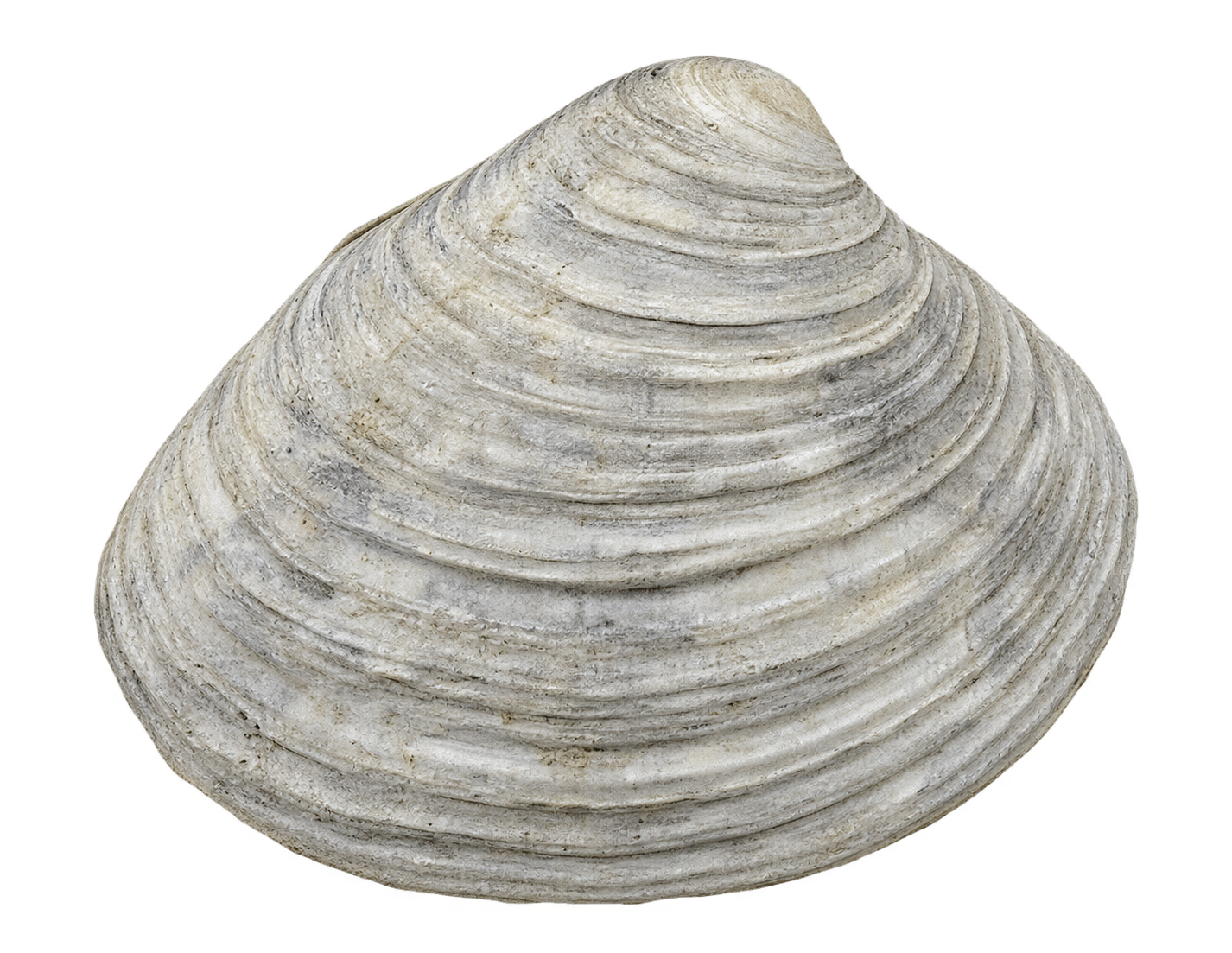
The southern quahog, Mercenaria campechiensis, is a thick-shelled bivalve with an inflated, rounded-triangular outline. Its concentric ridges often remain conspicuous across the middle of the valve. Pale gray or dull white shells can look understated beside brightly patterned beach shells, but their shape and sculpture tell a useful identification story.
Atlantic Florida context
This is not a Gulf-only species. UF/IFAS describes the southern hard clam as native throughout Florida and documents its occurrence alongside the northern quahog in the Indian River Lagoon. Its habitats include sediment in shallow coastal water, with records extending into open coastal waters. That range supports an Atlantic Florida profile without implying that it is routinely visible on offshore coral reefs.
Around the Vero Beach–Key Largo corridor, distinguish a regional species record from a confirmed local encounter. A photograph of a shell carried onto a beach cannot establish where a living clam was growing. Record whether a specimen was alive in the bottom, an empty shell underwater or a shell found on shore.
Life beneath the sediment
The muscular foot allows a hard clam to burrow. Paired siphons connect the buried animal with water above the bottom: one draws water in and the other carries it out. Suspended microscopic plants and organic particles provide food. The animal does not need to leave its burial site to pursue a meal.
Hard clams link the water column and seabed through feeding and the material they deposit. This role is one reason Florida researchers are interested in clam restoration. It should not be simplified into a claim that one clam will make polluted water safe for swimming or seafood collection.
Reproduction and lookalikes
FWC describes spring and fall spawning for Florida hard clams. Northern and southern quahogs can interbreed where they occur together, including the Indian River Lagoon. Strong ridges favor a southern-quahog identification, while a smoother central shell surface often suggests the northern species. However, these are tendencies rather than a perfect identification test. UF/IFAS specifically warns that overlapping shell features and hybrids can defeat visual identification.
A careful encounter
Photograph exposed features without excavating a live clam or pulling up seagrass. If identification remains uncertain, a genus-level record is better than a confident mistake. Current shellfish harvest-area classifications, licenses and local restrictions are separate from identification. Follow the linked official rules before any collection, and never treat a field-guide entry as permission to remove a living animal.
Florida DEP’s 2014 St. Lucie Inlet Preserve animal inventory provides an additional dated local record.
References
Collection and shellfish safety
FWC regulates hard-clam harvest, including size, gear and bag requirements. Live clams may be taken only from designated approved or conditionally approved shellfish areas that are currently open. Check the exact location and current closure status before any collection. Neither this illustration nor identification of a clam establishes that it is safe to eat. FWC live-shell collection guidance and FWC hard-clam and oyster rules. Official guidance reviewed November 12, 2026; no location-specific harvest or sanitation clearance is given.
Make your next dive happen
Dive With Us
Explore local charters and plan a dive suited to your experience.
View dive calendarTrain With Us
Build your fish identification, buoyancy and diving skills.
Explore trainingTravel With Us
Discover upcoming dive adventures and trip details.
Explore dive travelShop With Us
Browse equipment for your diving and ask our team for help choosing.
Explore dive gearReview current dates, availability, prices, inclusions and requirements on each listing before booking or buying.
Call us now
Ask about fish identification training
Reef Fish Identification
Ask about dates, prerequisites or your next step. An inquiry does not reserve a place. Please provide your own contact details; do not include medical, payment or a child's personal information.
We use these details to respond to your inquiry. This form does not sign you up for marketing.
Explore more with Stuart Scuba
Open Water course options · Advanced Adventure training · Technical training · Professional training · All courses · Local dives · Dive trips · Facebook · Instagram · YouTube
Your surface-interval essentials
Questions for Stuart Scuba? info@stuartscuba.com
Check the Stuart Scuba Weather Center · Play scuba trivia
Weather and wildlife vary. Confirm current conditions, trip requirements and departure details with the operator.
Plan Your Next Dive with Stuart Scuba
Dive With Us
Explore upcoming local charters and choose a dive that fits your experience.
Before you book
Check the individual listing for departure time, requirements and availability.
Travel With Us
Find upcoming dive adventures and start planning your next trip.
Plan your trip
Review dates, inclusions and trip details on the travel calendar.
Stay Connected with Stuart Scuba
 Follow pageShare
YouTube
SubscribeWatch & shareFollow on InstagramView & share post
Follow company news, training updates, and dive stories.
Follow on LinkedInGoogle Reviews
See Stuart Scuba’s current Google rating and review count below. Open the listing in Google Maps to browse customer reviews.



