

Fish identification archive / Slippery Dick
Slippery Dick
Halichoeres bivittatus
I saw this
Spotted this marine animal? Share the guide with your dive buddies. Review your caption before posting.
For Instagram, copy the caption and link into your own post or message. Nothing is posted automatically and this does not record a verified sighting.
Fun facts for your next surface interval
- Its scientific name bivittatus points to the two-striped look.
- A striped youngster and a green-and-pink adult can be the same species.
- Sand can be a hiding place, so a disappearing wrasse has not necessarily swum far away.
Florida and local context
Lake Worth Lagoon / Blue Heron Bridge, Palm Beach County: Florida Museum checklist explicitly marks this species verified. This documents occurrence, not local abundance.
Documented regional presence is not a guarantee of an encounter or a measure of how common this animal is at your dive site.
How to recognize this animal
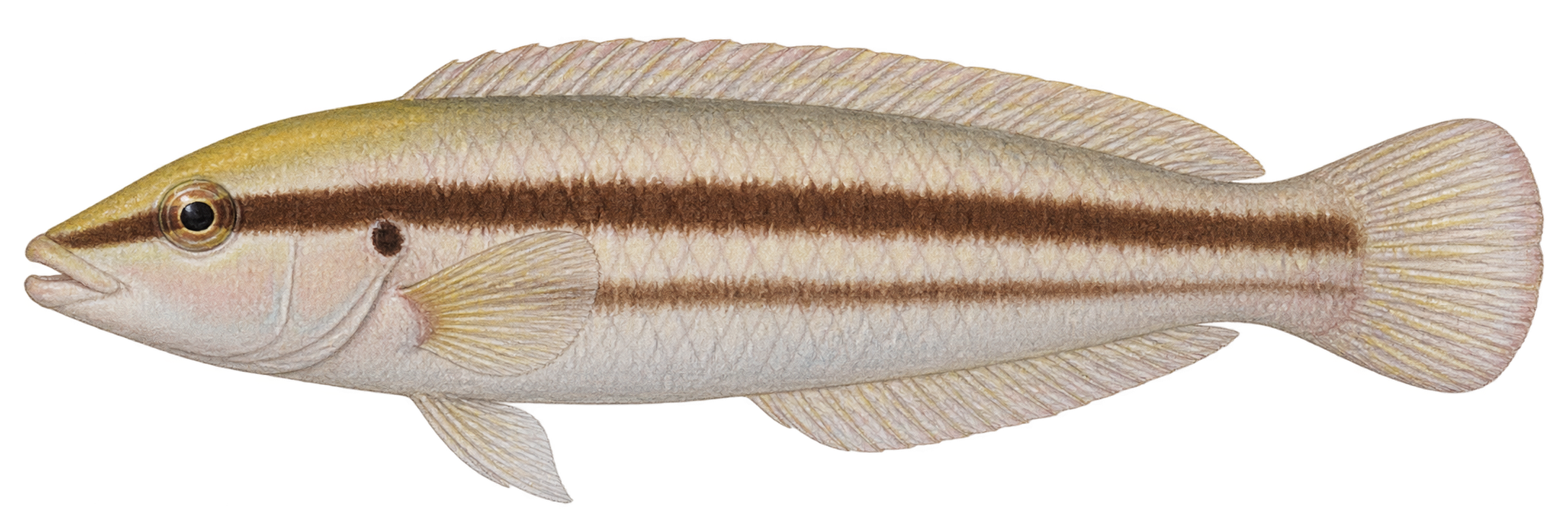
The memorably named slippery dick is a wrasse with an identification challenge built into its life history. Initial-phase fish are pale with two dark lengthwise stripes, the stronger one passing through the eye. Terminal-phase adults become greenish with pink markings. Look for the small dark mark near the upper rear corner of the gill cover as another supporting clue.
Size and life stages
The species reaches approximately 14 inches, or 35 centimeters, in total length, although many fish encountered by divers are smaller. Body length and color phase should be recorded separately. A little striped individual is not automatically a different species from a larger green one. Photographing the entire fish preserves tail shape and both stripes for a later comparison.
Habitat and where to look
It uses reefs, seagrass and adjacent sand or rubble. These varied habitats make it worth watching the bottom during the quieter sections of a dive, not just at a colorful reef ledge. A wrasse moving among grass blades may disappear from view without leaving the area. Wait for a natural opening rather than brushing vegetation aside.
Range and local context
This is a western Atlantic species with a range that includes Florida, the Gulf region and the Caribbean. Florida Museum explicitly verifies it in Lake Worth Lagoon. That local evidence is useful for a Palm Beach identification guide, while remaining distinct from a claim about today's conditions, the best season to see it or its abundance at any particular site.
What is on the menu?
Slippery dicks search for small bottom-living animals, including crustaceans, worms and mollusks. The small mouth and mobile jaws are suited to picking food from the substrate. Follow the direction of a feeding pass with your eyes rather than following so closely that the fish must change course. An unhurried observation may reveal several different bites in succession.
Daily habits and behavior
Like other sand-burying Halichoeres wrasses, it can use the substrate as shelter. Color also changes as fish develop, so the adult green-and-pink pattern and the familiar double stripes belong in the same mental identification file. Never try to demonstrate burial by chasing a wrasse; a natural retreat is enough reason to leave that patch undisturbed.
Mating and the next generation
Reproduction involves eggs released into the water and a pelagic larval stage. Wrasse color phases are connected with development and reproductive biology, but an underwater glance does not reveal every individual's reproductive history. Use initial phase and terminal phase as descriptions of visible appearance, and avoid assigning a precise age or claiming that you watched a sex change.
Look-alikes and identification traps
A juvenile yellowhead wrasse has a blue lengthwise stripe on yellow rather than the slippery dick's characteristic pair of dark stripes. Other small wrasses remain possible when colors are muted. Check the cheek, gill-cover mark and lower stripe together. The unusual common name is memorable, but it is no substitute for checking the fish itself.
Observe without disturbing
Maintain buoyancy above sand and seagrass, keep your hands out of hiding places, and let a moving fish pass. A short sequence of images may capture both stripes better than one blurred frame. For the Stuart Scuba archive, a sighting with a date, approximate depth and visible identification marks is more useful than an unsupported claim of certainty.
Harvest, protection and eating safety
Restricted marine life: live collection only; no spearing
Can it be hunted or harvested?
Slippery Dick (Halichoeres bivittatus) is restricted tropical ornamental marine life, not an ordinary food-fishing species or a blanket no-take species. Where collection is lawful, a saltwater fishing license is required unless exempt. Land and keep the fish alive with adequate circulation or aeration. No species-specific size limit is listed. Daily limit: five of this species within 20 marine-life organisms total per person. Two-day possession maximum: ten of this species within 40 organisms total. Recreational sale is prohibited.
Florida seasons and areas
No annual recreational closed months are listed for this marine-life species. Collection is prohibited within the designated Blue Heron Bridge dive-site boundary and throughout Biscayne National Park. Florida marine-life rules also apply in adjacent federal waters on both coasts. Check the exact sanctuary, park and refuge zone before collecting. Western Dry Rocks’ designated one-square-mile area is closed to all fishing April 1–July 31 annually.
Can it be speared?
No. Spears are not authorized recreational gear for this regulated tropical marine-life fish. Use only lawful live-collection methods, such as permitted hand-held, barrier or drop nets or a slurp gun, and comply with the live-landing requirement.
Is it safe to eat?
Not recommended as a food target. This species is regulated for live collection, and this guide does not certify it as safe to eat. Check Florida DOH guidance before eating any locally caught fish. Cooking does not remove all marine toxins, and legal collection is not evidence of food safety.
Before you act: This recreational overview is not permission to collect or spear at your dive site. Confirm the species, date, management area, state or federal waters, gear, licenses and current local closures. Identification artwork cannot establish an identification or guarantee seafood safety.
Official rules and health guidance
- FWC recreational marine-life rules
- FWC recreational saltwater licenses and exemptions
- FWC Biscayne National Park limits and closed areas
- NOAA Florida Keys sanctuary zones
- Florida Administrative Code 68B-42.007: marine-life gear
- Florida DOH seafood-consumption guidance
- Florida DOH ciguatera and other seafood poisoning
- FWC Western Dry Rocks seasonal closure
Reviewed 2026-11-10. Rules and advisories can change; check the linked authorities before harvesting or eating.
Sources and review
Reviewed 2026-11-10.
Make your next dive happen
Dive With Us
Explore local charters and plan a dive suited to your experience.
View dive calendarTrain With Us
Build your fish identification, buoyancy and diving skills.
Explore trainingTravel With Us
Discover upcoming dive adventures and trip details.
Explore dive travelShop With Us
Browse equipment for your diving and ask our team for help choosing.
Explore dive gearReview current dates, availability, prices, inclusions and requirements on each listing before booking or buying.
Call us now
Ask about marine life identification
Marine Life Identification
Ask about dates, prerequisites or your next step. An inquiry does not reserve a place. Please provide your own contact details; do not include medical, payment or a child's personal information.
We use these details to respond to your inquiry. This form does not sign you up for marketing.
Explore more with Stuart Scuba
Open Water course options · Advanced Adventure training · Technical training · Professional training · All courses · Local dives · Dive trips · Facebook · Instagram · YouTube
Your surface-interval essentials
Questions for Stuart Scuba? info@stuartscuba.com
Check the Stuart Scuba Weather Center · Play scuba trivia
Weather and wildlife vary. Confirm current conditions, trip requirements and departure details with the operator.
Plan Your Next Dive with Stuart Scuba
Dive With Us
Explore upcoming local charters and choose a dive that fits your experience.
Before you book
Check the individual listing for departure time, requirements and availability.
Travel With Us
Find upcoming dive adventures and start planning your next trip.
Plan your trip
Review dates, inclusions and trip details on the travel calendar.
Stay Connected with Stuart Scuba
 Follow pageShare
YouTube
SubscribeWatch & shareFollow on InstagramView & share post
Follow company news, training updates, and dive stories.
Follow on LinkedInGoogle Reviews
See Stuart Scuba’s current Google rating and review count below. Open the listing in Google Maps to browse customer reviews.



