

Fish identification archive / Silver Porgy
Silver Porgy
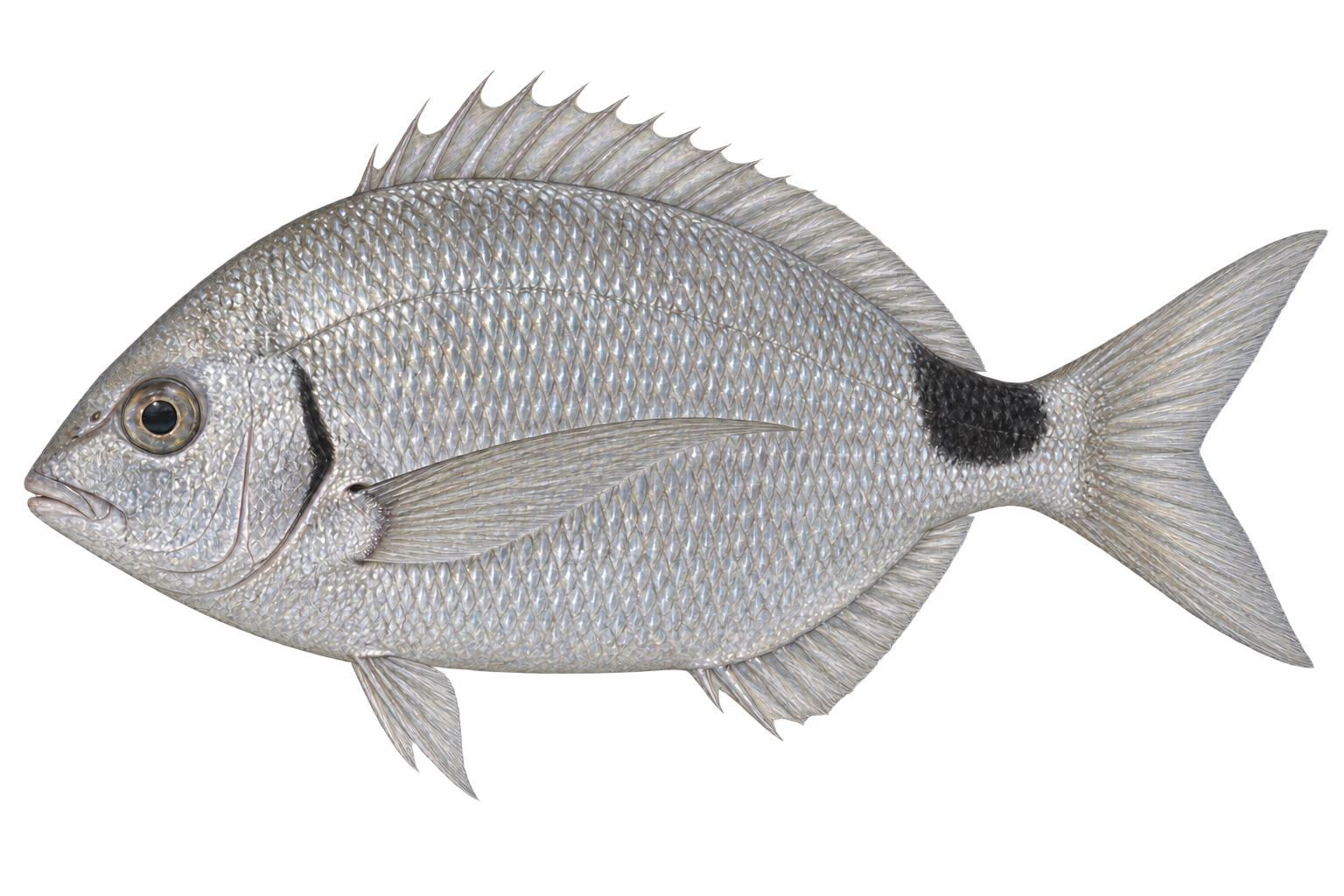
Diplodus caudimacula
Fun facts for your next surface interval
- Its tail-base spot sits mainly above the lateral line, an unusually useful small detail for an otherwise silver fish. [source]
- The mouth has both incisor-like front teeth and molar-like crushing teeth farther back. [source]
- Young fish can show faint bars that are much less obvious in larger individuals. [source]
Florida and local context
REEF's cumulative diver-survey report lists Diplodus caudimacula at Blue Heron Bridge (WPB), Phil Foster Park. This is a species-level citizen-science report, not an independently reidentified specimen or a prediction of present-day abundance.
A documented past record does not establish present abundance or guarantee an encounter.
Sources: REEF: Blue Heron Bridge cumulative diver-survey species report
How to recognize this animal
A deep, oval, silvery porgy with a pointed snout and a conspicuous black mark on the upper half of the tail base. The mark extends only slightly below the lateral line. Smaller fish can show faint dark bars. The tail-base mark, body depth and relatively low dorsal fin are more useful together than silver color by itself.
Sources: Smithsonian Tropical Research Institute: silver porgy
Size and life stages
Smithsonian lists 30 cm (12 inches) as the maximum. Small fish can carry eight or nine faint vertical bars, so a barred juvenile need not resemble a nearly plain adult photograph. The sources do not provide a dependable diver-visible age or sex key. Use size as context, not as proof of maturity.
Sources: Smithsonian Tropical Research Institute: silver porgy
Habitat and where to look
The reviewed regional account describes clear, shallow coastal water over rock and coral, with occurrence to about 28 m. Search along structure and the nearby bottom, keeping enough distance for a full side view. Habitat helps narrow the search but cannot settle the identity of a silver fish with an obscured tail.
Sources: Smithsonian Tropical Research Institute: silver porgy
Range and local context
The Smithsonian account extends from North Carolina to the southern Caribbean; the Catalog of Fishes gives a narrower southeastern Florida, southern Gulf and Caribbean summary. Both support a western Atlantic regional identity. Brazilian Diplodus argenteus should not be folded into this taxon. Local inclusion rests on the named Blue Heron Bridge survey record.
Sources: Smithsonian Tropical Research Institute: silver porgy; California Academy of Sciences: Catalog of Fishes, Diplodus caudimacula
What is on the menu?
The Smithsonian feeding compilation includes crustaceans, algae and detrital material. Its mouth combines broad front incisors with crushing molars farther back. That mixed equipment fits a broader feeding description than “fish eater.” Watch an actual feeding event before assigning a prey item from the surrounding habitat.
Sources: Smithsonian Tropical Research Institute: silver porgy
Daily habits and behavior
This is a bottom-associated coastal fish. A useful behavioral observation records whether it is feeding, passing structure or remaining with other fish, rather than assuming that every gathering is reproductive. The reviewed sources do not establish typical local group size, territory size or an hourly activity timetable.
Sources: Smithsonian Tropical Research Institute: silver porgy
Mating and the next generation
The Smithsonian compilation lists pelagic eggs and larvae. The next generation therefore has an open-water stage rather than a nest that a diver can identify from the adult’s tail mark. A species-specific Palm Beach spawning season, maturity size and sex-change pattern were not verified and are not inferred from other porgies.
Sources: Smithsonian Tropical Research Institute: silver porgy
Look-alikes and identification traps
Spottail pinfish also invite attention to the tail base, but the shape and extent of the black patch and the fin profile matter. Silver porgy’s spot is concentrated above the lateral line. Get a broadside photograph including the dorsal fin and the entire tail base; a dark patch in an otherwise blurry image is not enough.
Sources: Smithsonian Tropical Research Institute: silver porgy
Observe without disturbing
Observe at the fish’s level without chasing it against a wall or into a school. Do not bait a silver fish for a closer view, and do not catch one simply to count teeth or scales. Record an uncertain identification honestly when the distinguishing features are not visible.
Sources: Smithsonian Tropical Research Institute: silver porgy
Harvest, protection and eating safety
Unknown: exact harvest rules need verification
The neutral gray status means the rules or scope have not been fully verified. No affirmative species-specific season or complete take allowance for Diplodus caudimacula was established in this review. Florida default limits are conditional background, not permission for every species, jurisdiction or site. Do not substitute other porgy species limits. Omitted closed months are not evidence of a year-round open season. Food safety and menu presence remain unverified.
This color is a qualified summary, not permission to collect or a guarantee that a particular animal is safe to eat.
Can it be hunted or harvested?
The reviewed FWC lists do not establish a species-specific recreational size, bag or season rule for Diplodus caudimacula. FWC’s statewide default for species without specific limits is two fish or 100 pounds per person per day, whichever is greater, but that default is not a substitute for confirming this exact species, jurisdiction and location. This guide withholds a species-specific take recommendation.
Florida seasons and areas
These statewide default rules do not establish permission at a particular dive site or in federal waters. At Phil Foster Park, designated sport-fishing areas and the separate mapped tropical-ornamental collection closure must be distinguished; this guide does not authorize taking this animal on a Blue Heron Bridge dive. Monroe County, Gulf waters, parks, refuges and Florida Keys sanctuary zones require their own location-specific check. No annual statewide season is claimed here.
Can it be speared?
Neither this species nor its family is identified on FWC’s published species-prohibited list. This is not a spearfishing clearance: FWC prohibits spearfishing near public swimming beaches, public fishing piers and fishing bridges, and in other specified areas. The Blue Heron Bridge/Phil Foster setting is not a general offshore spearfishing site.
Is it safe to eat?
No species-specific safe meal allowance is established here. Legal harvest does not establish food safety. Check current Florida Department of Health advice for the exact fish, capture waters and consumer, especially pregnancy and children. Cooking cannot eliminate every marine toxin. No recipe is supplied.
Diplodus caudimacula must not inherit red porgy, jolthead porgy, sheepshead or other named porgy limits merely because they share a common-name group.
Palm Beach is Atlantic Florida. Do not transfer Atlantic guidance to the Gulf, Monroe County, or federal waters without checking the applicable rules.
Before you act: Confirm the species, date, exact management area, state or federal waters, gear, licenses and current local closures. A local occurrence record never grants permission to take an animal.
Official rules and health guidance
- FWC: default recreational rules for species without specific limits
- FWC recreational marine-life requirements and species list
- Florida Rule 68B-42.001: listed marine-life species
- Palm Beach County: Phil Foster Park fishing and collection notice
- FWC spearing restrictions
- Florida Department of Health: current seafood consumption advice
- Florida Department of Health: seafood toxin warnings
- NOAA: Florida Keys sanctuary zones
Reviewed 2026-11-11. Rules and advisories can change; check the linked authorities before acting.
Identification and source cautions
- Northern range summaries differ; not used as evidence of local abundance.
- No verified Palm Beach breeding season or species-specific sex-change claim.
Sources and review
Biology and taxonomy reviewed 2026-11-11. Photographs on cited sites are reference material and are not reproduced here.
Make your next dive happen
Dive With Us
Explore local charters and plan a dive suited to your experience.
View dive calendarTrain With Us
Build your fish identification, buoyancy and diving skills.
Explore trainingTravel With Us
Discover upcoming dive adventures and trip details.
Explore dive travelShop With Us
Browse equipment for your diving and ask our team for help choosing.
Explore dive gearReview current dates, availability, prices, inclusions and requirements on each listing before booking or buying.
Call us now
Ask about marine life identification
Marine Life Identification
Ask about dates, prerequisites or your next step. An inquiry does not reserve a place. Please provide your own contact details; do not include medical, payment or a child's personal information.
We use these details to respond to your inquiry. This form does not sign you up for marketing.
Explore more with Stuart Scuba
Open Water course options · Advanced Adventure training · Technical training · Professional training · All courses · Local dives · Dive trips · Facebook · Instagram · YouTube
Your surface-interval essentials
Questions for Stuart Scuba? info@stuartscuba.com
Check the Stuart Scuba Weather Center · Play scuba trivia
Weather and wildlife vary. Confirm current conditions, trip requirements and departure details with the operator.
Plan Your Next Dive with Stuart Scuba
Dive With Us
Explore upcoming local charters and choose a dive that fits your experience.
Before you book
Check the individual listing for departure time, requirements and availability.
Travel With Us
Find upcoming dive adventures and start planning your next trip.
Plan your trip
Review dates, inclusions and trip details on the travel calendar.
Stay Connected with Stuart Scuba
 Follow pageShare
YouTube
SubscribeWatch & shareFollow on InstagramView & share post
Follow company news, training updates, and dive stories.
Follow on LinkedInGoogle Reviews
See Stuart Scuba’s current Google rating and review count below. Open the listing in Google Maps to browse customer reviews.



