

Fish identification archive / Silky Shark
Silky Shark
Carcharhinus falciformis · Carcharhinidae
I saw this
Spotted this fish? Share the guide with your dive buddies. Review your caption before posting.
For Instagram, copy the caption and link into your own post or message. Nothing is posted automatically and this does not record a verified sighting.
Identification
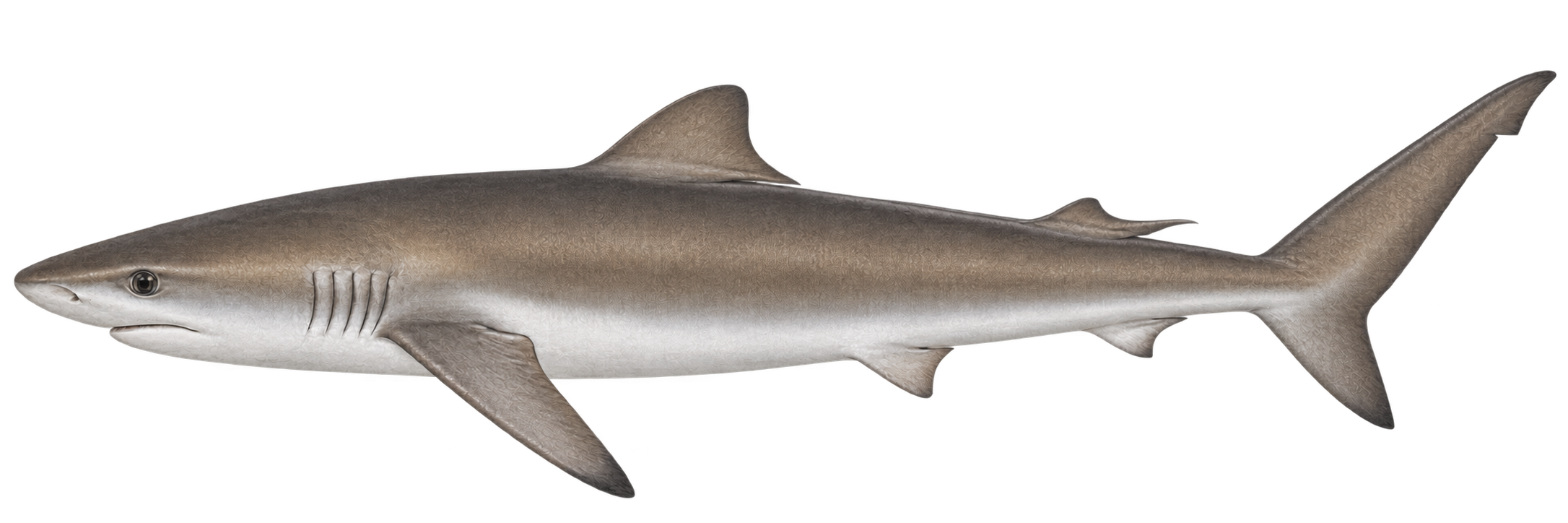
The silky shark has a slender body, a rounded snout and a relatively low, rounded first dorsal fin beginning behind the free rear tips of the pectoral fins. Its small second dorsal fin has a conspicuously elongated free rear tip. That trailing extension is an important comparison feature, particularly when distinguishing similar gray sharks. NOAA’s silky shark identification guide illustrates the fin arrangement.
The upper body is gray with a bronzy cast and the underside is pale. A low ridge joins the region between the dorsal fins. The Florida Museum’s silky shark profile provides additional biological context. Look at fin positions and proportions together rather than relying only on color. A partial silhouette may not provide enough information for a confident identification, especially when the second dorsal is hidden.
Southeastern Florida context
The National Park Service’s Biscayne fish list includes silky shark among fishes reported in the park. This supports southeastern Florida occurrence but does not establish present-day abundance, a named dive-site sighting or a guaranteed encounter.
Silky sharks are primarily associated with warm open water, continental shelf edges and deeper reef environments. The museum describes younger animals using coastal areas and larger individuals occurring farther offshore. These habitat tendencies are context, not a reason to pursue a shark beyond the planned dive area.
Feeding and reproduction
Bony fishes, including tunas, are important prey; squid and crustaceans also occur in the diet. Silky sharks give birth to live young supported during development by a placenta. Reproductive timing and litter characteristics vary geographically, so this profile does not substitute a distant population’s schedule for local observations.
The common name refers to the fine, closely packed scales that give the skin its texture. That is an identification fact to learn from reference material, never an invitation to touch a wild shark.
Protected harvest status and responsible diving
FWC prohibits silky shark harvest in Florida state waters, and NOAA prohibits recreational retention in the Atlantic shark fishery. NOAA requires prohibited species to be released with minimal injury without removing them from the water. Do not bring one aboard for photographs or identification.
During a dive, avoid feeding, chasing, touching or blocking the animal’s route. Stay with your buddy and follow the planned procedures for the site. This guide is for recognition and responsible observation, not a fishing authorization or seafood recommendation.
Quick quiz
- Which fin has an unusually long free rear tip? The second dorsal.
- Is a Biscayne record a guarantee of a sighting? No.
- May recreational anglers retain this shark under the cited rules? No.
Current recreational retention rules
Checked November 12, 2026: Florida prohibits silky shark harvest in state waters, and NOAA prohibits recreational retention in the Atlantic shark fishery. Release incidental catches with minimal injury without removing the shark from the water; keep its gills submerged under Florida handling rules. This recreational prohibition must not be confused with rules for separately permitted commercial fisheries. Official FWC shark rules Official NOAA retention guidance Federal regulation text (Cornell LII) Federal regulation text (Cornell LII)
Make your next dive happen
Dive With Us
Explore local charters and plan a dive suited to your experience.
View dive calendarTrain With Us
Build your fish identification, buoyancy and diving skills.
Explore trainingTravel With Us
Discover upcoming dive adventures and trip details.
Explore dive travelShop With Us
Browse equipment for your diving and ask our team for help choosing.
Explore dive gearReview current dates, availability, prices, inclusions and requirements on each listing before booking or buying.
Call us now
Ask about fish identification training
Reef Fish Identification
Ask about dates, prerequisites or your next step. An inquiry does not reserve a place. Please provide your own contact details; do not include medical, payment or a child's personal information.
We use these details to respond to your inquiry. This form does not sign you up for marketing.
Explore more with Stuart Scuba
Open Water course options · Advanced Adventure training · Technical training · Professional training · All courses · Local dives · Dive trips · Facebook · Instagram · YouTube
Your surface-interval essentials
Questions for Stuart Scuba? info@stuartscuba.com
Check the Stuart Scuba Weather Center · Play scuba trivia
Weather and wildlife vary. Confirm current conditions, trip requirements and departure details with the operator.
Plan Your Next Dive with Stuart Scuba
Dive With Us
Explore upcoming local charters and choose a dive that fits your experience.
Before you book
Check the individual listing for departure time, requirements and availability.
Travel With Us
Find upcoming dive adventures and start planning your next trip.
Plan your trip
Review dates, inclusions and trip details on the travel calendar.
Stay Connected with Stuart Scuba
 Follow pageShare
YouTube
SubscribeWatch & shareFollow on InstagramView & share post
Follow company news, training updates, and dive stories.
Follow on LinkedInGoogle Reviews
See Stuart Scuba’s current Google rating and review count below. Open the listing in Google Maps to browse customer reviews.



