

Fish identification archive / Sheepshead
Sheepshead
Archosargus probatocephalus
I saw this
Spotted this marine animal? Share the guide with your dive buddies. Review your caption before posting.
For Instagram, copy the caption and link into your own post or message. Nothing is posted automatically and this does not record a verified sighting.
Fun facts for your next surface interval
- Those famous teeth are a shell-crushing toolkit, not a novelty smile.
- Barnacles can be dinner, which helps explain its interest in pilings.
- The convict-fish nickname comes from its bold dark vertical bars.
Florida and local context
Lake Worth Lagoon / Blue Heron Bridge, Palm Beach County: Florida Museum checklist explicitly marks this species verified. This documents occurrence, not local abundance.
Documented regional presence is not a guarantee of an encounter or a measure of how common this animal is at your dive site.
How to recognize this animal
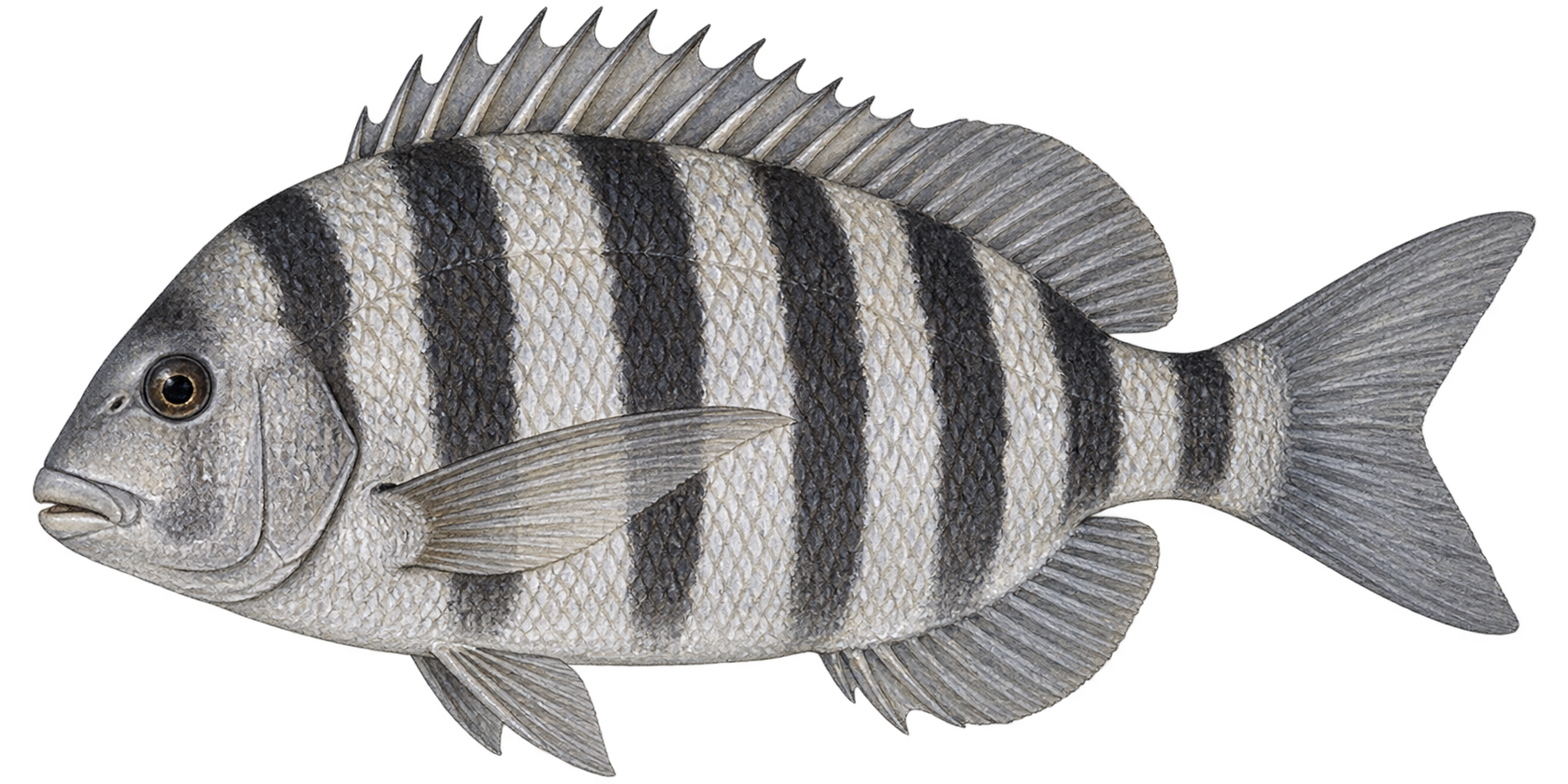
Five or six dark bars cross a deep silver body, giving the sheepshead its familiar convict-fish look. The head is blunt, the mouth small, and the dorsal fin has sturdy spines. Its tail is only shallowly forked. Look beneath the chin as well as at the stripes: a sheepshead lacks the conspicuous chin barbels found on a young black drum.
Size and life stages
Adults are often described around 14–18 inches long, with exceptional fish approaching 30 inches, or 76 centimeters, in total length. Thick bodies and strong fins can exaggerate their apparent size beside a piling. A scale reference is useful only if it is at a similar distance. Do not approach or handle a fish merely to improve a size estimate.
Habitat and where to look
Pilings, jetties, rocks, oyster-covered structure and estuarine margins all suit sheepshead. Young fish use seagrass and soft-bottom habitat. This species is comfortable in brackish water, making it a good example of a coastal fish that links ocean and estuary. Around structures, maintain extra awareness of fishing line, sharp growth and boat traffic rather than focusing solely on the fish.
Range and local context
Sheepshead inhabit the western Atlantic and Gulf coastal region, including Florida. Florida Museum explicitly verifies them in Lake Worth Lagoon. Their broad coastal distribution and familiar appearance do not imply that every striped fish beside a local bridge is one. Confirm the shape and chin details, and treat the checklist as evidence of presence rather than a current abundance estimate.
What is on the menu?
Strong incisors and crushing teeth help sheepshead feed on shelled prey such as barnacles, crabs, clams and oysters. Their much-photographed teeth have a practical purpose rather than a humanlike smile. Other small animals and some plant material can also enter the diet. Watch a fish picking at a surface without scraping the surface yourself to attract its attention.
Daily habits and behavior
Sheepshead often inspect hard structures where food grows. A fish repeatedly approaching a piling may be feeding rather than guarding a home. Their stripes can be especially distinct in younger individuals, and lighting changes how dark the bars appear. A steady view of the whole animal is more useful than deciding from one flashing black-and-silver patch.
Mating and the next generation
Adults move toward coastal or offshore spawning areas, particularly around late winter and spring in parts of their range. Fertilized eggs drift, and larvae later develop into the small barred fish associated with nursery habitat. Exact timing varies with place and conditions. Do not read a seasonal fishing rule as a complete biological description or identify a gathering as spawning without evidence.
Look-alikes and identification traps
Young black drum also wear dark vertical bars, but have chin barbels. Atlantic spadefish have a much more disk-shaped silhouette and longer, more dramatic soft dorsal and anal fins. Compare mouth, head and fins as well as stripes. A blurry barred fish should remain unidentified until at least one of those useful differences can be seen.
Observe without disturbing
Keep fingers, bait and camera accessories away from the mouth and do not invite a feeding interaction. Around pilings, preserve enough space to avoid entanglement or contact with sharp encrusting growth. If sharing a photograph, describe the identification clues rather than staging a close-up of the teeth. Harvest and seafood questions are addressed separately with the current Florida rules.
Harvest, protection and eating safety
Regulated food fish: year-round with size, bag and spring vessel limits
Can it be hunted or harvested?
Florida Atlantic and Gulf state waters, with state rules extending into adjacent federal waters: minimum 12 inches total length and eight fish per person daily. During March and April, a vessel may keep no more than fifty per trip, while individual limits still apply. Sheepshead counts toward Biscayne National Park’s ten-fish aggregate. A saltwater fishing license is required unless exempt. Snatching and multiple hooks used with natural bait are prohibited.
Florida seasons and areas
Open year-round under the reviewed species rule. The March–April fifty-fish vessel limit is an additional restriction, not a seasonal closure. Local closures still apply, including Biscayne National Park’s mapped bonefish pre-spawning area, closed to fishing and fish possession March 1–May 31 with a properly stowed continuous-transit exception. Check Florida Keys sanctuary zones before fishing. Western Dry Rocks’ designated one-square-mile area is closed to all fishing April 1–July 31 annually.
Can it be speared?
Allowed only where spearfishing is lawful and the fish meets all size, bag and seasonal rules. Florida exclusions include within 100 yards of public swimming beaches, fishing piers and bridges open to fishing, the specified jetty buffer, state-park waters, and Monroe County from Long Key north to the Miami-Dade line. Florida prohibits powerheads and rebreathers under its spearing rules. Check sanctuary and other site restrictions before entering the water. In Volusia County inland waters, the sheepshead exception permits a barbed spear with no more than three prongs; do not apply the general permission to other fish there.
Is it safe to eat?
Edible when legally retained and properly handled, but Florida DOH lists a mercury advisory for sheepshead. Check the current guidance for the catch location and the person eating it, especially children and people who are pregnant or breastfeeding. Chill promptly and cook to 145°F. Cooking does not remove mercury, so a cooked fish is not automatically suitable for frequent meals.
Before you act: This recreational overview is not permission to collect or spear at your dive site. Confirm the species, date, management area, state or federal waters, gear, licenses and current local closures. Identification artwork cannot establish an identification or guarantee seafood safety.
Official rules and health guidance
- FWC sheepshead recreational limits
- FWC Biscayne National Park limits and closed areas
- FWC recreational saltwater licenses and exemptions
- NOAA Florida Keys sanctuary zones
- FWC species and location restrictions on spearing
- Florida DOH advisory booklet currently linked from its seafood page
- Florida DOH seafood-consumption guidance
- Florida DOH location-specific fish-advisory search
- FDA safe seafood handling and cooking
- FDA/EPA questions about mercury and fish preparation
- FWC Western Dry Rocks seasonal closure
Reviewed 2026-11-10. Rules and advisories can change; check the linked authorities before harvesting or eating.
Sources and review
Reviewed 2026-11-10.
Make your next dive happen
Dive With Us
Explore local charters and plan a dive suited to your experience.
View dive calendarTrain With Us
Build your fish identification, buoyancy and diving skills.
Explore trainingTravel With Us
Discover upcoming dive adventures and trip details.
Explore dive travelShop With Us
Browse equipment for your diving and ask our team for help choosing.
Explore dive gearReview current dates, availability, prices, inclusions and requirements on each listing before booking or buying.
Call us now
Ask about marine life identification
Marine Life Identification
Ask about dates, prerequisites or your next step. An inquiry does not reserve a place. Please provide your own contact details; do not include medical, payment or a child's personal information.
We use these details to respond to your inquiry. This form does not sign you up for marketing.
Explore more with Stuart Scuba
Open Water course options · Advanced Adventure training · Technical training · Professional training · All courses · Local dives · Dive trips · Facebook · Instagram · YouTube
Your surface-interval essentials
Questions for Stuart Scuba? info@stuartscuba.com
Check the Stuart Scuba Weather Center · Play scuba trivia
Weather and wildlife vary. Confirm current conditions, trip requirements and departure details with the operator.
Plan Your Next Dive with Stuart Scuba
Dive With Us
Explore upcoming local charters and choose a dive that fits your experience.
Before you book
Check the individual listing for departure time, requirements and availability.
Travel With Us
Find upcoming dive adventures and start planning your next trip.
Plan your trip
Review dates, inclusions and trip details on the travel calendar.
Stay Connected with Stuart Scuba
 Follow pageShare
YouTube
SubscribeWatch & shareFollow on InstagramView & share post
Follow company news, training updates, and dive stories.
Follow on LinkedInGoogle Reviews
See Stuart Scuba’s current Google rating and review count below. Open the listing in Google Maps to browse customer reviews.



