

Fish identification archive / Sharksucker
Sharksucker
Echeneis naucrates
I saw this
Spotted this fish? Share the guide with your dive buddies. Review your caption before posting.
For Instagram, copy the caption and link into your own post or message. Nothing is posted automatically and this does not record a verified sighting.
Fun facts for your next surface interval
- The suction cup is a modified fin. Its mouth is still available for lunch.
- Despite the name, a sharksucker accepts rides from more than sharks.
- Some youngsters work at cleaning stations before becoming better-known reef hitchhikers.
Palm Beach connection
Lake Worth Lagoon / Blue Heron Bridge, Palm Beach County: Verified species row (x).
Documented regional presence is not a guarantee of an encounter or a measure of how common this fish is at your dive site.
How to recognize this fish
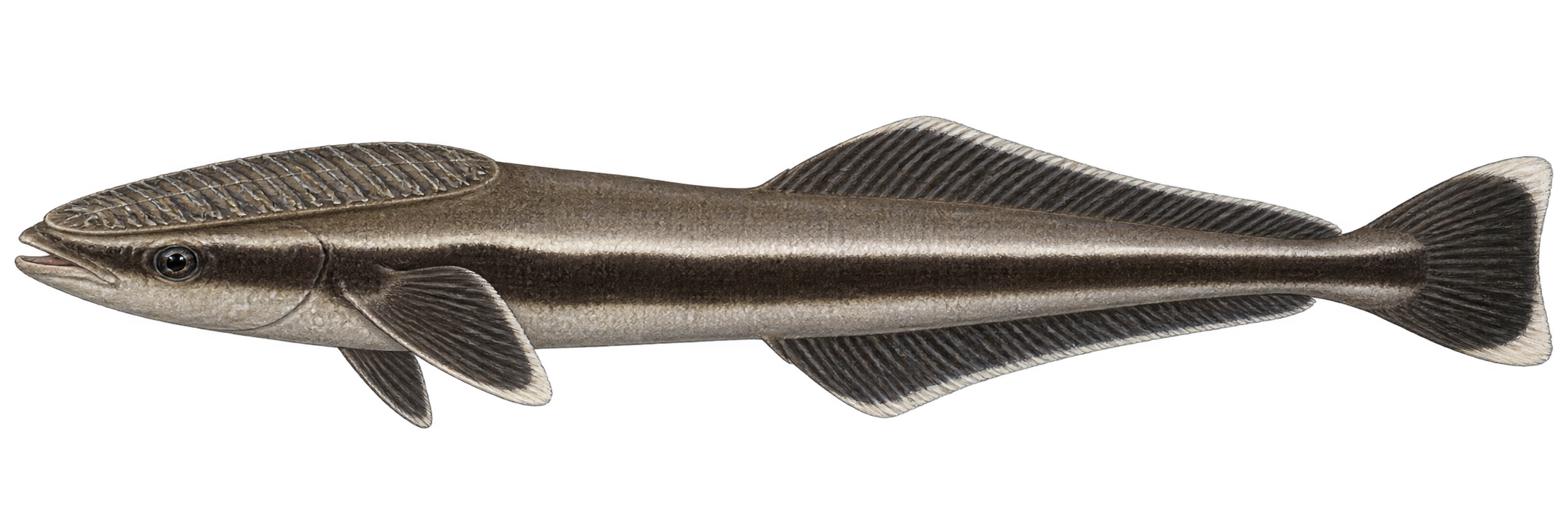
The unmistakable starting point is an oval attachment disc on top of the head and forward back. This remora also has a slender body and a broad dark lengthwise stripe bordered by pale lines. Its lower jaw projects beyond the upper one. Long dorsal and anal fins run along much of the rear body.
Size and life stages
Sharksuckers can reach about 1.1 meters, or 43 inches. Many encountered fish will be smaller, and a remora beside a large host can be surprisingly easy to underestimate. Compare proportions within the photograph rather than assigning an exact length from memory. The adult outline and disc remain more helpful than apparent size at a distance.
Habitat and where to look
This fish occurs near shore and offshore, including shallow reef environments. It may be attached to a host or swimming independently, so look both beside large animals and in open water around the reef. Do not approach a turtle, ray or shark more closely just because a remora has attracted your attention.
Range and local context
The sharksucker is widespread in warm seas, including the western Atlantic. A verified Lake Worth Lagoon record supports its Palm Beach inclusion. A mobile fish associated with mobile hosts need not remain at one site. This profile describes identification and natural history, not a route for finding a particular animal or a guarantee of local abundance.
What is on the menu?
Its diet includes small fishes, host food scraps and parasites, with other small animal prey also taken. Some juveniles clean reef fishes at stations. The relationship is therefore more interesting than the cartoon of a passenger waiting for leftovers. Watch for independent feeding or cleaning, but do not offer food to a remora or its host.
Daily habits and behavior
The attachment disc is a modified dorsal fin, not the mouth. Sharksuckers use many hosts, including rays, turtles and large bony fishes as well as sharks. They can also swim free and sometimes follow divers. Stay calm if one approaches, and resist touching or trying to encourage attachment for a novelty photograph.
Mating and the next generation
Sharksuckers reproduce through externally fertilized eggs that develop in the water column. Young fish develop the characteristic attachment disc as they grow. Seeing two remoras on one host does not establish that they are a mating pair. A careful dive log distinguishes an observed association from a reproductive explanation that was not actually witnessed.
Look-alikes and identification traps
Whitefin sharksuckers and other remoras deserve consideration when the view is brief. Body slenderness, stripe pattern, fin appearance and the disc all contribute to identification; attachment to a shark does not determine the species. Try to retain a side view and a view of the disc without chasing either the remora or its host.
Observe without disturbing
Observe the pair as one wildlife encounter: keep a respectful distance from both passenger and host. Never pull off a remora, stroke its disc or bait it toward a diver. Avoid crowding an animal’s path with cameras. If you only identify it as a remora, that honest record is better than a confident but unsupported species label.
Harvest, protection and eating safety
General Florida harvest rules; local restrictions apply
Can it be hunted or harvested?
Sharksucker (Echeneis naucrates) is a bony fish, not a shark, and does not inherit shark harvest rules. It is absent from the restricted ornamental categories reviewed. Where harvest is otherwise lawful in Florida state waters, the default limit is two fish or 100 pounds per person daily, whichever is greater; no species-specific statewide size rule was identified. A saltwater license is normally required unless exempt.
Florida seasons and areas
No species-specific statewide recreational closed season was identified in the FWC rules reviewed. Florida state waters extend to 3 nautical miles on the Atlantic side and 9 on the Gulf side. Verify the exact site, federal rules offshore and current sanctuary/park closures before targeting this species.
Can it be speared?
Not named on FWC’s species-specific no-spearing list, but all location and gear restrictions apply. Leave sharksuckers attached to sharks, turtles or other large hosts alone to avoid injuring the host; this guide is not permission to disturb protected animals.
Is it safe to eat?
Food safety is not established here. No species-specific Florida consumption recommendation was verified. Consult Florida DOH guidance for the actual catch location and consumer group; do not infer low mercury or edibility from the absence of a harvest ban.
Before you act: This recreational overview is not permission to collect or spear at your dive site. Confirm the species, date, management area, state or federal waters, gear, licenses and current local closures. A fish illustration cannot establish an identification or guarantee seafood safety.
Official rules and health guidance
- FWC: Full Rule Text by Species
- FWC: Recreational Marine Life
- Florida Administrative Code: Marine-life Species, 68B-42.001 (Cornell reproduction)
- FWC: Unregulated Species and Default Bag Limit
- FWC: Saltwater Recreational Licenses and Permits
- Florida Museum: Sharksucker
- FWC: Boundary Maps and Management Zones
- NOAA: Florida Keys National Marine Sanctuary Zones
- NOAA: Gulf Fishing Regulations and Seasonal Closures
- FWC: Spearing
- Florida Department of Health: Eating Healthy Seafood and Local Advisories
- FDA/EPA: Advice About Eating Fish
Reviewed 2026-11-10. Rules and advisories can change; check the linked authorities before harvesting or eating.
Sources and review
Reviewed 2026-11-10.
Make your next dive happen
Dive With Us
Explore local charters and plan a dive suited to your experience.
View dive calendarTrain With Us
Build your fish identification, buoyancy and diving skills.
Explore trainingTravel With Us
Discover upcoming dive adventures and trip details.
Explore dive travelShop With Us
Browse equipment for your diving and ask our team for help choosing.
Explore dive gearReview current dates, availability, prices, inclusions and requirements on each listing before booking or buying.
Call us now
Ask about fish identification training
Reef Fish Identification
Ask about dates, prerequisites or your next step. An inquiry does not reserve a place. Please provide your own contact details; do not include medical, payment or a child's personal information.
We use these details to respond to your inquiry. This form does not sign you up for marketing.
Explore more with Stuart Scuba
Open Water course options · Advanced Adventure training · Technical training · Professional training · All courses · Local dives · Dive trips · Facebook · Instagram · YouTube
Your surface-interval essentials
Questions for Stuart Scuba? info@stuartscuba.com
Check the Stuart Scuba Weather Center · Play scuba trivia
Weather and wildlife vary. Confirm current conditions, trip requirements and departure details with the operator.
Plan Your Next Dive with Stuart Scuba
Dive With Us
Explore upcoming local charters and choose a dive that fits your experience.
Before you book
Check the individual listing for departure time, requirements and availability.
Travel With Us
Find upcoming dive adventures and start planning your next trip.
Plan your trip
Review dates, inclusions and trip details on the travel calendar.
Stay Connected with Stuart Scuba
 Follow pageShare
YouTube
SubscribeWatch & shareFollow on InstagramView & share post
Follow company news, training updates, and dive stories.
Follow on LinkedInGoogle Reviews
See Stuart Scuba’s current Google rating and review count below. Open the listing in Google Maps to browse customer reviews.



