

Fish identification archive / Scrawled Filefish
Scrawled Filefish
Aluterus scriptus
I saw this
Spotted this marine animal? Share the guide with your dive buddies. Review your caption before posting.
For Instagram, copy the caption and link into your own post or message. Nothing is posted automatically and this does not record a verified sighting.
Fun facts for your next surface interval
- Turning edge-on is an excellent disappearing act for this very flat fish.
- Its scribbled blue pattern gives the common name a visual explanation.
- Young fish can travel with floating weeds before settling into a more reef-associated life.
Florida and local context
Lake Worth Lagoon / Blue Heron Bridge, Palm Beach County: Florida Museum checklist explicitly marks this species verified. This documents occurrence, not local abundance.
Documented regional presence is not a guarantee of an encounter or a measure of how common this animal is at your dive site.
How to recognize this animal
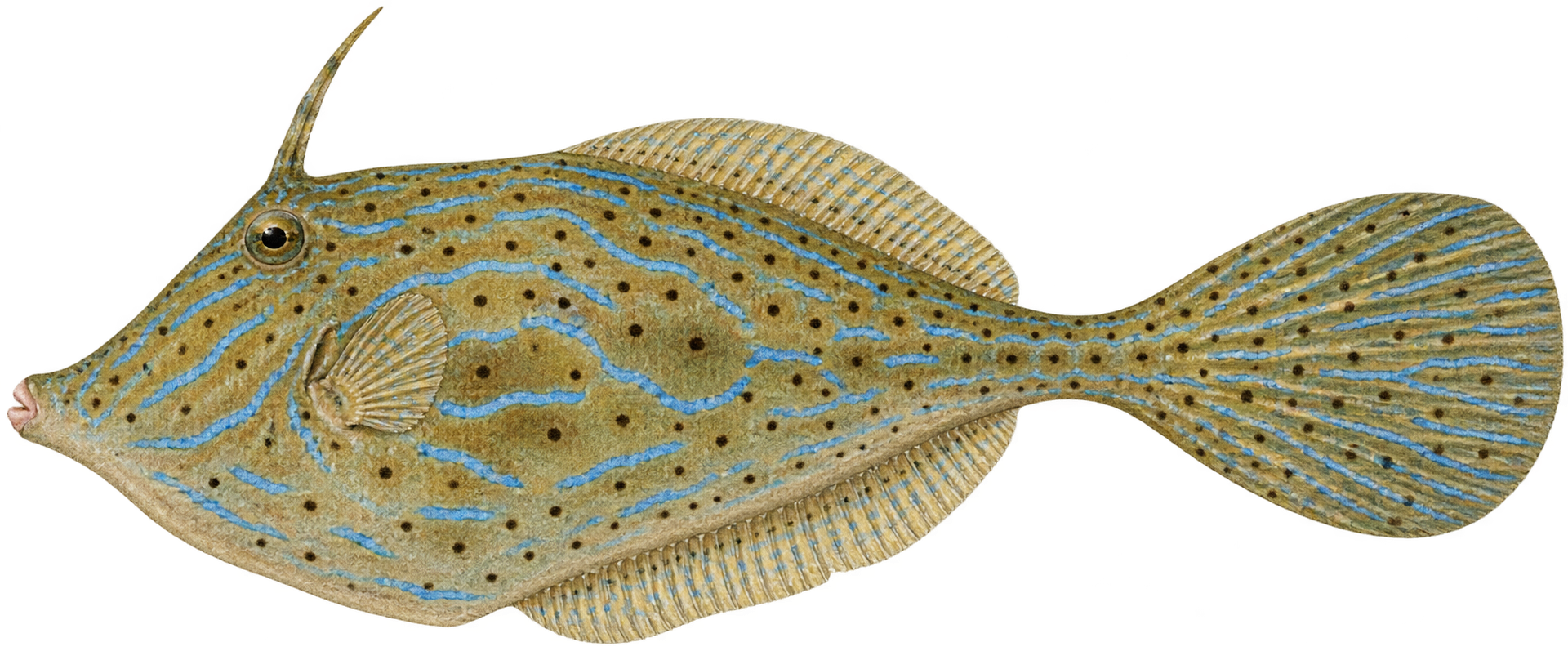
Blue scribbles and scattered dark dots cover the scrawled filefish's olive-brown or gray body. The long, flattened profile, concave snout, tiny upturned mouth and very long rounded tail are stronger clues than color alone. A narrow dorsal spine rises above the head. Look for the slow rippling soft dorsal and anal fins rather than expecting a conventional fast-swimming fish outline.
Size and life stages
It commonly reaches around 22 inches, or 55 centimeters, while the published maximum is approximately 43 inches, or 110 centimeters, in total length. The large tail accounts for a considerable part of that outline. A fish seen head-on can look surprisingly narrow; wait for a broadside view before judging size or deciding that it is a smaller filefish species.
Habitat and where to look
Scrawled filefish use lagoons and reefs, and juveniles can travel with floating vegetation. The adult is often associated with reef structure, but a young fish beside a weed raft is ecologically plausible too. Underwater, examine the spaces beside ledges and soft growth from a stable position. Avoid following an animal into a tight passage where it has little room to turn.
Range and local context
The species has a circumtropical distribution, occurring in warm regions of several oceans. Florida is within its Atlantic range, and Florida Museum verifies it in Lake Worth Lagoon. That local record is a documented connection, not a claim of constant visibility. A wide global range also does not mean that every similarly patterned filefish worldwide belongs to this species.
What is on the menu?
Its diet includes algae and seagrass as well as attached animals such as hydroids, soft corals and tunicates. The small mouth takes targeted bites rather than swallowing large prey whole. A fish pecking repeatedly at reef growth may be feeding on organisms difficult to distinguish from a diver's distance. Describe the action without guessing an exact food item from one photograph.
Daily habits and behavior
The extremely compressed body can nearly disappear when the fish turns edge-on. Juveniles associated with drifting vegetation may adopt a head-down posture that helps them blend with the weed. For adults, fin movement and a slowly changing angle can reveal more than the blue markings alone. Let the fish choose its position instead of chasing it into a cleaner background.
Mating and the next generation
The reproductive account includes eggs associated with the bottom and a pelagic larval stage. Detailed accounts of filefish parental care should be applied cautiously rather than assuming every individual behaves identically. A pair close to the substrate is not enough evidence of a nest. Record a clearly observed egg patch or guarding behavior before giving a sighting a reproductive label.
Look-alikes and identification traps
Orangespotted filefish are much smaller and have a characteristic white blotch on the upper tail base. Whitespotted filefish have a different, deeper profile and variable pale spots. The scrawled filefish's elongated body and unusually long rounded tail are useful even when blue markings look muted. Compare the whole outline rather than identifying from one colorful patch of skin.
Observe without disturbing
Do not corner this slow-looking fish, pull it from shelter or touch its rough skin. A quiet broadside photograph can show the snout, dorsal spine and entire tail in a single frame. If it turns away, allow the encounter to end. Its appearance in a Florida identification archive is an invitation to observe, while any collection questions require the separate current rules.
Harvest, protection and eating safety
Restricted marine life: live collection only; no spearing
Can it be hunted or harvested?
Scrawled Filefish (Aluterus scriptus) is restricted tropical ornamental marine life, not an ordinary food-fishing species or a blanket no-take species. Where collection is lawful, a saltwater fishing license is required unless exempt. Land and keep the fish alive with adequate circulation or aeration. No species-specific size limit is listed. Daily limit: five of this species within 20 marine-life organisms total per person. Two-day possession maximum: ten of this species within 40 organisms total. Recreational sale is prohibited.
Florida seasons and areas
No annual recreational closed months are listed for this marine-life species. Collection is prohibited within the designated Blue Heron Bridge dive-site boundary and throughout Biscayne National Park. Florida marine-life rules also apply in adjacent federal waters on both coasts. Check the exact sanctuary, park and refuge zone before collecting. Western Dry Rocks’ designated one-square-mile area is closed to all fishing April 1–July 31 annually.
Can it be speared?
No. Spears are not authorized recreational gear for this regulated tropical marine-life fish. Use only lawful live-collection methods, such as permitted hand-held, barrier or drop nets or a slurp gun, and comply with the live-landing requirement.
Is it safe to eat?
Not recommended as a food target. This species is regulated for live collection, and this guide does not certify it as safe to eat. Check Florida DOH guidance before eating any locally caught fish. Cooking does not remove all marine toxins, and legal collection is not evidence of food safety.
Before you act: This recreational overview is not permission to collect or spear at your dive site. Confirm the species, date, management area, state or federal waters, gear, licenses and current local closures. Identification artwork cannot establish an identification or guarantee seafood safety.
Official rules and health guidance
- FWC recreational marine-life rules
- FWC recreational saltwater licenses and exemptions
- FWC Biscayne National Park limits and closed areas
- NOAA Florida Keys sanctuary zones
- Florida Administrative Code 68B-42.007: marine-life gear
- Florida DOH seafood-consumption guidance
- Florida DOH ciguatera and other seafood poisoning
- FWC Western Dry Rocks seasonal closure
Reviewed 2026-11-10. Rules and advisories can change; check the linked authorities before harvesting or eating.
Sources and review
Reviewed 2026-11-10.
Make your next dive happen
Dive With Us
Explore local charters and plan a dive suited to your experience.
View dive calendarTrain With Us
Build your fish identification, buoyancy and diving skills.
Explore trainingTravel With Us
Discover upcoming dive adventures and trip details.
Explore dive travelShop With Us
Browse equipment for your diving and ask our team for help choosing.
Explore dive gearReview current dates, availability, prices, inclusions and requirements on each listing before booking or buying.
Call us now
Ask about marine life identification
Marine Life Identification
Ask about dates, prerequisites or your next step. An inquiry does not reserve a place. Please provide your own contact details; do not include medical, payment or a child's personal information.
We use these details to respond to your inquiry. This form does not sign you up for marketing.
Explore more with Stuart Scuba
Open Water course options · Advanced Adventure training · Technical training · Professional training · All courses · Local dives · Dive trips · Facebook · Instagram · YouTube
Your surface-interval essentials
Questions for Stuart Scuba? info@stuartscuba.com
Check the Stuart Scuba Weather Center · Play scuba trivia
Weather and wildlife vary. Confirm current conditions, trip requirements and departure details with the operator.
Plan Your Next Dive with Stuart Scuba
Dive With Us
Explore upcoming local charters and choose a dive that fits your experience.
Before you book
Check the individual listing for departure time, requirements and availability.
Travel With Us
Find upcoming dive adventures and start planning your next trip.
Plan your trip
Review dates, inclusions and trip details on the travel calendar.
Stay Connected with Stuart Scuba
 Follow pageShare
YouTube
SubscribeWatch & shareFollow on InstagramView & share post
Follow company news, training updates, and dive stories.
Follow on LinkedInGoogle Reviews
See Stuart Scuba’s current Google rating and review count below. Open the listing in Google Maps to browse customer reviews.



