

Fish identification archive / Scotch bonnet
Scotch bonnet
Semicassis granulata
Fun facts for your next surface interval
Florida and local context
A July 2025 BHB diary reports and photographs the author’s first Scotch bonnet snail, explicitly named Semicassis granulata.
A documented past record does not establish present abundance or guarantee an encounter.
How to recognize this animal
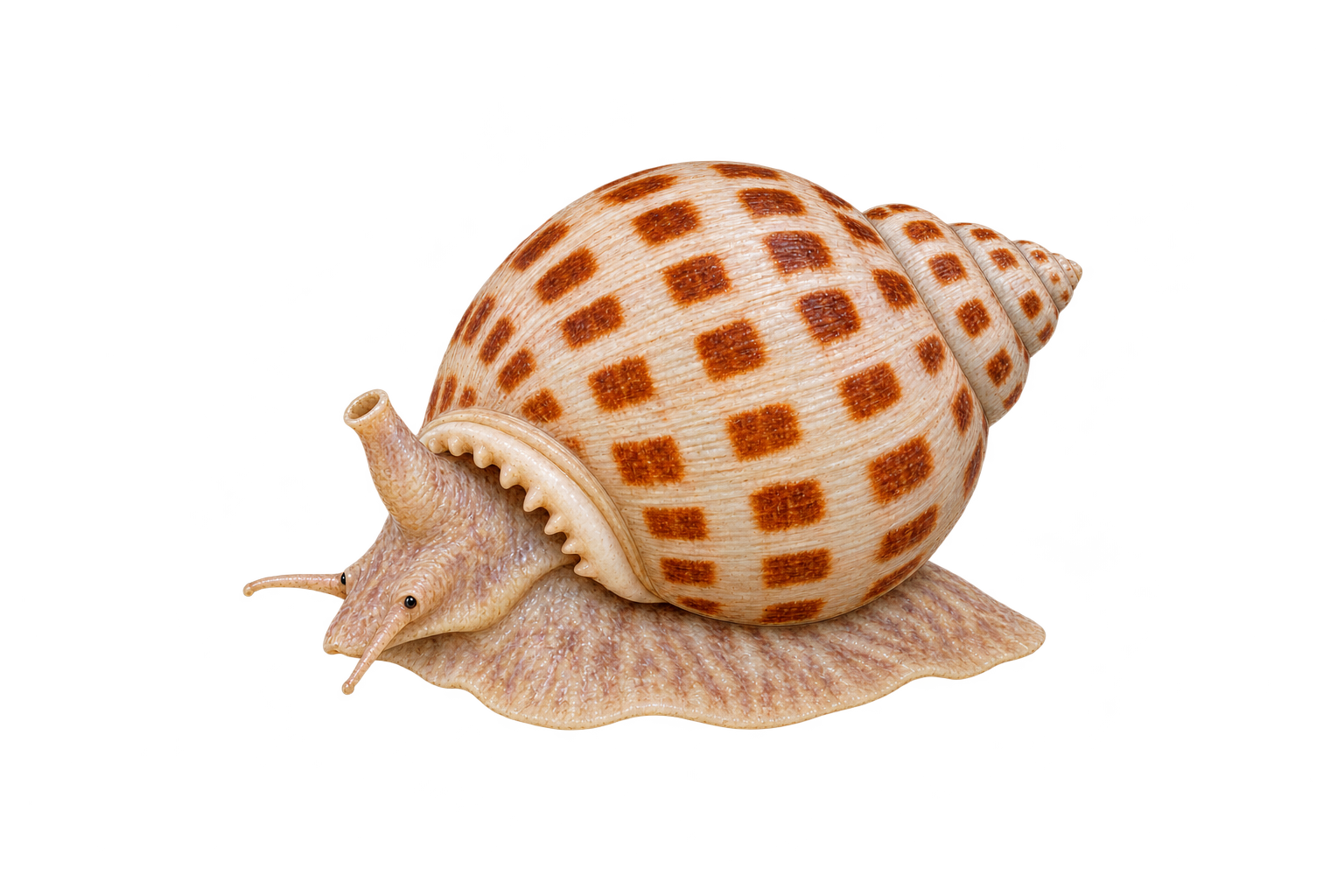
The Scotch bonnet is a shelled snail with a rounded, egg-shaped shell, a short spire and pale cream-to-tan coloring marked by roughly rectangular brown spots. Look for fine spiral grooves, a thickened outer lip with small internal teeth, and granular bumps on the inner side of the opening. The short siphonal canal bends upward. These features together are more useful than the spotted pattern alone, especially on worn shells.
Sources: Bailey-Matthews National Shell Museum: Scotch Bonnet
Size and life stages
The Bailey-Matthews National Shell Museum gives shell length up to 90 mm, while some regional guides report larger specimens. Use 90 mm as the museum’s stated figure, not a universal maximum or the expected size of every adult. Shell length also differs from the changing reach of the live animal’s foot and siphon. The local dive diary does not provide a measured length.
Sources: Bailey-Matthews National Shell Museum: Scotch Bonnet; Laura Kushner: It’s been a while… (20 July 2025)
Habitat and where to look
This snail lives on sandy bottoms. The South Carolina beachcomber guide specifically places it on shallow sandy flats, and the University of Oldenburg also lists soft bottom and sand. When diving, watch the surface without digging or fanning it away. An animal partly hidden in sediment may provide only a limited view, which is a reason to photograph cautiously rather than excavate.
Sources: South Carolina Beachcomber’s Guide: Scotch Bonnet; University of Oldenburg: Semicassis granulata
Range and local context
Regional references place the Scotch bonnet from North Carolina through Florida, the Gulf of Mexico and Caribbean to Brazil. For the West Palm Beach diving area, a July 2025 diary explicitly identifies a photographed Scotch bonnet at Blue Heron Bridge in Riviera Beach. That named-site record is the basis for its local inclusion. It does not establish how frequently visitors can expect to encounter one.
Sources: South Carolina Beachcomber’s Guide: Scotch Bonnet; Laura Kushner: It’s been a while… (20 July 2025)
What is on the menu?
Scotch bonnets prey on sand dollars and other sea urchins. The DORIS account describes locating buried prey and opening the hard test using the proboscis and radula, assisted by acidic secretion. A test is the echinoderm’s skeleton, not a mollusk shell. This explains why a substantial snail may be associated with sand rather than actively browsing a reef surface.
Sources: DORIS: Semicassis granulata
Daily habits and behavior
A moving bonnet shell is not automatically a live Scotch bonnet: regional guides note that empty shells can be occupied by hermit crabs. Observe the inhabitant without picking the shell up. For a useful sighting record, distinguish a live snail, a crab using the shell and an apparently empty shell; they represent different observations even when the shell identification is identical.
Mating and the next generation
The sexes are separate, unlike the hermaphroditic nudibranchs also featured in this guide. Fertilization is internal, and females deposit linked egg capsules that form a towerlike structure. Larvae pass through a swimming veliger stage. The local diary mentions earlier encounters with eggs but does not establish a breeding season. A tower-shaped egg mass should be photographed in place rather than pulled apart to investigate.
Sources: DORIS: Semicassis granulata; Laura Kushner: It’s been a while… (20 July 2025)
Look-alikes and identification traps
Related helmet and bonnet shells can be confusing, particularly small or unusually smooth individuals. DORIS highlights resemblance to Casmaria ponderosa and the eastern Atlantic relative Semicassis undulata. The latter is a distinct accepted species, not simply another name to merge into the local count. For difficult shells, retain views of the opening, lip and spire and seek specialist review.
Sources: DORIS: Semicassis granulata; WoRMS: Semicassis undulata accepted-species treatment
Observe without disturbing
Leave live snails, eggs and apparently vacant shells where they are. Avoid placing a shell on clean sand for a photograph or flushing sediment out of its opening. Record what you actually saw, including whether soft tissue was visible. A careful photograph and locality note can preserve identification evidence without removing a useful part of the seabed.
Harvest, protection and eating safety
Unknown: exact harvest rules need verification
The neutral gray status means the rules or scope have not been fully verified. The exact species-specific recreational numerical allowance and annual season are not established here. This Cassidae snail is not automatically covered by the enumerated ornamental marine-life 5/20 allowance. Do not infer permission at Blue Heron Bridge or import Lee/Manatee rules as corridor-wide limits. No food suitability or local-menu claim is made.
This color is a qualified summary, not permission to collect or a guarantee that a particular animal is safe to eat.
Can it be hunted or harvested?
A live Scotch bonnet, Semicassis granulata, is a gastropod in family Cassidae. Taking a shell with a living animal requires a Florida recreational saltwater license, including from shore, unless a statutory exemption applies. The reviewed marine-life list does not name this species, so the five-per-species ornamental limit is not assigned by analogy. FWC distinguishes regulated shells from species under its default recreational rule. This guide does not establish a species-specific numerical take allowance.
Florida seasons and areas
Lee County prohibits taking or possessing most shells containing live organisms; Scotch bonnet is not among the listed food-shell exceptions. Manatee County limits shells with live organisms to two of a species daily, apart from listed exceptions. Neither rule is a Palm Beach-wide rule. Parks, refuges and Florida Keys sanctuary zones can add prohibitions. An apparently empty shell may house another animal. The Blue Heron Bridge tropical-ornamental closure is a separate defined category, not evidence that every shelled animal follows the same rule. Leave this animal in place during a dive unless the exact site and species rules have been confirmed.
Can it be speared?
No spearfishing allowance is established here. It is not a food-fish identification, and destructive collection can harm the snail and surrounding habitat. This guide recommends observation rather than collection.
Is it safe to eat?
No safe-to-eat determination or recipe is provided. Florida health guidance warns that marine gastropods can accumulate harmful-algal-bloom toxins through their prey, and cooking or freezing does not remove those toxins. A legal shell-collecting allowance is not food-safety clearance.
Palm Beach is Atlantic Florida. Do not transfer Atlantic guidance to the Gulf, Monroe County, or federal waters without checking the applicable rules.
Before you act: Confirm the species, date, exact management area, state or federal waters, gear, licenses and current local closures. A local occurrence record never grants permission to take an animal.
Official rules and health guidance
- FWC: living shell collection and county restrictions
- FWC: default recreational rules for species without specific limits
- FWC recreational marine-life requirements and species list
- Florida Rule 68B-42.001: listed marine-life species
- Palm Beach County: Phil Foster Park fishing and collection notice
- Florida Department of Health: seafood toxin warnings
- NOAA: Florida Keys sanctuary zones
Reviewed 2026-11-11. Rules and advisories can change; check the linked authorities before acting.
Identification and source cautions
- Size sources vary; museum figure is reported with attribution rather than universal maximum.
- Local diary is a photo record, not a measured population survey.
- Local spawning season not established; do not assign every bonnet-like egg tower without supporting evidence.
Sources and review
Biology and taxonomy reviewed 2026-11-11. Photographs on cited sites are reference material and are not reproduced here.
- Bailey-Matthews National Shell Museum: Scotch Bonnet
- Laura Kushner: It’s been a while… (20 July 2025)
- South Carolina Beachcomber’s Guide: Scotch Bonnet
- University of Oldenburg: Semicassis granulata
- DORIS: Semicassis granulata
- WoRMS: Semicassis undulata accepted-species treatment
- WoRMS / MolluscaBase: Semicassis granulata
Make your next dive happen
Dive With Us
Explore local charters and plan a dive suited to your experience.
View dive calendarTrain With Us
Build your fish identification, buoyancy and diving skills.
Explore trainingTravel With Us
Discover upcoming dive adventures and trip details.
Explore dive travelShop With Us
Browse equipment for your diving and ask our team for help choosing.
Explore dive gearReview current dates, availability, prices, inclusions and requirements on each listing before booking or buying.
Call us now
Ask about marine life identification
Marine Life Identification
Ask about dates, prerequisites or your next step. An inquiry does not reserve a place. Please provide your own contact details; do not include medical, payment or a child's personal information.
We use these details to respond to your inquiry. This form does not sign you up for marketing.
Explore more with Stuart Scuba
Open Water course options · Advanced Adventure training · Technical training · Professional training · All courses · Local dives · Dive trips · Facebook · Instagram · YouTube
Your surface-interval essentials
Questions for Stuart Scuba? info@stuartscuba.com
Check the Stuart Scuba Weather Center · Play scuba trivia
Weather and wildlife vary. Confirm current conditions, trip requirements and departure details with the operator.
Plan Your Next Dive with Stuart Scuba
Dive With Us
Explore upcoming local charters and choose a dive that fits your experience.
Before you book
Check the individual listing for departure time, requirements and availability.
Travel With Us
Find upcoming dive adventures and start planning your next trip.
Plan your trip
Review dates, inclusions and trip details on the travel calendar.
Stay Connected with Stuart Scuba
 Follow pageShare
YouTube
SubscribeWatch & shareFollow on InstagramView & share post
Follow company news, training updates, and dive stories.
Follow on LinkedInGoogle Reviews
See Stuart Scuba’s current Google rating and review count below. Open the listing in Google Maps to browse customer reviews.



