

Fish identification archive / Schoolmaster
Schoolmaster
Lutjanus apodus
I saw this
Spotted this fish? Share the guide with your dive buddies. Review your caption before posting.
For Instagram, copy the caption and link into your own post or message. Nothing is posted automatically and this does not record a verified sighting.
Fun facts for your next surface interval
- The schoolmaster often gathers in groups, but there is no evidence it assigns homework.
- Its pale body bars may fade with growth: an adult can retire part of the school uniform.
- Juveniles can use sheltered lagoons while adults spend more time around reefs.
Palm Beach connection
Lake Worth Lagoon / Blue Heron Bridge, Palm Beach County: Verified species row (x).
Documented regional presence is not a guarantee of an encounter or a measure of how common this fish is at your dive site.
How to recognize this fish
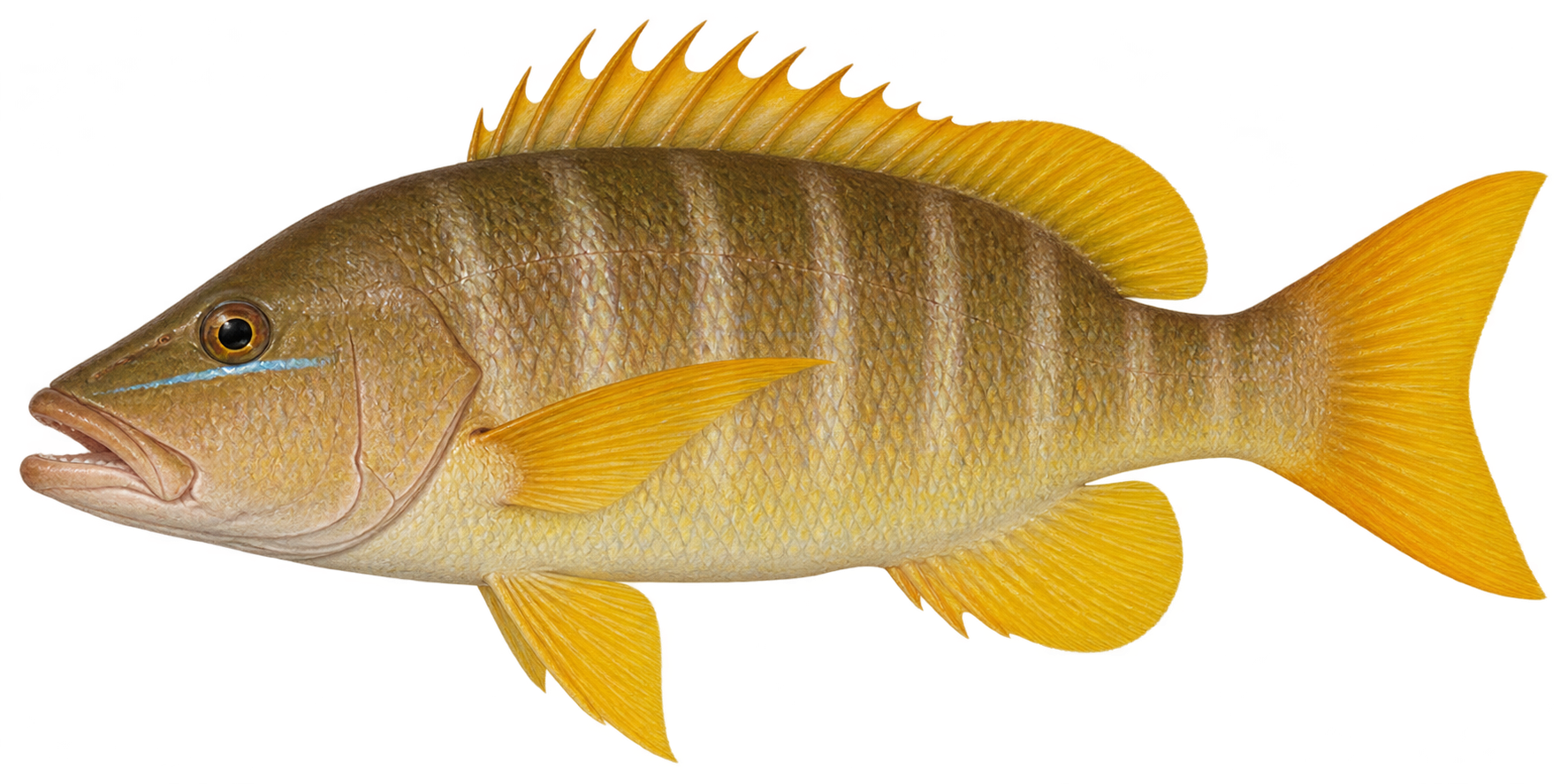
Yellow fins are a strong opening clue, followed by an olive to brown upper body and lighter underside. Pale vertical bars may show across the sides, although they can fade in large adults. A blue line often runs below the eye. The snout is relatively long and pointed, giving the face a different profile from many grunts.
Size and life stages
A common reported length is about 35 centimeters, or 14 inches. Large fish can exceed two feet, but published maxima vary by source and measurement convention. Treat those records as an upper context, not a normal dive expectation. Young schoolmasters can display stronger bars and a head stripe that is less apparent in the adult illustration.
Habitat and where to look
Adults use warm coastal reef habitat, often near shelter. Juveniles also occupy sandy or muddy lagoon bottoms, seagrass and mangrove-associated areas, sometimes in brackish water. Look along the boundary between a sheltered structure and the surrounding open space. Do not reach under cover or push vegetation aside to obtain a view of a hidden fish.
Range and local context
The species belongs to the western Atlantic and Caribbean fauna. For the regional archive, the important evidence is its verified Lake Worth Lagoon record. Southern range limits need care because the similar Brazilian species Lutjanus alexandrei has historically complicated accounts. The Palm Beach fish should be identified from local diagnostic features, not from a broad distribution map alone.
What is on the menu?
Schoolmasters eat fishes and a variety of invertebrates, including shrimp, crabs, worms, mollusks and cephalopods. A quiet fish near cover is not necessarily resting for the entire day; one short dive samples only a moment. Watch any natural feeding without introducing bait or trying to expose prey that would otherwise remain protected beneath the substrate.
Daily habits and behavior
Schoolmasters sometimes form daytime resting groups near shelter. The name therefore fits a recognizable social scene, even though it says nothing about teaching ability. Take time to see whether a gathering contains more than one species. Yellow fins can draw the eye, but nearby snappers or grunts should be checked individually rather than assigned the same identification.
Mating and the next generation
This snapper produces pelagic eggs and larvae, meaning the early stages develop in the water rather than in a guarded bottom nest. The presence of adults beside one another does not establish that they are spawning. Without a directly observed reproductive event, record a school or pair as such and avoid inventing a breeding story.
Look-alikes and identification traps
Dog snapper, gray snapper and other yellowish snappers can be confusing. Schoolmaster’s yellow fins, pale bars and blue cheek line are useful together. The Brazilian sister species has different bar and blue-spot patterns, but is not a reason to relabel a Florida fish without strong evidence. Clear side and head views are preferable to color alone.
Observe without disturbing
Give resting groups room, and avoid repeatedly driving them back into a crevice for a photograph. Keep your fins clear of coral, seagrass and loose sediment. Never feed the fish or try to open its mouth to inspect teeth. When sharing the encounter, a well-supported identification and an honest description are more useful than a dramatic but speculative caption.
Harvest, protection and eating safety
Regulated recreational harvest; restrictions apply
Can it be hunted or harvested?
Florida recreational guidance: minimum ten inches total length, with up to ten per person daily within the ten-snapper aggregate. Biscayne National Park has special rules. This is regulated harvest, not a species-wide no-take designation; identification must be certain.
Florida seasons and areas
No fixed seasonal closure under the Florida recreational summary for either coast, including Atlantic/Palm Beach. Schoolmaster was removed from the South Atlantic federal management plan; Florida rules can still govern Florida landings and applicable vessels. Do not interpret federal delisting as unrestricted take. Check local protected areas and current Florida requirements.
Can it be speared?
Allowed where lawful, for legal-sized fish within the applicable season and bag limits. Check the site before diving: beaches, piers, parks and parts of the Keys have exclusions. Florida state waters prohibit using rebreathers or powerheads to harvest this species.
Is it safe to eat?
Edible, but not automatically safe. Check Florida DOH consumption advisories for the catch location, especially for children and anyone who is or might become pregnant or is breastfeeding. Reef fish can carry ciguatoxin, which cannot be detected by taste or removed by cooking or freezing. Avoid the head, liver, intestines and roe, and do not eat reef fish from areas under a ciguatera advisory. Mercury meal limits and ciguatera precautions address different risks.
Before you act: This recreational overview is not permission to collect or spear at your dive site. Confirm the species, date, management area, state or federal waters, gear, licenses and current local closures. A fish illustration cannot establish an identification or guarantee seafood safety.
Official rules and health guidance
- FWC snapper recreational rules
- South Atlantic Council Amendment 35: schoolmaster removal
- NOAA Gulf seasons and closures
- FWC spearing rules
- Florida DOH seafood poisoning
- Florida DOH local fish advisories
- FDA/EPA fish consumption guidance
- Florida Administrative Code: state-water diving gear
Reviewed 2026-11-10. Rules and advisories can change; check the linked authorities before harvesting or eating.
Sources and review
Reviewed 2026-11-10.
Make your next dive happen
Dive With Us
Explore local charters and plan a dive suited to your experience.
View dive calendarTrain With Us
Build your fish identification, buoyancy and diving skills.
Explore trainingTravel With Us
Discover upcoming dive adventures and trip details.
Explore dive travelShop With Us
Browse equipment for your diving and ask our team for help choosing.
Explore dive gearReview current dates, availability, prices, inclusions and requirements on each listing before booking or buying.
Call us now
Ask about fish identification training
Reef Fish Identification
Ask about dates, prerequisites or your next step. An inquiry does not reserve a place. Please provide your own contact details; do not include medical, payment or a child's personal information.
We use these details to respond to your inquiry. This form does not sign you up for marketing.
Explore more with Stuart Scuba
Open Water course options · Advanced Adventure training · Technical training · Professional training · All courses · Local dives · Dive trips · Facebook · Instagram · YouTube
Your surface-interval essentials
Questions for Stuart Scuba? info@stuartscuba.com
Check the Stuart Scuba Weather Center · Play scuba trivia
Weather and wildlife vary. Confirm current conditions, trip requirements and departure details with the operator.
Plan Your Next Dive with Stuart Scuba
Dive With Us
Explore upcoming local charters and choose a dive that fits your experience.
Before you book
Check the individual listing for departure time, requirements and availability.
Travel With Us
Find upcoming dive adventures and start planning your next trip.
Plan your trip
Review dates, inclusions and trip details on the travel calendar.
Stay Connected with Stuart Scuba
 Follow pageShare
YouTube
SubscribeWatch & shareFollow on InstagramView & share post
Follow company news, training updates, and dive stories.
Follow on LinkedInGoogle Reviews
See Stuart Scuba’s current Google rating and review count below. Open the listing in Google Maps to browse customer reviews.



