

Fish identification archive / Scamp
Scamp
Mycteroperca phenax
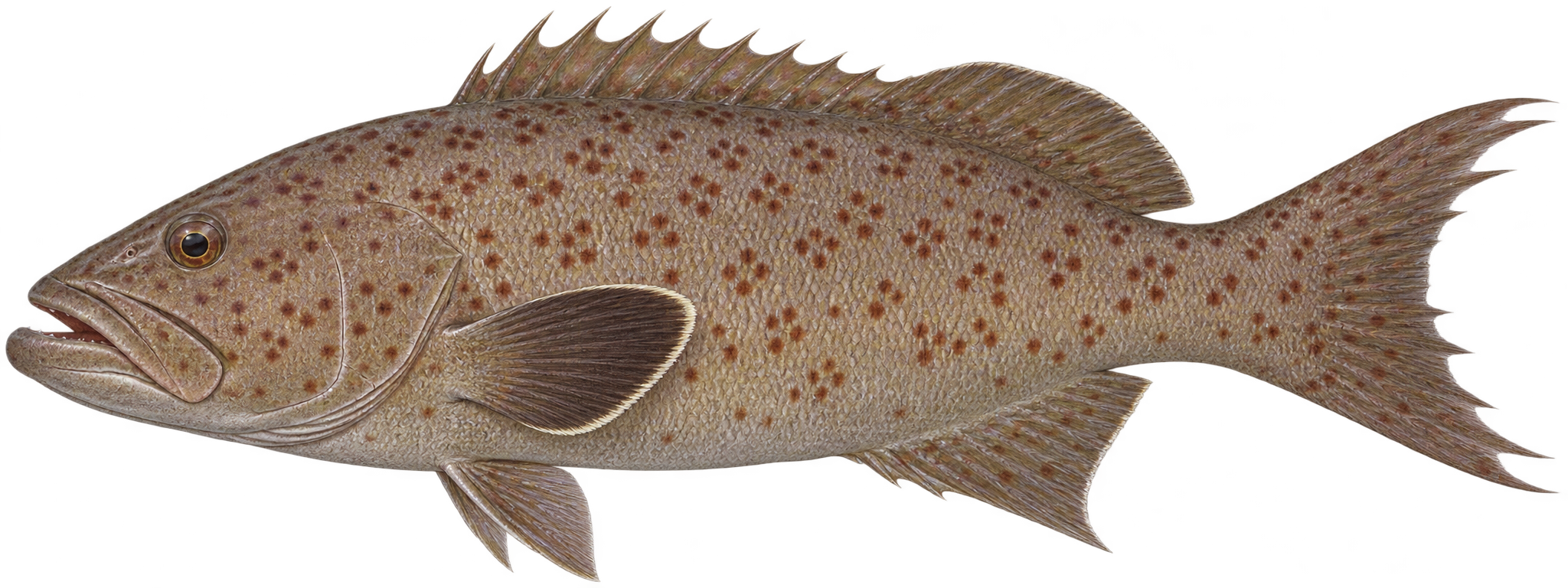
Fun facts for your next surface interval
- Paw prints, no paws: Clusters of tiny spots can resemble paw prints.
- A naturally ragged hem: Adult tail rays project unevenly beyond the tail edge.
- The deeper end: Adults are usually deeper than 30 m, although juveniles can use shallow mangrove habitat.
Florida and local context
Reported in REEF diver surveys at Blue Heron Bridge (WPB), Phil Foster Park. Cumulative survey records document occurrence, not a guaranteed encounter or present-day abundance.
Documented regional presence is not a guarantee of an encounter or a measure of how common this animal is at your dive site.
How to recognize this animal
Scamp have an elongated grouper outline with a projecting lower jaw and a light brown to gray background. Small reddish-brown spots often gather into clusters resembling paw prints. The spots can extend onto the dorsal and anal fins. Large adults have a strongly concave tail with unevenly projecting rays, plus a more pointed rear anal fin. A pale outer edge and darker inner border on the pectoral fin provide supporting clues.
Size and life stages
Smithsonian gives a maximum of 107 cm, approximately 42 inches, consistent with FWC's maximum. Smaller fish may not display the dramatic ragged tail seen in adult reference images. Size is therefore useful context for the fin outline, not a reason to reject every short-tailed juvenile. Do not treat a maximum-size illustration as a typical local encounter.
Habitat and where to look
Adults live around reefs, rocky bottom and ledges. Smithsonian reports a broad 0–110 m range but specifies that adults are usually below 30 m, about 98 feet. Juveniles may enter shallow habitats, including mangroves. Scamp should therefore be presented as a regional reef species with a deeper adult association, not as a routine shallow-water snorkeling subject.
Range and local context
The species occurs in the western Atlantic from North Carolina to Brazil. FWC's Florida account and Smithsonian's regional records support its inclusion in a South Florida guide. They do not establish regular sightings at a named Palm Beach or Stuart site, and deeper adult habitat further limits what a shallow-dive listing can promise. Reported in REEF diver surveys at Blue Heron Bridge (WPB), Phil Foster Park. Cumulative survey records document occurrence, not a guaranteed encounter or present-day abundance.
What is on the menu?
The diet includes small fishes and invertebrates. Smithsonian's account lists bottom-living crustaceans and cephalopods as well as bony fishes. This is an animal-eating reef predator, not a grazer. Watching a fish pause above structure may reveal where it spends time, but prey cannot be named confidently unless the feeding event is actually visible.
Daily habits and behavior
Scamp show several color patterns. Some retain a pale, densely spotted body; others become strikingly two-toned, with a lighter front and darker rear. The species account specifically distinguishes juvenile patterning from the bicolored adult phase. Photograph the whole fish if possible, because a dark rear half alone is poor evidence of identity and does not establish what social interaction is occurring.
Mating and the next generation
FWC describes late-spring spawning and a female-to-male change as fish grow older. State this as the documented life-history pattern rather than assigning a sex to every large fish. Smithsonian records pelagic eggs and larvae. The reviewed material does not provide a verified Palm Beach spawning calendar, so a local seasonal breeding claim would require additional evidence.
Look-alikes and identification traps
Yellowmouth grouper is a particularly close comparison; a hint of yellow at a scamp's mouth corner does not settle the identification. Examine the fine clustered spots, pectoral margins, adult tail rays and overall pattern together. Gag generally show broader marbling and lack the projecting adult tail rays. A juvenile with an incomplete view should remain tentatively identified.
Observe without disturbing
Observe without pursuing a retreating fish below the planned dive depth. Deep occurrence records are biological records, not recreational dive recommendations. Keep lights and cameras outside the shelter opening, and leave enough room for the fish to pass. Do not bait it out of a ledge or handle it to inspect mouth coloration.
Harvest, protection and eating safety
Conditional harvest; rules and location must be checked
Yellow means collection or harvest is conditional on current rules and location. It is not permission to harvest or an assurance that the fish is safe to eat.
This color is a qualified summary, not permission to collect or a guarantee that a particular catch is safe to eat. Read the current rules and health guidance below.
Can it be hunted or harvested?
Florida Atlantic/all Monroe state waters: FWC lists 20-inch total-length minimum and up to three within the three-grouper/tilefish aggregate. SOUTH ATLANTIC FEDERAL WATERS: current 50 CFR 622.187(b)(2)(v) is stricter, allowing only ONE scamp or yellowmouth grouper combined within the three-fish grouper/tilefish aggregate. State and federal bag limits differ. Gulf: 16-inch minimum and up to four within the four-grouper aggregate; federal for-hire captain/crew may retain no grouper. Reef-fish gear and intact landing requirements apply.
Florida seasons and areas
Atlantic/all Monroe state waters: May 1–December 31, closed January–April. Gulf state table lists year-round; federal details require the newer rules: NOAA’s October 2, 2026 Amendment 62 removes the old February–March closure seaward of 20 fathoms. NOAA also says the Gulf other-shallow-water complex, including scamp, will close January 1–June 30 beginning 2027. The former 20-fathom seasonal closure is no longer current. The Edges and other mapped restrictions remain separate checks. Check the precise capture position, jurisdiction and transit route. Keys sanctuary preservation, conservation, research and restoration zones can override general allowances. Within the designated Western Dry Rocks boundary, fishing is closed April 1–July 31; continuous transit requires fish and gear properly stowed. Biscayne’s designated bonefish pre-spawning area prohibits fishing and fish possession March 1–May 31, with a properly stowed continuous-transit exception. These are mapped area rules, not statewide closures.
Can it be speared?
Conditionally possible only when harvest is otherwise legal and the fish can be positively identified before shooting. Species limits, closed seasons and area restrictions still apply. FWC prohibits spearfishing in Monroe County from Long Key north to the Miami-Dade line, near designated public beaches/piers/bridges and jetties, and in applicable park waters. No powerheads, bangsticks or rebreathers. This is not permission for a particular dive site.
Is it safe to eat?
Grouper and snapper can carry ciguatera toxin. Cooking, freezing or marinating does not remove it, and smell/taste do not identify it. Avoid head, viscera and roe of reef fish. No blanket safe-to-eat assurance. Consult current Florida DOH advice for the exact fish, capture water and consumer, particularly pregnancy, nursing and children; this guide does not establish a species-specific meal allowance. Legal harvest and normal appearance do not establish food safety.
Blue Heron Bridge is an observation site: marine-life harvest is prohibited within the designated dive-site boundary. A local occurrence record is not permission to collect or spear.
Before you act: This recreational overview is not permission to collect or spear at your dive site. Confirm the species, date, management area, state or federal waters, gear, licenses and current local closures. Identification artwork cannot establish an identification or guarantee seafood safety.
Official rules and health guidance
- FWC recreational grouper rules
- Current eCFR South Atlantic bag limits
- Current eCFR Gulf bag limits
- NOAA Keys sanctuary zones
- FWC Western Dry Rocks closure
- FWC Biscayne National Park regulations
- FWC jurisdiction and boundary maps
- NOAA Amendment 62 October 2, 2026 bulletin
- Amendment 62 final legal text, 91 FR 63502
- FWC spearing restrictions
- Florida DOH fish consumption guidance
- Florida DOH seafood poisoning
Reviewed 2026-11-11. Rules and advisories can change; check the linked authorities before harvesting or eating.
Sources and review
Reviewed 2026-11-11.
Make your next dive happen
Dive With Us
Explore local charters and plan a dive suited to your experience.
View dive calendarTrain With Us
Build your fish identification, buoyancy and diving skills.
Explore trainingTravel With Us
Discover upcoming dive adventures and trip details.
Explore dive travelShop With Us
Browse equipment for your diving and ask our team for help choosing.
Explore dive gearReview current dates, availability, prices, inclusions and requirements on each listing before booking or buying.
Call us now
Ask about marine life identification
Marine Life Identification
Ask about dates, prerequisites or your next step. An inquiry does not reserve a place. Please provide your own contact details; do not include medical, payment or a child's personal information.
We use these details to respond to your inquiry. This form does not sign you up for marketing.
Explore more with Stuart Scuba
Open Water course options · Advanced Adventure training · Technical training · Professional training · All courses · Local dives · Dive trips · Facebook · Instagram · YouTube
Your surface-interval essentials
Questions for Stuart Scuba? info@stuartscuba.com
Check the Stuart Scuba Weather Center · Play scuba trivia
Weather and wildlife vary. Confirm current conditions, trip requirements and departure details with the operator.
Plan Your Next Dive with Stuart Scuba
Dive With Us
Explore upcoming local charters and choose a dive that fits your experience.
Before you book
Check the individual listing for departure time, requirements and availability.
Travel With Us
Find upcoming dive adventures and start planning your next trip.
Plan your trip
Review dates, inclusions and trip details on the travel calendar.
Stay Connected with Stuart Scuba
 Follow pageShare
YouTube
SubscribeWatch & shareFollow on InstagramView & share post
Follow company news, training updates, and dive stories.
Follow on LinkedInGoogle Reviews
See Stuart Scuba’s current Google rating and review count below. Open the listing in Google Maps to browse customer reviews.



