

Fish identification archive / Sand Seatrout
Sand Seatrout
Cynoscion arenarius · Sciaenidae
I saw this
Spotted this fish? Share the guide with your dive buddies. Review your caption before posting.
For Instagram, copy the caption and link into your own post or message. Nothing is posted automatically and this does not record a verified sighting.
Identification
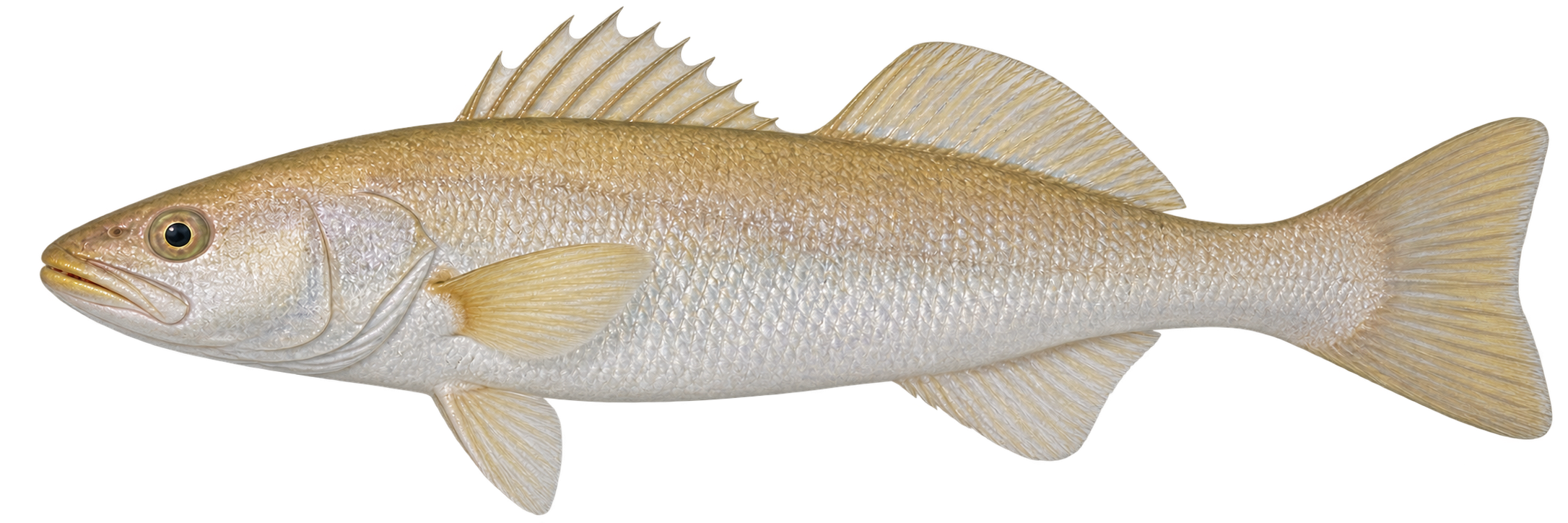
Sand seatrout are pale, elongated fishes with a tan or yellowish upper body, a silvery underside and enlarged teeth at the front of the upper jaw. The inside of the mouth is yellow. Unlike weakfish and spotted seatrout, they lack dark spots on the back, and they have no chin barbels. Do not handle a fish to inspect its mouth; use visible external features and keep uncertain records tentative. FWC sand seatrout identification
Silver seatrout can be confused with this species, and white trout is a nickname used for more than one fish. A pale body or a local nickname alone does not settle the identification. Florida also has weakfish–sand-seatrout hybrids, which can complicate apparent pattern differences.
Why it is included cautiously
FWC describes sand seatrout as primarily Gulf fishes and explicitly calls Atlantic occurrence rare. Nevertheless, the National Park Service includes Cynoscion arenarius among fishes reported in Biscayne National Park. That is adequate for a carefully labeled reported-occurrence profile, not for advertising frequent encounters anywhere from Vero Beach to Key Largo. Biscayne National Park reported fishes
Keep the rare-Atlantic qualification attached whenever this profile is shared. A broad Florida guide can include an unusual fish without implying that a diver is likely to see it on the next trip.
Habitat, food and reproduction
Sand and mud bottoms in coastal bays and offshore settings are important in Gulf accounts. Louisiana Sea Grant describes larger individuals using deeper holes and offshore habitat. Those Gulf observations should not be relabeled as measured Palm Beach behavior. Fish and shrimp are major prey. Sea Grant sand seatrout biology
FWC describes maturity in the first or second year and prolonged spring–summer spawning. A precise southeast Florida calendar has not been established here. Its usual-size statement is below 15 inches, with no specified measurement axis; this is not an absolute maximum.
Three memorable details
- A fish called white trout can have a yellow mouth.
- Lack of dark back spots is part of the identification, not a missing illustration detail.
- Reported in Biscayne and rare in Atlantic waters can both be true; presence does not imply abundance.
Observation and harvest caution
Do not chase or collect an uncertain seatrout to improve a photograph. Record the date, habitat and visible features instead.
FWC’s weakfish regulations address weakfish-like fish, including sand seatrout and hybrids, and distinguish a northeast Florida management zone from other state waters. Confirm current species treatment, location and gear restrictions before any harvest. This page supplies no unrestricted-collection or food-safety assurance. FWC weakfish and look-alike regulations
Make your next dive happen
Dive With Us
Explore local charters and plan a dive suited to your experience.
View dive calendarTrain With Us
Build your fish identification, buoyancy and diving skills.
Explore trainingTravel With Us
Discover upcoming dive adventures and trip details.
Explore dive travelShop With Us
Browse equipment for your diving and ask our team for help choosing.
Explore dive gearReview current dates, availability, prices, inclusions and requirements on each listing before booking or buying.
Call us now
Ask about fish identification training
Reef Fish Identification
Ask about dates, prerequisites or your next step. An inquiry does not reserve a place. Please provide your own contact details; do not include medical, payment or a child's personal information.
We use these details to respond to your inquiry. This form does not sign you up for marketing.
Explore more with Stuart Scuba
Open Water course options · Advanced Adventure training · Technical training · Professional training · All courses · Local dives · Dive trips · Facebook · Instagram · YouTube
Your surface-interval essentials
Questions for Stuart Scuba? info@stuartscuba.com
Check the Stuart Scuba Weather Center · Play scuba trivia
Weather and wildlife vary. Confirm current conditions, trip requirements and departure details with the operator.
Plan Your Next Dive with Stuart Scuba
Dive With Us
Explore upcoming local charters and choose a dive that fits your experience.
Before you book
Check the individual listing for departure time, requirements and availability.
Travel With Us
Find upcoming dive adventures and start planning your next trip.
Plan your trip
Review dates, inclusions and trip details on the travel calendar.
Stay Connected with Stuart Scuba
 Follow pageShare
YouTube
SubscribeWatch & shareFollow on InstagramView & share post
Follow company news, training updates, and dive stories.
Follow on LinkedInGoogle Reviews
See Stuart Scuba’s current Google rating and review count below. Open the listing in Google Maps to browse customer reviews.



