

Fish identification archive / Roughtail Stingray
Roughtail Stingray
Bathytoshia centroura · Dasyatidae
I saw this
Spotted this fish? Share the guide with your dive buddies. Review your caption before posting.
For Instagram, copy the caption and link into your own post or message. Nothing is posted automatically and this does not record a verified sighting.
Identification
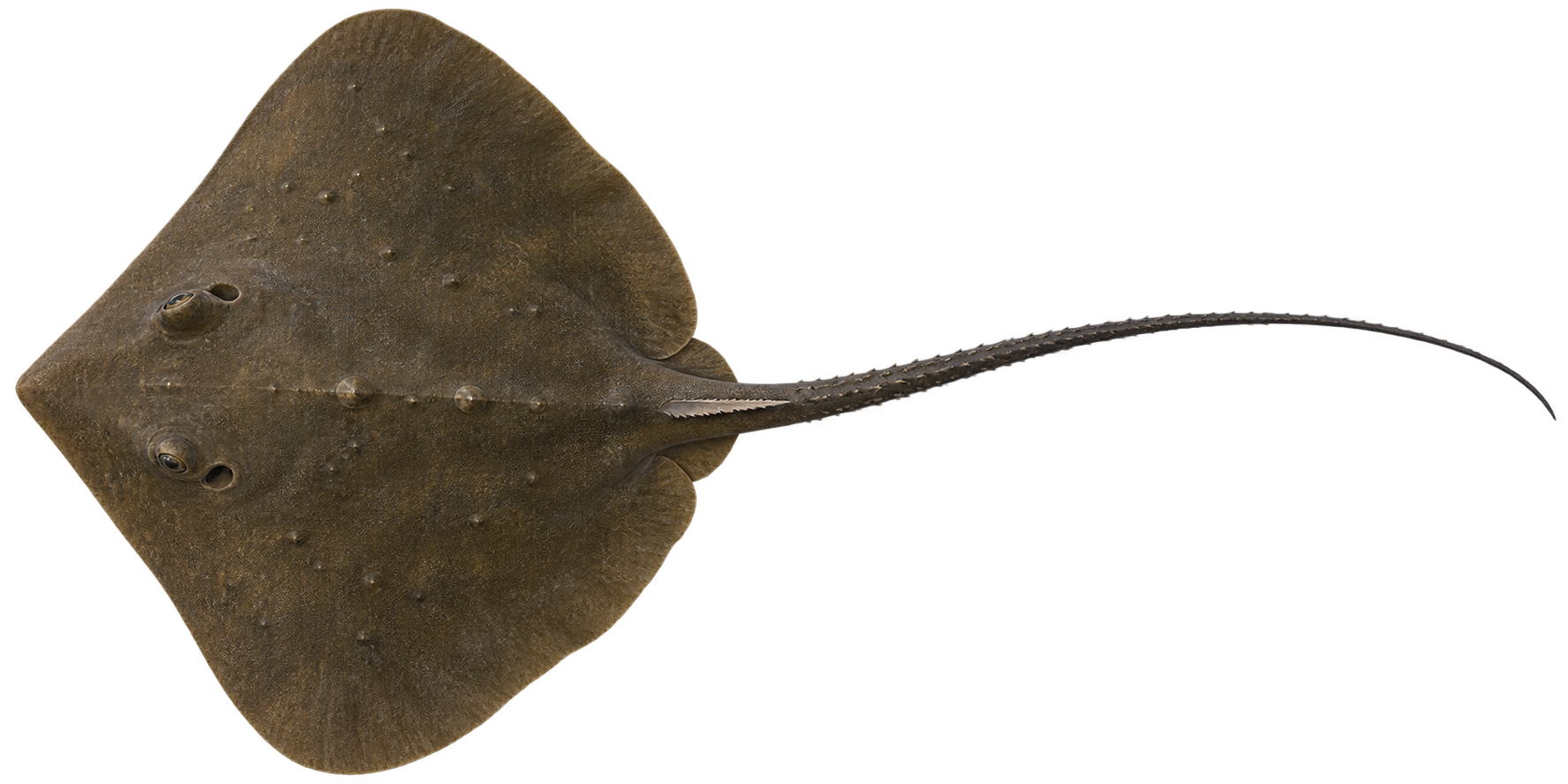
Look for a broad, angular disc and a long tail carrying conspicuous rows of thorns. These rough tail features are more useful than the animal’s impressive size alone. The upper surface is generally dark brown or olive, with a pale underside. The Florida Museum’s roughtail stingray profile also describes larger bucklers along the back and additional roughness on larger animals.
A partly buried ray or one photographed at a steep angle can hide important features. Record the disc outline and naturally visible tail details without approaching the spine. Do not assign a species solely because a ray looks unusually large. Nor should a missing detail in one photograph be treated as proof that it is absent from the animal.
Range and habitat
This species belongs in a regional guide: the museum documents its western Atlantic range south to southern Florida. Sandy and muddy bottoms, including offshore habitat, are characteristic settings. FWC’s roughtail stingray account provides another Florida identification reference.
Neither source establishes a current sighting at a named Stuart Scuba dive site. Older literature may use Dasyatis centroura and broader Atlantic distributions; this guide uses Bathytoshia centroura and does not extend the local claim beyond the supported western Atlantic range. No numerical maximum is used here because width, total length and historical taxonomic scope need careful comparison.
Feeding and reproduction
Roughtail stingrays eat bottom-dwelling invertebrates and fishes. Their young develop inside the female and are born alive. Developing embryos receive yolk and additional maternal nourishment, rather than completing development in an egg case deposited on the seabed. These are biological distinctions, not cues that require handling an animal to confirm.
Responsible observation and rules
Leave a resting ray room to depart and keep fins clear of the bottom. Never touch its tail, stand on its disc or chase it for a better angle. Observe the entire animal from a respectful distance.
FWC explains that “unregulated” does not mean unrestricted: general gear and recreational harvest rules still apply. This profile does not establish a species-specific harvest allowance. Verify identification, jurisdiction and protected-area restrictions before any proposed take. No seafood or restaurant recommendation is implied.
Quick quiz
- What is the most helpful namesake feature? Rows of thorns on the tail.
- Does disc width include the tail? No.
- Egg cases or live young? Live young.
Current observation and collection guidance
This identification guide does not establish permission to collect or harvest this species. Check current FWC rules for Florida waters and possession or landing in Florida, and applicable federal rules for fishing in federal waters. Those jurisdictions are not interchangeable. Biscayne National Park and Florida Keys sanctuary zones can impose additional restrictions or closures. Verify the exact species, location and activity before any proposed take; no food-safety recommendation is made here. FWC recreational saltwater fishing regulations FWC recreational fishing maps FWC guidance for species without individual bag limits Florida shark rule 68B-44.004 Florida Administrative Register notice 30356458 Biscayne National Park fishing regulations Florida Keys National Marine Sanctuary regulations
Blue Heron Bridge report
A November 2010 REEF report by Mike Phelan records roughtail stingray at Blue Heron Bridge (BHB). This historical report does not establish current abundance or guarantee a sighting. Site-specific observation source.
Make your next dive happen
Dive With Us
Explore local charters and plan a dive suited to your experience.
View dive calendarTrain With Us
Build your fish identification, buoyancy and diving skills.
Explore trainingTravel With Us
Discover upcoming dive adventures and trip details.
Explore dive travelShop With Us
Browse equipment for your diving and ask our team for help choosing.
Explore dive gearReview current dates, availability, prices, inclusions and requirements on each listing before booking or buying.
Call us now
Ask about fish identification training
Reef Fish Identification
Ask about dates, prerequisites or your next step. An inquiry does not reserve a place. Please provide your own contact details; do not include medical, payment or a child's personal information.
We use these details to respond to your inquiry. This form does not sign you up for marketing.
Explore more with Stuart Scuba
Open Water course options · Advanced Adventure training · Technical training · Professional training · All courses · Local dives · Dive trips · Facebook · Instagram · YouTube
Your surface-interval essentials
Questions for Stuart Scuba? info@stuartscuba.com
Check the Stuart Scuba Weather Center · Play scuba trivia
Weather and wildlife vary. Confirm current conditions, trip requirements and departure details with the operator.
Plan Your Next Dive with Stuart Scuba
Dive With Us
Explore upcoming local charters and choose a dive that fits your experience.
Before you book
Check the individual listing for departure time, requirements and availability.
Travel With Us
Find upcoming dive adventures and start planning your next trip.
Plan your trip
Review dates, inclusions and trip details on the travel calendar.
Stay Connected with Stuart Scuba
 Follow pageShare
YouTube
SubscribeWatch & shareFollow on InstagramView & share post
Follow company news, training updates, and dive stories.
Follow on LinkedInGoogle Reviews
See Stuart Scuba’s current Google rating and review count below. Open the listing in Google Maps to browse customer reviews.



