

Fish identification archive / Rock Beauty
Rock Beauty
Holacanthus tricolor
I saw this
Spotted this fish? Share the guide with your dive buddies. Review your caption before posting.
For Instagram, copy the caption and link into your own post or message. Nothing is posted automatically and this does not record a verified sighting.
Fun facts for your next surface interval
- That spot has expansion plans: a youngster’s black patch grows into its adult outfit.
- Tiny mouth, surprising toolkit: comb-like teeth are tucked inside.
- Sponges without the chore chart: this specialist eats them rather than washing dishes.
Palm Beach connection
Lake Worth Lagoon / Blue Heron Bridge: Verified species row in Florida Museum local checklist.
Documented regional presence is not a guarantee of an encounter or a measure of how common this fish is at your dive site.
How to recognize this fish
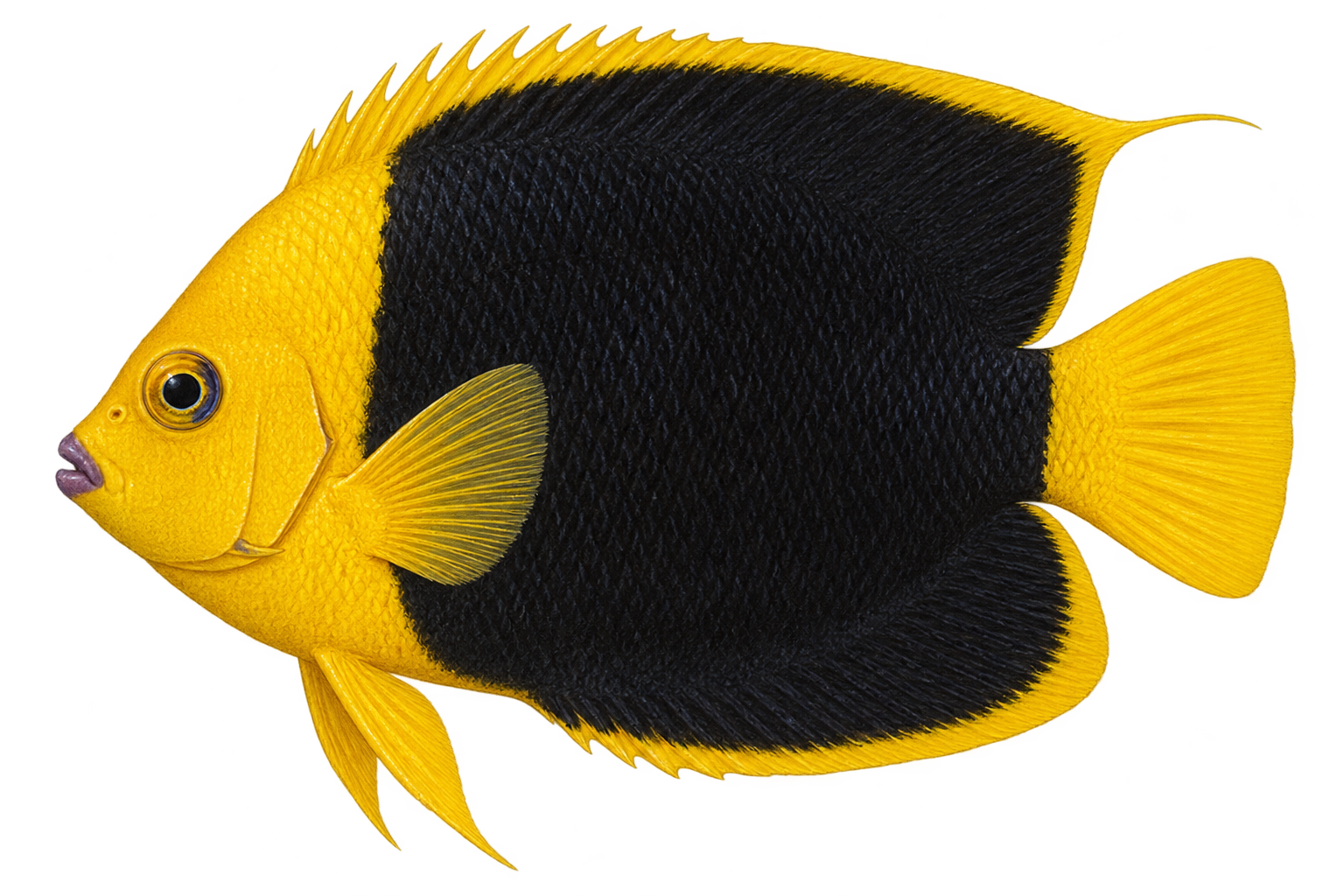
The adult Rock Beauty is an immediately memorable combination of yellow and black: yellow covers the head, front of the body and tail, while a large black field occupies most of the rear body and much of the dorsal and anal fins. The small mouth can look purplish. The body is deep and strongly flattened, with a continuous dorsal fin and a nearly straight rear edge to the tail.
Size and life stages
Published size summaries differ. Smithsonian lists a maximum around 25 cm, while FishBase reports a 35 cm maximum total length. This page retains that difference openly: think of a modest-sized angelfish, with larger published records up to 35 cm, rather than treating either value as a guaranteed ceiling. Small juveniles are mostly yellow with a blue-edged dark spot that enlarges as the adult pattern develops.
Habitat and where to look
Rock and coral reefs provide its principal habitat, and FishBase also records rock jetties. Juveniles are often associated with fire coral. Look with your eyes rather than moving growth or placing hands beside a fish: an apparently convenient support may be living habitat. A good side view should show the division between the yellow forebody and broad black rear field.
Range and local context
Its western Atlantic range includes Florida and extends from the southeastern United States toward Brazil, with island populations also represented. The specific local evidence here is a verified Rock Beauty entry in Florida Museum's Lake Worth Lagoon inventory. That is stronger than assuming presence simply because a range map includes Florida, but it still does not establish regularity on any one dive site.
What is on the menu?
Sponges are important food, and recorded dietary items also include tunicates, zoantharians and algae. A small mouth and brush-like teeth suit picking at attached food. Do not infer the meal from a quick glance at a fish beside coral; it may be taking material from the surface rather than eating the entire structure that appears behind it.
Daily habits and behavior
Adults are often described in persistent pairs. Color pattern is useful for recognition, but it does not reliably distinguish the sexes. A large and a small fish together should not automatically receive male and female labels in a dive log. For a useful behavioral observation, note whether both are feeding, traveling, or remaining close to the same patch of reef.
Mating and the next generation
Spawning pairs rise above the bottom and release eggs and sperm into the water. Eggs and early larvae are pelagic, not guarded on a rock. Sex change has been proposed for this species, but FishBase explicitly treats that proposal as awaiting confirmation; it should not appear here as an established fact. Observed pairing also does not justify a universal claim of lifelong monogamy.
Look-alikes and identification traps
The adult color blocks are more useful than a generic angelfish outline. Juveniles can be less familiar because their blue-ringed black spot has not yet expanded. Compare the position of that spot and the fin shape before assigning a small yellow fish to this species. Do not confuse 'Rock Beauty' with the unrelated Indo-Pacific aquarium name 'Coral Beauty.'
Observe without disturbing
Watch without touching, feeding or rearranging the habitat. Give juvenile fish and their shelter extra room, and do not use fire coral as a handhold. A photograph that includes the complete tail and forebody is more useful for identification than an extreme close-up. If the fish retreats, stop advancing and allow it to resume normal activity.
Harvest, protection and eating safety
Restricted marine life: live collection only; no spearing
Can it be hunted or harvested?
Rock Beauty is regulated as tropical ornamental marine life, rather than an ordinary food-fishing target. Where collection is lawful, a recreational saltwater fishing license is required unless exempt; fish must be landed and kept alive with suitable aeration or circulation. Legal live-collection size: 2–5 inches total length. The daily limit is five angelfish combined, not five of each angelfish species. Five angelfish combined count toward the 20-organism daily marine-life total. A two-day possession limit also applies.
Florida seasons and areas
No recreational closed months are listed in the FWC marine-life rules reviewed. This does not make every location open: collection is prohibited within the designated Blue Heron Bridge dive-site boundary. Florida marine-life rules also apply in adjacent federal waters, on both coasts. Check park, refuge and Florida Keys sanctuary restrictions before collecting.
Can it be speared?
Prohibited. FWC expressly includes this ornamental-fish family in its no-spearing list.
Is it safe to eat?
Not assessed here as food and not recommended as a food target. Legal live collection is not a finding that a fish is safe to eat. Florida DOH advisories depend on catch location and consumer group; cooking cannot remove all marine toxins.
Before you act: This recreational overview is not permission to collect or spear at your dive site. Confirm the species, date, management area, state or federal waters, gear, licenses and current local closures. A fish illustration cannot establish an identification or guarantee seafood safety.
Official rules and health guidance
- FWC: Recreational Marine Life
- Florida Administrative Code: Marine Life, Chapter 68B-42
- FWC: Saltwater Recreational Licenses and Permits
- NOAA: Florida Keys National Marine Sanctuary Zones
- FWC: Spearing
- Florida Department of Health: Eating Healthy Seafood and Local Advisories
- Florida Department of Health: Seafood Poisoning
Reviewed 2026-11-10. Rules and advisories can change; check the linked authorities before harvesting or eating.
Sources and review
Reviewed 2026-11-10.
Make your next dive happen
Dive With Us
Explore local charters and plan a dive suited to your experience.
View dive calendarTrain With Us
Build your fish identification, buoyancy and diving skills.
Explore trainingTravel With Us
Discover upcoming dive adventures and trip details.
Explore dive travelShop With Us
Browse equipment for your diving and ask our team for help choosing.
Explore dive gearReview current dates, availability, prices, inclusions and requirements on each listing before booking or buying.
Call us now
Ask about fish identification training
Reef Fish Identification
Ask about dates, prerequisites or your next step. An inquiry does not reserve a place. Please provide your own contact details; do not include medical, payment or a child's personal information.
We use these details to respond to your inquiry. This form does not sign you up for marketing.
Explore more with Stuart Scuba
Open Water course options · Advanced Adventure training · Technical training · Professional training · All courses · Local dives · Dive trips · Facebook · Instagram · YouTube
Your surface-interval essentials
Questions for Stuart Scuba? info@stuartscuba.com
Check the Stuart Scuba Weather Center · Play scuba trivia
Weather and wildlife vary. Confirm current conditions, trip requirements and departure details with the operator.
Plan Your Next Dive with Stuart Scuba
Dive With Us
Explore upcoming local charters and choose a dive that fits your experience.
Before you book
Check the individual listing for departure time, requirements and availability.
Travel With Us
Find upcoming dive adventures and start planning your next trip.
Plan your trip
Review dates, inclusions and trip details on the travel calendar.
Stay Connected with Stuart Scuba
 Follow pageShare
YouTube
SubscribeWatch & shareFollow on InstagramView & share post
Follow company news, training updates, and dive stories.
Follow on LinkedInGoogle Reviews
See Stuart Scuba’s current Google rating and review count below. Open the listing in Google Maps to browse customer reviews.



