

Fish identification archive / Redspotted hawkfish
Redspotted hawkfish
Amblycirrhitus pinos
Fun facts for your next surface interval
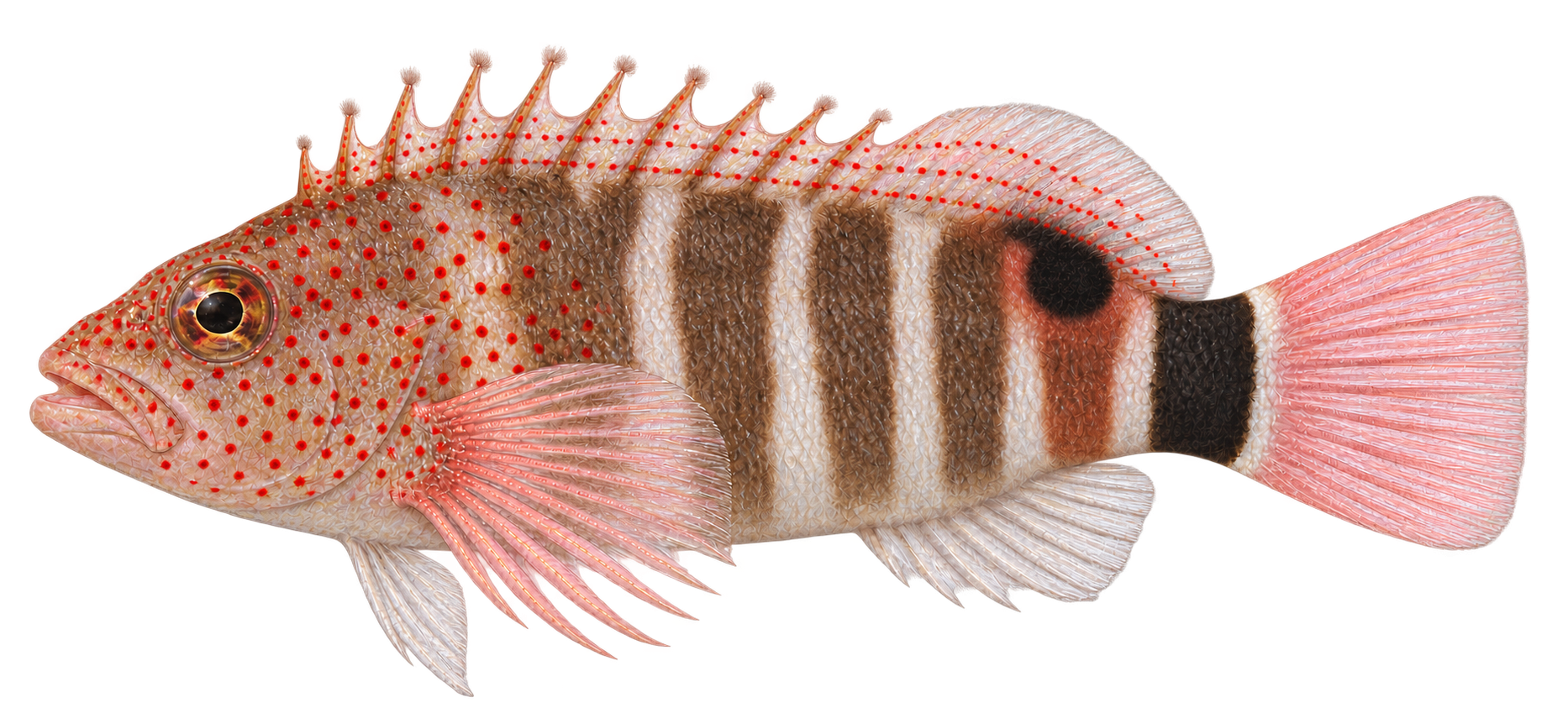
- Built-in perches: its lower pectoral rays act as supports while it perches.
- A little fringe on top: each dorsal spine has a small tuft of threads at its tip.
- Pocket-sized personality: the reported maximum length is less than four inches.
Florida and local context
Reported in REEF diver surveys at Blue Heron Bridge (WPB), Phil Foster Park. Cumulative survey records document occurrence, not a guaranteed encounter or present-day abundance.
Documented regional presence is not a guarantee of an encounter or a measure of how common this animal is at your dive site.
How to recognize this animal
This small hawkfish wears bright red dots on the head and front third of its body, with brown-gray vertical markings farther back. A large dark mark reaches the base of the soft dorsal, and a broad dark band crosses the tail base. Look closely at the dorsal outline: the spine tips carry tiny threadlike tufts. The lower pectoral rays are thick and elongated, forming supports for its perched stance.
Size and life stages
The Smithsonian account records a maximum of 9.5 cm, under four inches. It is small enough for the head pattern to disappear in an ordinary wide reef photograph. A scale estimate and a sharp side image help distinguish actual markings from background texture. Small size alone does not establish that a fish is juvenile.
Habitat and where to look
Reefs are the recorded habitat, with observations compiled across 1–125 m. The relevant field search is for a small fish positioned against hard structure, not for a species guaranteed at a particular depth. Stay clear of coral while examining a ledge or rock surface. Its compact body can blend into the broken colors of its surroundings.
Range and local context
The published range runs from Bermuda to Brazil. Smithsonian occurrence coordinates include the Florida Keys and southeast Florida, supporting regional relevance. The Smithsonian coordinates alone do not measure current abundance or guarantee a sighting. The exact taxon is Amblycirrhitus pinos, in the hawkfish family Cirrhitidae. Reported in REEF diver surveys at Blue Heron Bridge (WPB), Phil Foster Park. Cumulative survey records document occurrence, not a guaranteed encounter or present-day abundance.
What is on the menu?
The compiled diet includes small bottom crustaceans, worms and zooplankton. It is an animal-eater despite its modest size. The enlarged lower pectoral rays support perching, but a perched fish is not proof that it is about to attack prey. Record a feeding strike only if the movement and target are actually visible.
Daily habits and behavior
Perching is a particularly useful behavior to recognize: the lower pectoral rays extend beyond the others and can brace the fish against the bottom. A side-on observation can reveal both these supports and the dorsal tufts. Let the animal choose its position rather than encouraging it to hop between perches for a photograph.
Mating and the next generation
Smithsonian lists pelagic eggs and larvae, so early development includes life in the water column. The sources reviewed for this guide do not establish a Florida spawning season or a specific social group structure. Family-level descriptions of hawkfish mating should not be presented as locally verified behavior for this species.
Look-alikes and identification traps
Belted sandfish can create a similar first impression because both are small, banded reef fishes. For redspotted hawkfish, combine the red head dots, tufted dorsal spines, dark tail-base band and thick lower pectoral supports. Do not identify from a brown bar alone or assume that every fish sitting on a rock is a hawkfish.
Observe without disturbing
Take a patient macro-style view from outside the reef surface, with neutral buoyancy and no hand or camera resting on coral. Avoid moving the animal, lifting cover or repeatedly lighting its face. Include the complete dorsal outline and pectoral base when possible; those structures add more identification value than a tightly cropped portrait.
Harvest, protection and eating safety
No food harvest or spearing; restricted live aquarium collection only
Yellow means collection or harvest is conditional on current rules and location. It is not permission to harvest or an assurance that the fish is safe to eat.
This color is a qualified summary, not permission to collect or a guarantee that a particular catch is safe to eat. Read the current rules and health guidance below.
Can it be hunted or harvested?
Redspotted hawkfish is covered by Florida’s marine-life rules: hawkfish family Cirrhitidae. Recreational collection requires a saltwater license unless exempt, live landing and continued live support using a suitably sized circulating, aerated or oxygenated system. Five of this species within 20 marine-life organisms per person daily; two-day possession ten of this species within 40 total. No recreational sale. No species-specific size limit shown in FWC’s marine-life tables.
Florida seasons and areas
No species-specific annual closed months are listed for this live-collection category. Florida marine-life rules also apply in federal waters. Collection is prohibited inside the designated Blue Heron Bridge dive-site boundary, throughout Biscayne National Park and for this listed group at John Pennekamp Coral Reef State Park. Check the precise capture position, jurisdiction and transit route. Keys sanctuary preservation, conservation, research and restoration zones can override general allowances. Within the designated Western Dry Rocks boundary, fishing is closed April 1–July 31; continuous transit requires fish and gear properly stowed. Biscayne’s designated bonefish pre-spawning area prohibits fishing and fish possession March 1–May 31, with a properly stowed continuous-transit exception. These are mapped area rules, not statewide closures.
Can it be speared?
No. Live-only requirements and the authorized hand/net/slurp-gun methods exclude recreational spearing. No quinaldine.
Is it safe to eat?
Not a food-harvest species under these live-only rules. Do not convert aquarium collection permission into an edible/safe badge. No blanket safe-to-eat assurance. Consult current Florida DOH advice for the exact fish, capture water and consumer, particularly pregnancy, nursing and children; this guide does not establish a species-specific meal allowance. Legal harvest and normal appearance do not establish food safety.
Blue Heron Bridge is an observation site: marine-life harvest is prohibited within the designated dive-site boundary. A local occurrence record is not permission to collect or spear.
Before you act: This recreational overview is not permission to collect or spear at your dive site. Confirm the species, date, management area, state or federal waters, gear, licenses and current local closures. Identification artwork cannot establish an identification or guarantee seafood safety.
Official rules and health guidance
- FWC recreational marine life
- FWC marine-life taxon and Pennekamp applicability; commercial quotas NOT adopted
- FAC marine-life designation rule index
- NOAA Keys sanctuary zones
- FWC Western Dry Rocks closure
- FWC Biscayne National Park regulations
- FWC spearing restrictions
- Florida DOH fish consumption guidance
- Florida DOH seafood poisoning
Reviewed 2026-11-11. Rules and advisories can change; check the linked authorities before harvesting or eating.
Sources and review
Reviewed 2026-11-11.
Make your next dive happen
Dive With Us
Explore local charters and plan a dive suited to your experience.
View dive calendarTrain With Us
Build your fish identification, buoyancy and diving skills.
Explore trainingTravel With Us
Discover upcoming dive adventures and trip details.
Explore dive travelShop With Us
Browse equipment for your diving and ask our team for help choosing.
Explore dive gearReview current dates, availability, prices, inclusions and requirements on each listing before booking or buying.
Call us now
Ask about marine life identification
Marine Life Identification
Ask about dates, prerequisites or your next step. An inquiry does not reserve a place. Please provide your own contact details; do not include medical, payment or a child's personal information.
We use these details to respond to your inquiry. This form does not sign you up for marketing.
Explore more with Stuart Scuba
Open Water course options · Advanced Adventure training · Technical training · Professional training · All courses · Local dives · Dive trips · Facebook · Instagram · YouTube
Your surface-interval essentials
Questions for Stuart Scuba? info@stuartscuba.com
Check the Stuart Scuba Weather Center · Play scuba trivia
Weather and wildlife vary. Confirm current conditions, trip requirements and departure details with the operator.
Plan Your Next Dive with Stuart Scuba
Dive With Us
Explore upcoming local charters and choose a dive that fits your experience.
Before you book
Check the individual listing for departure time, requirements and availability.
Travel With Us
Find upcoming dive adventures and start planning your next trip.
Plan your trip
Review dates, inclusions and trip details on the travel calendar.
Stay Connected with Stuart Scuba
 Follow pageShare
YouTube
SubscribeWatch & shareFollow on InstagramView & share post
Follow company news, training updates, and dive stories.
Follow on LinkedInGoogle Reviews
See Stuart Scuba’s current Google rating and review count below. Open the listing in Google Maps to browse customer reviews.



