

Fish identification archive / Red hind
Red hind
Epinephelus guttatus
Fun facts for your next surface interval
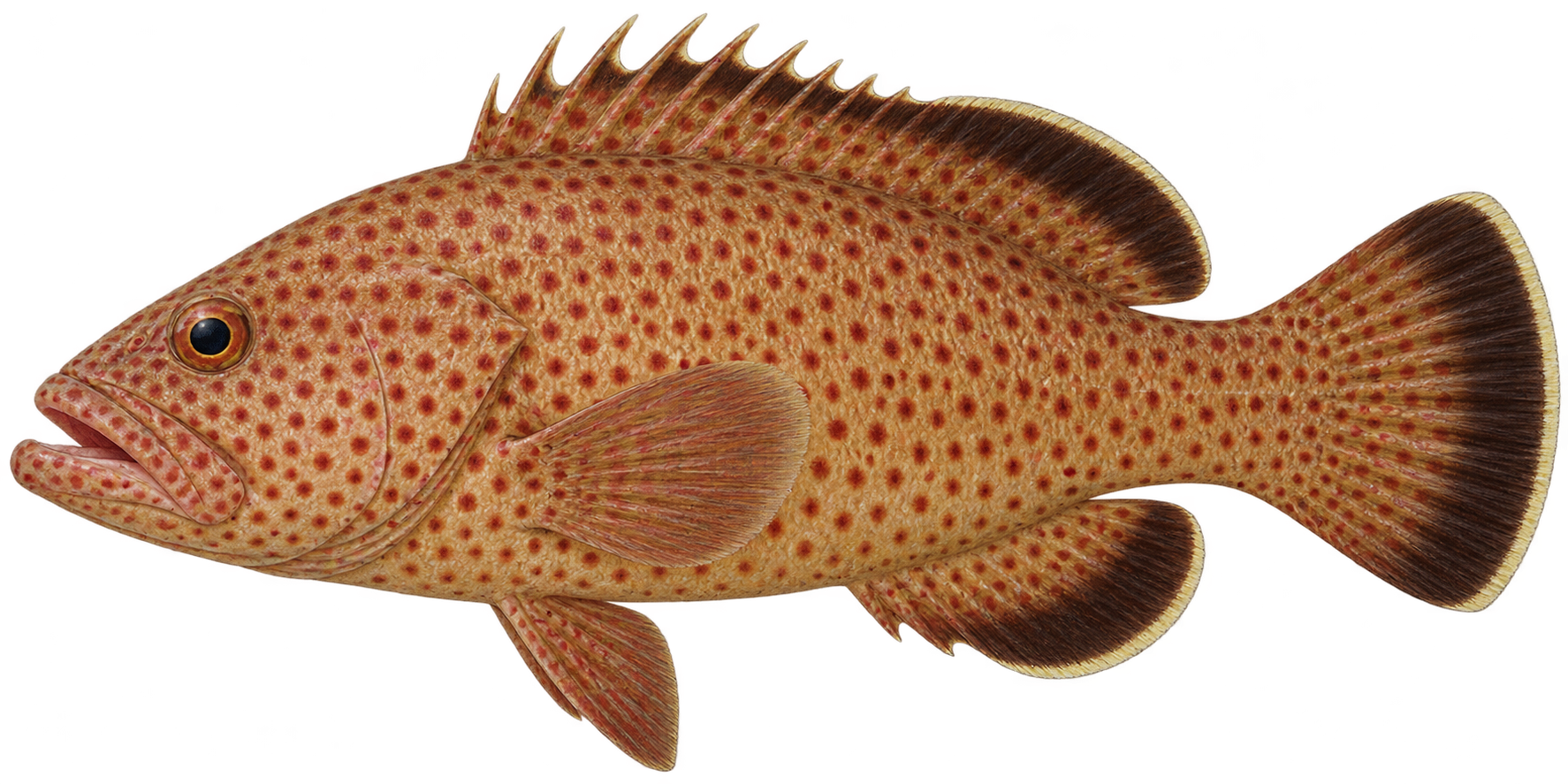
- Finishing touches: its rear fins wear a broad dark band with a thin pale rim.
- Scientists are all ears: researchers can study reproductive activity by listening to its calls.
- An open-water nursery: its early eggs and larvae occupy the water column rather than a visible reef nest.
Florida and local context
Reported in REEF diver surveys at Blue Heron Bridge (WPB), Phil Foster Park. Cumulative survey records document occurrence, not a guaranteed encounter or present-day abundance.
Documented regional presence is not a guarantee of an encounter or a measure of how common this animal is at your dive site.
How to recognize this animal
A red hind is a sturdy, spotted grouper whose background can be pale, yellow-brown, greenish or reddish brown. Red-brown spots cover the head and body. The strongest separation clue lies in the fins: the soft dorsal, anal and tail carry a broad dark band near their outer edges, finished with a narrow pale rim. The tail edge is gently convex rather than deeply forked.
Size and life stages
The Smithsonian account reports a maximum of 76 cm, about 30 inches, and 8.3 kg. These are upper records, not a typical size promised to a diver. Juveniles resemble adults but have proportionally larger spots. Small size does not remove the need to compare fin borders and the back pattern with other hinds.
Habitat and where to look
Reefs and rocky structure are the consistent habitat description, with a compiled depth span of 2–181 m. A broad maximum depth describes occurrence, not a recommended dive destination.
Range and local context
The Smithsonian range extends from North Carolina to Brazil, with occurrence coordinates supporting the Florida Keys and southeast Florida. That supports regional inclusion but does not guarantee a sighting at Stuart or any Palm Beach site. The scientific identity is Epinephelus guttatus; it is distinct from rock hind despite their overlapping spotted appearance. Reported in REEF diver surveys at Blue Heron Bridge (WPB), Phil Foster Park. Cumulative survey records document occurrence, not a guaranteed encounter or present-day abundance.
What is on the menu?
Its listed prey include fishes, crustaceans, worms and cephalopods such as octopuses and squids. This variety describes the species' predatory diet, not the contents of every individual's meal. A fish resting beside a crevice may be using cover, hunting or doing neither visibly; describe an actual strike only when it is observed.
Daily habits and behavior
Red hind are notable for gathering to reproduce, and researchers have studied their reproductive sounds at Caribbean spawning sites. A recent study analyzed long-term acoustic records off western Puerto Rico. Sound offers scientists a way to study behavior that a quick visual survey can miss. These regional findings do not establish an acoustic schedule at a South Florida dive site.
Mating and the next generation
Species-specific research documents spawning aggregations and female-to-male sex change. The species data also list pelagic eggs and larvae. Spawning evidence from Puerto Rico and other Caribbean populations should not be presented as a Palm Beach calendar. Seeing several fish together is not sufficient to confirm a spawning event without additional observations.
Look-alikes and identification traps
Rock hind shares the red-brown spotting but has prominent dark saddles on the upper back and a dark upper tail-base blotch. Red hind's broad dark rear-fin bands and thin pale outer rims provide the better contrast. Graysby and coney are also spotted groupers, so combine tail shape, spot arrangement and fin borders rather than identifying from redness.
Observe without disturbing
Photograph the rear fin margins without chasing the fish from cover. Avoid baiting, touching or crowding a group, especially when reproductive behavior might be involved. Keep location and behavior notes factual, and do not translate an aggregation observation into permission to collect or fish. Current harvest guidance belongs in the separately verified rules section.
Harvest, protection and eating safety
Conditional harvest; rules and location must be checked
Yellow means collection or harvest is conditional on current rules and location. It is not permission to harvest or an assurance that the fish is safe to eat.
This color is a qualified summary, not permission to collect or a guarantee that a particular catch is safe to eat. Read the current rules and health guidance below.
Can it be hunted or harvested?
No minimum size on FWC’s table. Atlantic, including all Monroe County state waters: up to three per person within the three-grouper/tilefish aggregate. Gulf state waters excluding Monroe County: up to four within the four-grouper aggregate. These are combined limits, not extra limits for every species. Must be landed with head and fins intact; reef-fish gear and licensing requirements apply. Biscayne also includes this species in its ten-fish aggregate; smaller species limits still govern and excess listed-species aggregate cannot transit the park. Rule 68B-14.001(1)(c) extends this chapter’s Florida rules to adjacent federal EEZ waters for the expressly named species when no federal regulations apply. This species is expressly named. Federal management-list omission is therefore not a recreational exemption. Commercial permit exemptions do not remove these recreational requirements.
Florida seasons and areas
Atlantic and all Monroe state waters: May 1–December 31 open season, January 1–April 30 closed. Gulf table lists year-round, subject to areas and emergency changes. Check the precise capture position, jurisdiction and transit route. Keys sanctuary preservation, conservation, research and restoration zones can override general allowances. Within the designated Western Dry Rocks boundary, fishing is closed April 1–July 31; continuous transit requires fish and gear properly stowed. Biscayne’s designated bonefish pre-spawning area prohibits fishing and fish possession March 1–May 31, with a properly stowed continuous-transit exception. These are mapped area rules, not statewide closures.
Can it be speared?
Conditionally possible only when harvest is otherwise legal and the fish can be positively identified before shooting. Species limits, closed seasons and area restrictions still apply. FWC prohibits spearfishing in Monroe County from Long Key north to the Miami-Dade line, near designated public beaches/piers/bridges and jetties, and in applicable park waters. No powerheads, bangsticks or rebreathers. This is not permission for a particular dive site.
Is it safe to eat?
Grouper and snapper can carry ciguatera toxin. Cooking, freezing or marinating does not remove it, and smell/taste do not identify it. Avoid head, viscera and roe of reef fish. No blanket safe-to-eat assurance. Consult current Florida DOH advice for the exact fish, capture water and consumer, particularly pregnancy, nursing and children; this guide does not establish a species-specific meal allowance. Legal harvest and normal appearance do not establish food safety.
Blue Heron Bridge is an observation site: marine-life harvest is prohibited within the designated dive-site boundary. A local occurrence record is not permission to collect or spear.
Before you act: This recreational overview is not permission to collect or spear at your dive site. Confirm the species, date, management area, state or federal waters, gear, licenses and current local closures. Identification artwork cannot establish an identification or guarantee seafood safety.
Official rules and health guidance
- FWC recreational grouper rules
- FWC Biscayne National Park regulations
- Cornell codified mirror: FAC 68B-14.001(1)(c)
- Official FAC Rule 68B-14.001 registry
- NOAA Keys sanctuary zones
- FWC Western Dry Rocks closure
- FWC jurisdiction and boundary maps
- FWC spearing restrictions
- Florida DOH fish consumption guidance
- Florida DOH seafood poisoning
Reviewed 2026-11-11. Rules and advisories can change; check the linked authorities before harvesting or eating.
Sources and review
Reviewed 2026-11-11.
- Smithsonian Tropical Research Institute: Shorefishes of the Greater Caribbean, species account and data
- Chérubin et al. (2025), Assessing red hind spawning aggregation changes from call types
- Shervette (2024), red hind research permit application hosted by NOAA
- Smithsonian comparator species account
- Smithsonian comparator species account
- Smithsonian comparator species account
- REEF diver surveys: Blue Heron Bridge (WPB), Phil Foster Park
Make your next dive happen
Dive With Us
Explore local charters and plan a dive suited to your experience.
View dive calendarTrain With Us
Build your fish identification, buoyancy and diving skills.
Explore trainingTravel With Us
Discover upcoming dive adventures and trip details.
Explore dive travelShop With Us
Browse equipment for your diving and ask our team for help choosing.
Explore dive gearReview current dates, availability, prices, inclusions and requirements on each listing before booking or buying.
Call us now
Ask about marine life identification
Marine Life Identification
Ask about dates, prerequisites or your next step. An inquiry does not reserve a place. Please provide your own contact details; do not include medical, payment or a child's personal information.
We use these details to respond to your inquiry. This form does not sign you up for marketing.
Explore more with Stuart Scuba
Open Water course options · Advanced Adventure training · Technical training · Professional training · All courses · Local dives · Dive trips · Facebook · Instagram · YouTube
Your surface-interval essentials
Questions for Stuart Scuba? info@stuartscuba.com
Check the Stuart Scuba Weather Center · Play scuba trivia
Weather and wildlife vary. Confirm current conditions, trip requirements and departure details with the operator.
Plan Your Next Dive with Stuart Scuba
Dive With Us
Explore upcoming local charters and choose a dive that fits your experience.
Before you book
Check the individual listing for departure time, requirements and availability.
Travel With Us
Find upcoming dive adventures and start planning your next trip.
Plan your trip
Review dates, inclusions and trip details on the travel calendar.
Stay Connected with Stuart Scuba
 Follow pageShare
YouTube
SubscribeWatch & shareFollow on InstagramView & share post
Follow company news, training updates, and dive stories.
Follow on LinkedInGoogle Reviews
See Stuart Scuba’s current Google rating and review count below. Open the listing in Google Maps to browse customer reviews.



