

Fish identification archive / Red Grouper
Red Grouper
Epinephelus morio
I saw this
Spotted this fish? Share the guide with your dive buddies. Review your caption before posting.
For Instagram, copy the caption and link into your own post or message. Nothing is posted automatically and this does not record a verified sighting.
Fun facts for your next surface interval
- Some red grouper are underwater renovators, clearing spaces that other animals can use.
- Many start adult life as females; some later become males.
- A grouper can swallow prey whole: the large mouth is functional, not just a surprised expression.
Palm Beach connection
Lake Worth Lagoon / Blue Heron Bridge, Palm Beach County: Verified local record.
Documented regional presence is not a guarantee of an encounter or a measure of how common this fish is at your dive site.
How to recognize this fish
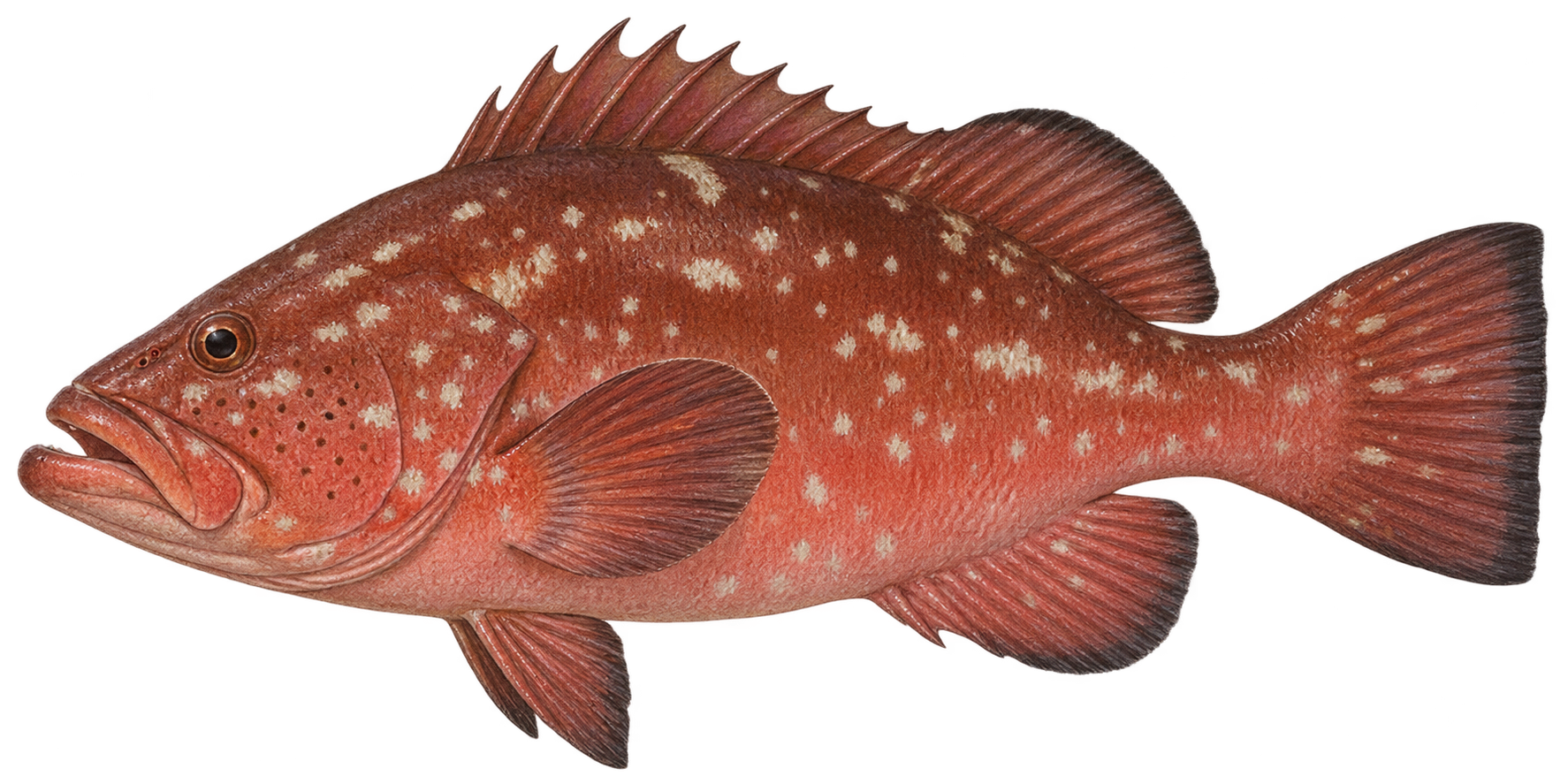
Look for a robust grouper with a large mouth, reddish-brown upper body and paler pinkish lower side. Scattered light blotches and small dark cheek spots can help. The tail is nearly squared rather than deeply forked. Reds may look muted underwater, so do not reject the identification just because the animal looks brown; use the full pattern and proportions.
Size and life stages
Large individuals can approach 4 feet, but a diver may encounter considerably smaller fish. Red grouper grow slowly and can live for decades. Size alone does not establish age or reproductive status. If a fish stays partly within a hole, avoid estimating a precise total length from the head and shoulders that happen to be visible.
Habitat and where to look
Young fish use shallow seagrass, rocky areas and reefs; larger fish often occupy offshore rocky habitat, ledges and cavities. Low-profile bottom can be important too, so the tallest reef feature is not the only place worth watching. Scan shelter edges without inserting a camera or light into the opening, and leave room for the fish to move freely.
Range and local context
Red grouper occur in the western Atlantic from the United States toward Brazil, including the Gulf and Caribbean. Verified Lake Worth Lagoon documentation supplies the local connection. It does not establish the size or abundance of today's population. The family is treated here as Epinephelidae, while some familiar references place groupers within a broader Serranidae classification.
What is on the menu?
Fish, octopuses and crustaceans are among the prey. A large mouth creates a rapid inward flow of water that helps engulf food. Those jaws are tools for capturing prey, not an invitation for feeding by hand. Natural predation can be observed without supplying bait or trying to place another reef animal in front of the grouper.
Daily habits and behavior
Red grouper can excavate and maintain areas of bottom, creating space used by other animals. NOAA describes this habitat-modifying role as marine engineering. If you notice a cleared depression, watch its surroundings without assuming every hole was made by the fish present. The association is interesting, but a photograph alone may not establish who constructed or maintains a particular shelter.
Mating and the next generation
This species generally matures as female, with some individuals later becoming male. Eggs and sperm are released into the water, and early stages drift before settling. Published spawning timing varies by region, so this page does not promise a specific local breeding spectacle. A large fish is not automatically a male, and a group near shelter is not automatically spawning.
Look-alikes and identification traps
Nassau grouper can show conspicuous vertical bars and a dark saddle at the tail base, unlike the typical red grouper pattern. Other grouper species can also be brown and blotched, so a reddish impression alone is weak evidence. A side photograph including the tail base, dorsal outline and cheek offers more useful detail than a close crop of the mouth.
Observe without disturbing
Do not feed, pursue or touch groupers, and never push equipment into a hole to make one leave. Keep away from the substrate around a shelter and let natural behavior continue. If you see a fish moving sediment, observe without helping or rearranging material. Record the behavior in plain terms and avoid assigning an exact age, sex or ecological role that the sighting cannot prove.
Harvest, protection and eating safety
Regulated recreational harvest; restrictions apply
Can it be hunted or harvested?
Minimum 20 inches total length. Atlantic/Palm Beach: up to three per person within the three-fish grouper/tilefish aggregate. Gulf: two within four-grouper aggregate; Gulf state charter captain/crew retention prohibited. Biscayne National Park has special limits.
Florida seasons and areas
Atlantic Florida federal waters and Atlantic/Monroe state waters: closed January 1–April 30, with a May 1–December 31 harvest pattern. Gulf state waters outside Monroe have no fixed seasonal closure. NOAA removed the Gulf federal February–March 20-fathom closure effective October 2, 2026. The Edges closes January–April. Annual catch limits can cause additional closures; verify current bulletins before harvesting.
Can it be speared?
Allowed where lawful, for legal-sized fish within the applicable season and bag limits. Check the site before diving: beaches, piers, parks and parts of the Keys have exclusions. Florida state waters prohibit using rebreathers or powerheads to harvest this species.
Is it safe to eat?
Edible, but not automatically safe. Check Florida DOH consumption advisories for the catch location, especially for children and anyone who is or might become pregnant or is breastfeeding. Reef fish can carry ciguatoxin, which cannot be detected by taste or removed by cooking or freezing. Avoid the head, liver, intestines and roe, and do not eat reef fish from areas under a ciguatera advisory. Mercury meal limits and ciguatera precautions address different risks.
Before you act: This recreational overview is not permission to collect or spear at your dive site. Confirm the species, date, management area, state or federal waters, gear, licenses and current local closures. A fish illustration cannot establish an identification or guarantee seafood safety.
Official rules and health guidance
- FWC grouper recreational rules
- NOAA Amendment 62 final rule, effective October 2, 2026
- NOAA Gulf seasons and closures
- South Atlantic Council species regulations
- FWC spearing rules
- Florida DOH seafood poisoning
- Florida DOH local fish advisories
- FDA/EPA fish consumption guidance
- Florida Administrative Code: state-water diving gear
Reviewed 2026-11-10. Rules and advisories can change; check the linked authorities before harvesting or eating.
Sources and review
Reviewed 2026-11-10.
Make your next dive happen
Dive With Us
Explore local charters and plan a dive suited to your experience.
View dive calendarTrain With Us
Build your fish identification, buoyancy and diving skills.
Explore trainingTravel With Us
Discover upcoming dive adventures and trip details.
Explore dive travelShop With Us
Browse equipment for your diving and ask our team for help choosing.
Explore dive gearReview current dates, availability, prices, inclusions and requirements on each listing before booking or buying.
Call us now
Ask about fish identification training
Reef Fish Identification
Ask about dates, prerequisites or your next step. An inquiry does not reserve a place. Please provide your own contact details; do not include medical, payment or a child's personal information.
We use these details to respond to your inquiry. This form does not sign you up for marketing.
Explore more with Stuart Scuba
Open Water course options · Advanced Adventure training · Technical training · Professional training · All courses · Local dives · Dive trips · Facebook · Instagram · YouTube
Your surface-interval essentials
Questions for Stuart Scuba? info@stuartscuba.com
Check the Stuart Scuba Weather Center · Play scuba trivia
Weather and wildlife vary. Confirm current conditions, trip requirements and departure details with the operator.
Plan Your Next Dive with Stuart Scuba
Dive With Us
Explore upcoming local charters and choose a dive that fits your experience.
Before you book
Check the individual listing for departure time, requirements and availability.
Travel With Us
Find upcoming dive adventures and start planning your next trip.
Plan your trip
Review dates, inclusions and trip details on the travel calendar.
Stay Connected with Stuart Scuba
 Follow pageShare
YouTube
SubscribeWatch & shareFollow on InstagramView & share post
Follow company news, training updates, and dive stories.
Follow on LinkedInGoogle Reviews
See Stuart Scuba’s current Google rating and review count below. Open the listing in Google Maps to browse customer reviews.



