

Fish identification archive / Red Drum
Red Drum
Sciaenops ocellatus · Sciaenidae
I saw this
Spotted this fish? Share the guide with your dive buddies. Review your caption before posting.
For Instagram, copy the caption and link into your own post or message. Nothing is posted automatically and this does not record a verified sighting.
Identification and lookalikes
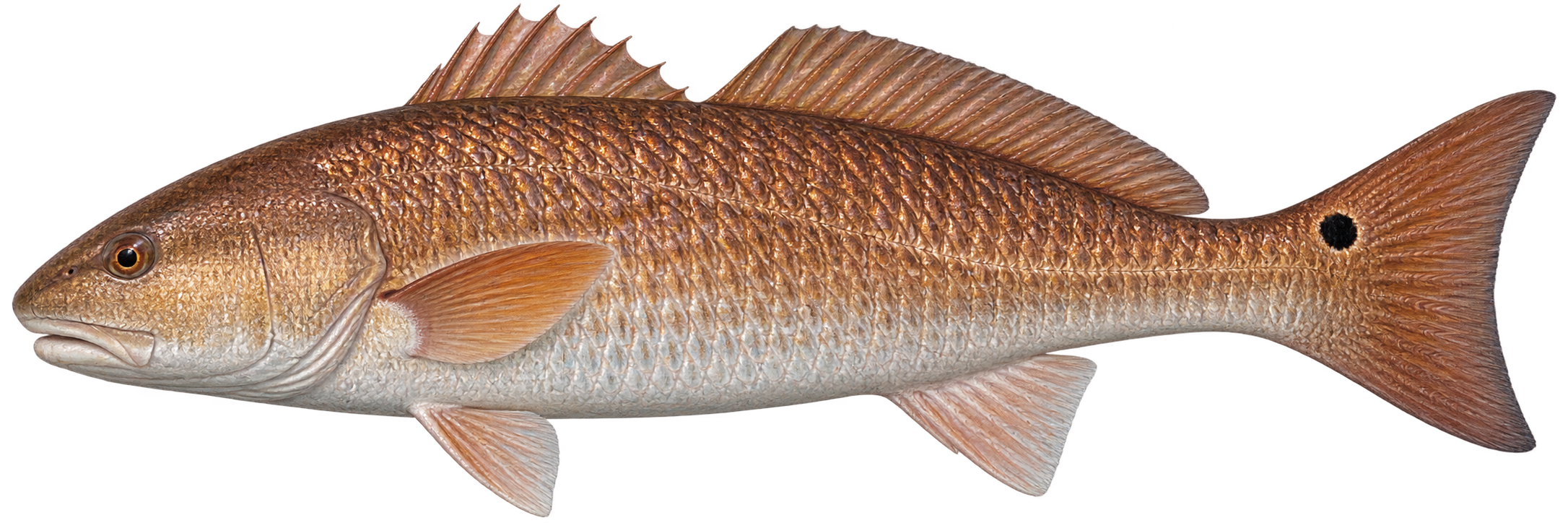
Start at the tail: red drum usually have a dark spot near its base, although some have several and a few lack one. Copper-bronze scales fade toward a pale belly. Check the chin as well: red drum lack the barbels of black drum. Color alone is unreliable because individuals can look much more silvery than their name suggests. FWC species identification Florida Museum species account
Florida habitat and range
Red drum use estuaries, oyster margins, seagrass, sand and muddy shallows. Younger fish spend their early years in sheltered coastal habitats; larger fish also occupy open coastal water. They tolerate substantial changes in salinity. These habitat descriptions support Florida occurrence, not a guaranteed encounter at any particular Palm Beach dive site. FWC species identification Florida Museum species account
Feeding and reproduction
The menu includes fishes and bottom invertebrates. FWC describes spawning around passes, inlets and lagoon estuaries approximately August through December. During reproduction, specialized muscles associated with the swim bladder help produce the familiar drumming sound. Dates describe a biological season, not a legal harvest season. FWC species identification
Size and growth
The Florida Museum reports a maximum of 155 cm total length. That measures from the snout to the end of the tail; it is neither a usual sighting size nor permission to keep a fish. Adults can live for decades, making older fish more than just oversized versions of juveniles. Florida Museum species account
Three facts to remember
- The percussion section is built in: a red drum can make sound without striking anything.
- Its tail spot is not a strict one-per-fish accessory; several spots can occur.
- An estuary nursery and an adult coastal habitat can be different chapters of the same fish’s life. FWC species identification Florida Museum species account
Observation and Florida harvest caution
Watch without feeding or cornering the fish. Record the whole flank, chin and tail pattern when photographing an identification.
Rules checked November 11, 2026: FWC lists the Indian River Lagoon region as catch-and-release only. The Southeast region has different limits: an 18–27-inch total-length slot, one fish per person daily and a two-fish vessel limit. The Martin–Palm Beach boundary matters, and the Loxahatchee River is included in the Southeast region. Spearing is prohibited. Check FWC’s map, current rules and protected-area restrictions before acting. FWC current harvest rules
Make your next dive happen
Dive With Us
Explore local charters and plan a dive suited to your experience.
View dive calendarTrain With Us
Build your fish identification, buoyancy and diving skills.
Explore trainingTravel With Us
Discover upcoming dive adventures and trip details.
Explore dive travelShop With Us
Browse equipment for your diving and ask our team for help choosing.
Explore dive gearReview current dates, availability, prices, inclusions and requirements on each listing before booking or buying.
Call us now
Ask about fish identification training
Reef Fish Identification
Ask about dates, prerequisites or your next step. An inquiry does not reserve a place. Please provide your own contact details; do not include medical, payment or a child's personal information.
We use these details to respond to your inquiry. This form does not sign you up for marketing.
Explore more with Stuart Scuba
Open Water course options · Advanced Adventure training · Technical training · Professional training · All courses · Local dives · Dive trips · Facebook · Instagram · YouTube
Your surface-interval essentials
Questions for Stuart Scuba? info@stuartscuba.com
Check the Stuart Scuba Weather Center · Play scuba trivia
Weather and wildlife vary. Confirm current conditions, trip requirements and departure details with the operator.
Plan Your Next Dive with Stuart Scuba
Dive With Us
Explore upcoming local charters and choose a dive that fits your experience.
Before you book
Check the individual listing for departure time, requirements and availability.
Travel With Us
Find upcoming dive adventures and start planning your next trip.
Plan your trip
Review dates, inclusions and trip details on the travel calendar.
Stay Connected with Stuart Scuba
 Follow pageShare
YouTube
SubscribeWatch & shareFollow on InstagramView & share post
Follow company news, training updates, and dive stories.
Follow on LinkedInGoogle Reviews
See Stuart Scuba’s current Google rating and review count below. Open the listing in Google Maps to browse customer reviews.



