

Fish identification archive / Ragged Sea Hare
Ragged Sea Hare
Bursatella leachii · Aplysiidae
I saw this
Spotted this marine life? Share the guide with your dive buddies. Review your caption before posting.
For Instagram, copy the caption and link into your own post or message. Nothing is posted automatically and this does not record a verified sighting.
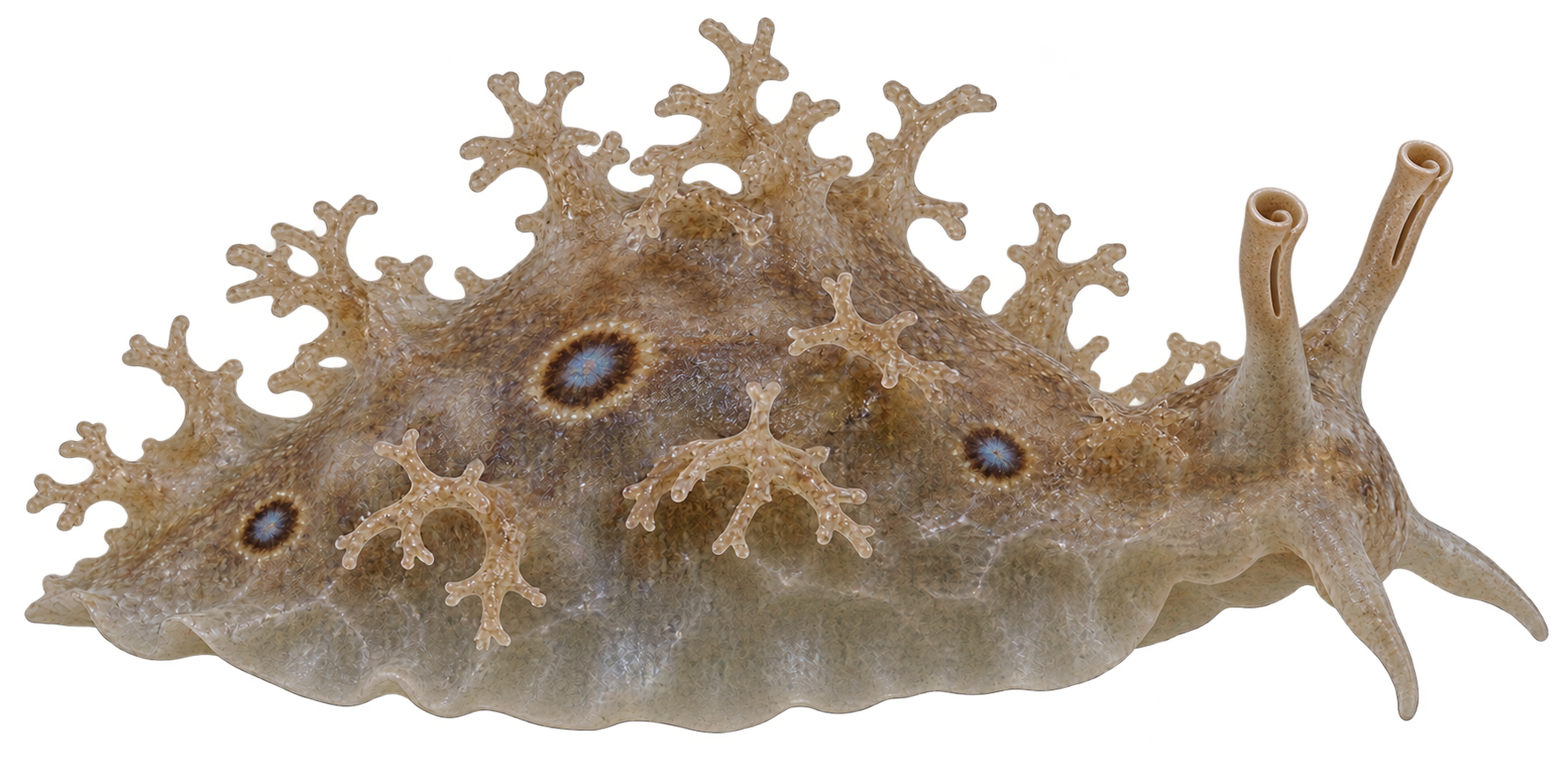
A ragged sea hare can resemble a loose tuft of growth until it starts crawling. Bursatella leachii has an irregular covering of branching, fleshy projections, often accompanied by dark blotches with bright blue centers. Its body varies in color, so the shaggy outline is more useful than expecting every animal to match one photograph. Unlike a shell-carrying snail, an adult has no visible external shell.
Documented local animals and eggs
This is a particularly strong addition to an Atlantic South Florida identification guide. Australian Museum Sea Slug Forum records describe living animals in Fort Pierce’s intertidal and shallow lagoon habitats in December 2008. Photographs from Lake Worth Lagoon, Riviera Beach, document adults laying eggs in November 2008. A separate February 2003 record shows animals and eggs in Boca Raton’s Intracoastal Waterway. Biscayne National Park also lists the species.
These are dated observations, not a promise that a present-day dive will encounter an aggregation. They support lagoon and sheltered nearshore coverage within the Vero–Key Largo corridor; they do not establish a sighting at every reef or at Vero Beach itself. The locality of each observation matters more than a general label such as “Florida Keys.”
Feeding and life history
Ragged sea hares graze on microbial and algal material, including cyanobacteria and diatoms. Their food is quite different from the animal prey pursued by many other marine snails. Keep that distinction in mind when watching a slug move across a film-covered bottom: movement alone does not reveal exactly what it is eating.
The eggs form a long cord containing capsules. After hatching, larvae enter the plankton before settling and developing toward the crawling adult stage. The photographed Lake Worth animals provide direct local evidence of egg-laying. One November observation cannot define a Florida-wide breeding season, and neither a dense gathering nor a stranded animal should automatically be described as breeding behavior.
Identification and observation
Photograph the whole animal, the head tentacles and the texture of the body without lifting it. The shaggy projections help separate this animal from the smoother spotted sea hare already included in this guide. Older sources sometimes use Bursatella leachii pleii; the World Register of Marine Species treats that name under Bursatella leachii, not as an additional species for counting pages.
Leave adults and egg cords where they are. Review current FWC marine-life requirements and the rules of the particular park or dive site before considering any collection. This identification page offers no harvest authorization.
References
Collection and habitat protection
Check current FWC marine-life requirements and exact-site restrictions before collecting. This profile is for observation, not collection authorization. Current FWC marine-life guidance. Guidance reviewed November 12, 2026. No location-specific collection clearance is given.
Make your next dive happen
Dive With Us
Explore local charters and plan a dive suited to your experience.
View dive calendarTrain With Us
Build your fish identification, buoyancy and diving skills.
Explore trainingTravel With Us
Discover upcoming dive adventures and trip details.
Explore dive travelShop With Us
Browse equipment for your diving and ask our team for help choosing.
Explore dive gearReview current dates, availability, prices, inclusions and requirements on each listing before booking or buying.
Call us now
Ask about fish identification training
Reef Fish Identification
Ask about dates, prerequisites or your next step. An inquiry does not reserve a place. Please provide your own contact details; do not include medical, payment or a child's personal information.
We use these details to respond to your inquiry. This form does not sign you up for marketing.
Explore more with Stuart Scuba
Open Water course options · Advanced Adventure training · Technical training · Professional training · All courses · Local dives · Dive trips · Facebook · Instagram · YouTube
Your surface-interval essentials
Questions for Stuart Scuba? info@stuartscuba.com
Check the Stuart Scuba Weather Center · Play scuba trivia
Weather and wildlife vary. Confirm current conditions, trip requirements and departure details with the operator.
Plan Your Next Dive with Stuart Scuba
Dive With Us
Explore upcoming local charters and choose a dive that fits your experience.
Before you book
Check the individual listing for departure time, requirements and availability.
Travel With Us
Find upcoming dive adventures and start planning your next trip.
Plan your trip
Review dates, inclusions and trip details on the travel calendar.
Stay Connected with Stuart Scuba
 Follow pageShare
YouTube
SubscribeWatch & shareFollow on InstagramView & share post
Follow company news, training updates, and dive stories.
Follow on LinkedInGoogle Reviews
See Stuart Scuba’s current Google rating and review count below. Open the listing in Google Maps to browse customer reviews.



