

Fish identification archive / Queen Triggerfish
Queen Triggerfish
Balistes vetula
I saw this
Spotted this fish? Share the guide with your dive buddies. Review your caption before posting.
For Instagram, copy the caption and link into your own post or message. Nothing is posted automatically and this does not record a verified sighting.
Fun facts for your next surface interval
- The dorsal spine has a locking mechanism: reef parking security, fish-style.
- Sea urchin dinner may begin with a water-powered flip.
- The royal-looking tail develops longer trailing tips as the fish grows.
Palm Beach connection
Lake Worth Lagoon / Blue Heron Bridge, Palm Beach County: Verified local record.
Documented regional presence is not a guarantee of an encounter or a measure of how common this fish is at your dive site.
How to recognize this fish
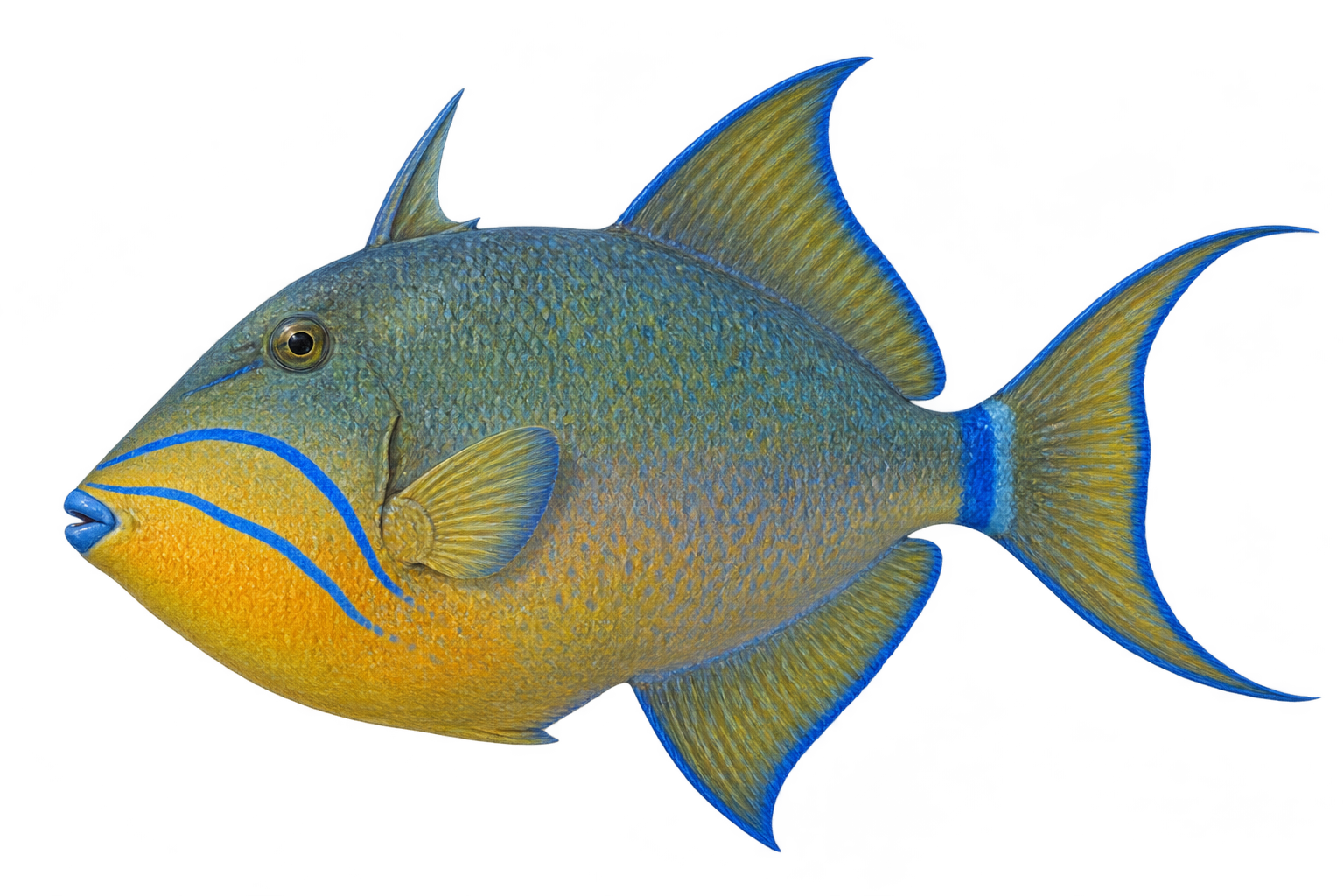
Look for a deep, compressed body with the eye high on the head and a small mouth at the front. Two sweeping blue bands curve across the lower face. Yellow-orange colors below contrast with a gray-green or bluish upper body. Adults develop an impressive crescent-shaped tail with extended tips. Those combined features are much more useful than remembering simply that the fish was colorful.
Size and life stages
A commonly reported length is about 12 inches, with maximum records near 24 inches. Juveniles can be paler and have shorter fin extensions, so an adult illustration is not a perfect template for every life stage. Record which features are visible rather than rejecting a small fish solely because its tail lacks the dramatic streamers of a large adult.
Habitat and where to look
Rocky and coral areas provide feeding and shelter, while sand and grassy habitats are also used. The interface between reef and open bottom is a useful place to scan during an otherwise planned dive. Avoid wandering into a nest area or leaving your group in pursuit of one. Habitat suggests where to look; it cannot confirm an identification by itself.
Range and local context
Queen triggerfish occur in the Atlantic on both its western and eastern sides. Our local connection is a verified Lake Worth Lagoon record. Presence in that checklist is not a promise of regular sightings at Blue Heron Bridge, nor does it mean all triggerfishes photographed nearby are this species. Match the blue facial bands and overall proportions before selecting a name.
What is on the menu?
Hard-bodied bottom animals are important food. A queen triggerfish can blow water at a sea urchin to turn it over and expose a less heavily defended surface. Its strong mouth handles a variety of invertebrates. Watch feeding without supplying prey or disturbing an urchin yourself; the behavior is interesting precisely because the fish is solving its own problem.
Daily habits and behavior
The trigger mechanism helps lock an erect dorsal spine in place when the fish shelters in a crevice. Swimming often relies on the rear dorsal and anal fins, while the tail remains available for stronger movement. These details reward a calm side-on view. Do not attempt to test the locking mechanism or encourage a defensive display for a photograph.
Mating and the next generation
Eggs are placed in a prepared depression in sand, and nesting fish can defend the area vigorously. This is a reason to allow generous space, not an opportunity to photograph a confrontation. If a fish turns toward you repeatedly or appears to be guarding a patch, withdraw calmly rather than staying to determine the exact boundary.
Look-alikes and identification traps
Gray triggerfish lack the queen's distinctive paired blue facial bands and adult trailing tail tips. Filefishes can also have deep bodies and an erect spine, but their proportions and markings differ. Concentrate on the face, tail and fin arrangement together. A glimpse of a raised spine tells you something useful, but it is not a complete species identification.
Observe without disturbing
Never approach a nest closely, feed a triggerfish, or put fingers near its mouth. Keep your body and equipment off the bottom and let the animal choose its route. A respectful photograph should show natural behavior without making the fish defend itself. For a dive log, record whether it was cruising, feeding or sheltering, and leave uncertain interpretations clearly labeled.
Harvest, protection and eating safety
Restricted marine life: live collection only; no spearing
Can it be hunted or harvested?
Queen Triggerfish is regulated as tropical ornamental marine life, rather than an ordinary food-fishing target. Where collection is lawful, a recreational saltwater fishing license is required unless exempt; fish must be landed and kept alive with suitable aeration or circulation. No species-specific size limit is listed. Queen triggerfish is not one of the gray/ocean triggerfish exceptions. The daily limit is five of this species within 20 marine-life organisms total. A two-day possession limit also applies.
Florida seasons and areas
No recreational closed months are listed in the FWC marine-life rules reviewed. This does not make every location open: collection is prohibited within the designated Blue Heron Bridge dive-site boundary. Florida marine-life rules also apply in adjacent federal waters, on both coasts. Check park, refuge and Florida Keys sanctuary restrictions before collecting.
Can it be speared?
Prohibited. The no-spearing exceptions for gray and ocean triggerfish do not include queen triggerfish. Do not copy gray-triggerfish seasons or limits onto this species.
Is it safe to eat?
Not assessed here as food and not recommended as a food target. Legal live collection is not a finding that a fish is safe to eat. Florida DOH advisories depend on catch location and consumer group; cooking cannot remove all marine toxins.
Before you act: This recreational overview is not permission to collect or spear at your dive site. Confirm the species, date, management area, state or federal waters, gear, licenses and current local closures. A fish illustration cannot establish an identification or guarantee seafood safety.
Official rules and health guidance
- FWC: Recreational Marine Life
- Florida Administrative Code: Marine Life, Chapter 68B-42
- FWC: Saltwater Recreational Licenses and Permits
- NOAA: Florida Keys National Marine Sanctuary Zones
- FWC: Spearing
- Florida Department of Health: Eating Healthy Seafood and Local Advisories
- Florida Department of Health: Seafood Poisoning
Reviewed 2026-11-10. Rules and advisories can change; check the linked authorities before harvesting or eating.
Sources and review
Reviewed 2026-11-10.
Make your next dive happen
Dive With Us
Explore local charters and plan a dive suited to your experience.
View dive calendarTrain With Us
Build your fish identification, buoyancy and diving skills.
Explore trainingTravel With Us
Discover upcoming dive adventures and trip details.
Explore dive travelShop With Us
Browse equipment for your diving and ask our team for help choosing.
Explore dive gearReview current dates, availability, prices, inclusions and requirements on each listing before booking or buying.
Call us now
Ask about fish identification training
Reef Fish Identification
Ask about dates, prerequisites or your next step. An inquiry does not reserve a place. Please provide your own contact details; do not include medical, payment or a child's personal information.
We use these details to respond to your inquiry. This form does not sign you up for marketing.
Explore more with Stuart Scuba
Open Water course options · Advanced Adventure training · Technical training · Professional training · All courses · Local dives · Dive trips · Facebook · Instagram · YouTube
Your surface-interval essentials
Questions for Stuart Scuba? info@stuartscuba.com
Check the Stuart Scuba Weather Center · Play scuba trivia
Weather and wildlife vary. Confirm current conditions, trip requirements and departure details with the operator.
Plan Your Next Dive with Stuart Scuba
Dive With Us
Explore upcoming local charters and choose a dive that fits your experience.
Before you book
Check the individual listing for departure time, requirements and availability.
Travel With Us
Find upcoming dive adventures and start planning your next trip.
Plan your trip
Review dates, inclusions and trip details on the travel calendar.
Stay Connected with Stuart Scuba
 Follow pageShare
YouTube
SubscribeWatch & shareFollow on InstagramView & share post
Follow company news, training updates, and dive stories.
Follow on LinkedInGoogle Reviews
See Stuart Scuba’s current Google rating and review count below. Open the listing in Google Maps to browse customer reviews.



