

Fish identification archive / Queen Conch
Queen Conch
Aliger gigas
I saw this
Spotted this marine animal? Share the guide with your dive buddies. Review your caption before posting.
For Instagram, copy the caption and link into your own post or message. Nothing is posted automatically and this does not record a verified sighting.
Fun facts for your next surface interval
- Its eyes ride on stalks, giving this snail a surprisingly alert expression.
- It moves with little lunges rather than the smooth glide expected from a garden snail.
- A flared shell lip is not a birthday certificate: thickness also matters when assessing maturity.
Florida and local context
South Florida, including the Florida Keys and Port Everglades: Official Florida and NOAA records support South Florida occurrence; not a Palm Beach-specific abundance claim.
Documented regional presence is not a guarantee of an encounter or a measure of how common this animal is at your dive site.
How to recognize this animal
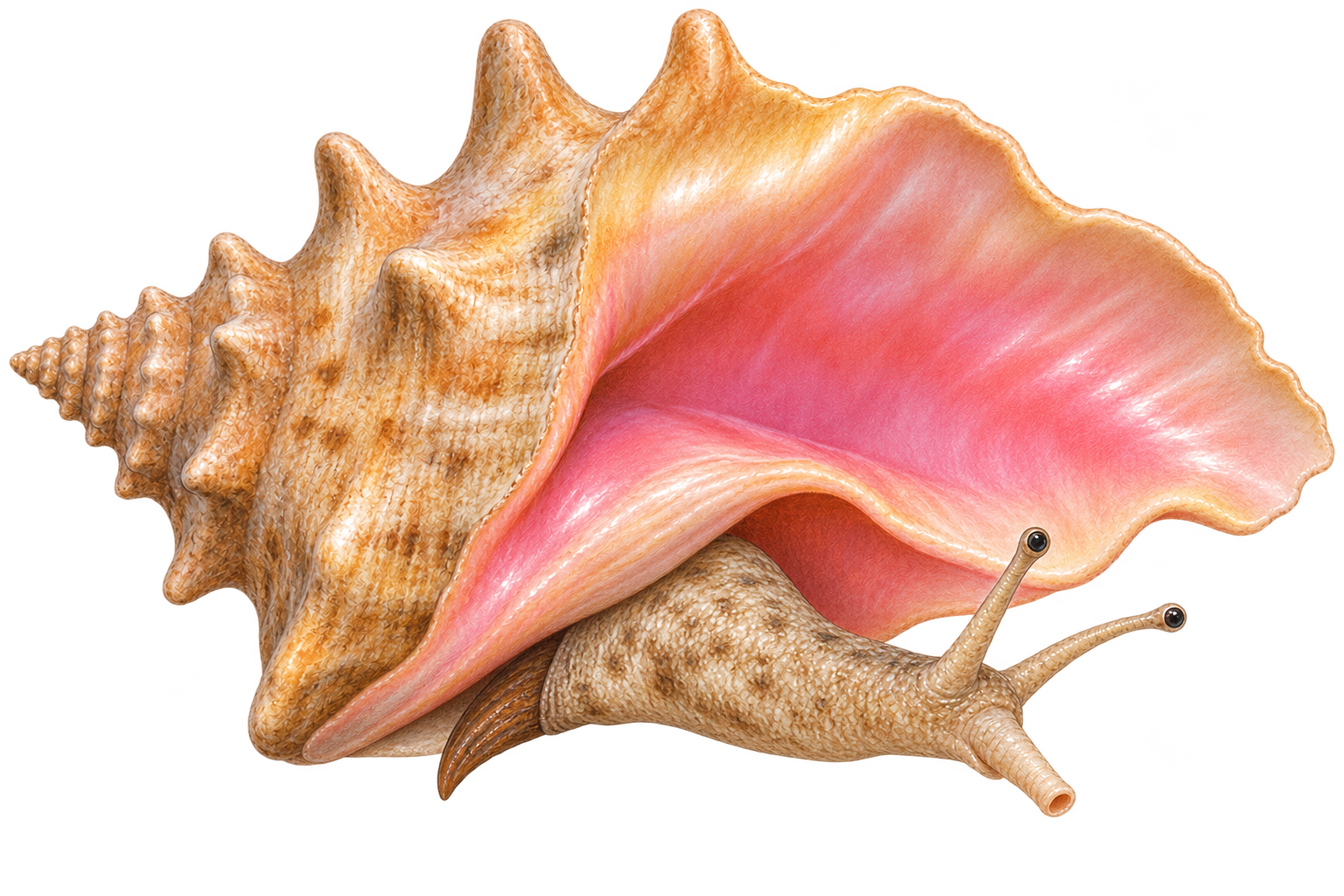
The adult queen conch carries a heavy spiral shell with a broad flared lip and pink interior. Stalked eyes and a muscular foot reveal the living snail beneath. Juveniles lack the fully flared adult lip, making shell shape and life stage important to identification.
Size and life stages
Shell length may approach 30 centimeters. A large shell or a newly formed lip does not automatically mean the animal is reproductively mature; lip thickness provides additional information.
Habitat and where to look
Seagrass meadows, sandy bottoms and nearby shallow marine habitats support queen conch. Young animals and adults do not use every habitat in the same way. Healthy bottom communities provide both food and shelter, connecting conservation of the snail with conservation of the surrounding seafloor.
Range and local context
The species occurs throughout the Caribbean region and reaches South Florida. Florida populations have suffered serious depletion, and official work includes the Keys and Port Everglades. Local absence on a dive is not proof of statewide absence, nor does one encounter demonstrate population recovery.
What is on the menu?
Queen conch graze on algae and organic material on the bottom. The long feeding structure reaches beyond the shell while the animal searches. It is not a large predatory whelk, despite sharing a heavy spiral shell with several meat-eating Florida snails.
Daily habits and behavior
The muscular foot and pointed operculum help the snail move in short, distinctive lunges. Its independent eyestalks can remain visible while much of the body stays protected.
Mating and the next generation
Females lay long, tangled egg masses, and developing larvae spend time in the plankton. Successful breeding requires adults to find one another, making low population density a concern. An empty-looking patch between adults can therefore matter more than an appealing photograph suggests. A long larval journey separates the bottom-dwelling adults from the next settled generation. The larvae feed in the plankton before changing into crawling juveniles. Later, shell growth produces the conspicuous outer lip, followed by further thickening. These distinct stages explain why counting shells of similar length is not the same as counting reproductively mature adults.
Look-alikes and identification traps
Florida fighting conch is much smaller and has a different adult shell profile. Horse conch has an elongated shell and often a conspicuous orange body. Identify a live snail from several visible features; pink coloration alone should never be used as permission to collect.
Observe without disturbing
Do not lift the animal to inspect its underside or test its apparent age. Watch these movements from a fixed position instead of picking the animal up to make it emerge. Protected: do not harvest living queen conch in Florida. NOAA lists the species as threatened under the Endangered Species Act. Keep the animal in place and underwater. Empty shells have separate rules, explained below, and are not a loophole for removing a living snail. Dive with Stuart Scuba to explore Florida marine life with an emphasis on careful observation. Ask about current conditions and an appropriate dive plan; wildlife sightings remain unpredictable.
Harvest, protection and eating safety
PROTECTED: no Florida recreational harvest; ESA threatened
Can it be hunted or harvested?
No. Do not take a live queen conch, remove it from its shell, kill it for a souvenir or retain locally harvested meat. Florida protects this species even when an older rule calls it Strombus gigas; its current name is Aliger gigas. A genuinely empty shell is a different case: FWC allows possession only when no living queen conch was present at collection and none was killed, mutilated or removed to obtain it. Possession of a queen conch shell with an off-center hole larger than 1/16 inch through its spire is prohibited. An empty shell occupied by another living animal is not an empty-shell exemption for that animal.
Florida seasons and areas
Closed to Florida recreational harvest all year. There is no Florida conch season or bag entitlement. NOAA lists queen conch as ESA threatened throughout its range. Florida and adjoining federal management, sanctuary protections and import rules are distinct; a legal imported restaurant product does not authorize collecting a Florida conch. Protected areas may also prohibit taking even empty natural shells. The Florida rule bars possession, transport or landing regardless of where a live queen conch was taken; accidentally caught animals must be returned immediately, unharmed.
Can it be speared?
No. Florida’s live-harvest prohibition applies regardless of gear, including spears, hands or nets.
Is it safe to eat?
Do not collect this animal for food. It is protected from recreational harvest in Florida. An edible relative, a restaurant dish, or customary use elsewhere does not make a wild Florida animal legal or safe to eat. For legally purchased conch from an authorized source, follow seafood handling guidance; conchs and whelks can accumulate red-tide toxins that cooking or freezing does not remove.
Before you act: This recreational overview is not permission to collect or spear at your dive site. Confirm the species, date, management area, state or federal waters, gear, licenses and current local closures. Identification artwork cannot establish an identification or guarantee seafood safety.
Official rules and health guidance
- FWC: Recreational Sea Shell Collecting
- Florida Administrative Code: Queen Conch, Chapter 68B-16
- NOAA: Queen Conch, ESA Threatened
- NOAA: Florida Keys Sanctuary Marine Zones
- Florida Department of Health: Seafood Poisoning
- FDA: Selecting and Serving Seafood Safely
- FAC 68B-16.004: queen conch prohibition (LII reproduction)
Reviewed 2026-11-10. Rules and advisories can change; check the linked authorities before harvesting or eating.
Sources and review
Reviewed 2026-11-10.
Make your next dive happen
Dive With Us
Explore local charters and plan a dive suited to your experience.
View dive calendarTrain With Us
Build your fish identification, buoyancy and diving skills.
Explore trainingTravel With Us
Discover upcoming dive adventures and trip details.
Explore dive travelShop With Us
Browse equipment for your diving and ask our team for help choosing.
Explore dive gearReview current dates, availability, prices, inclusions and requirements on each listing before booking or buying.
Call us now
Ask about marine life identification
Marine Life Identification
Ask about dates, prerequisites or your next step. An inquiry does not reserve a place. Please provide your own contact details; do not include medical, payment or a child's personal information.
We use these details to respond to your inquiry. This form does not sign you up for marketing.
Explore more with Stuart Scuba
Open Water course options · Advanced Adventure training · Technical training · Professional training · All courses · Local dives · Dive trips · Facebook · Instagram · YouTube
Your surface-interval essentials
Questions for Stuart Scuba? info@stuartscuba.com
Check the Stuart Scuba Weather Center · Play scuba trivia
Weather and wildlife vary. Confirm current conditions, trip requirements and departure details with the operator.
Plan Your Next Dive with Stuart Scuba
Dive With Us
Explore upcoming local charters and choose a dive that fits your experience.
Before you book
Check the individual listing for departure time, requirements and availability.
Travel With Us
Find upcoming dive adventures and start planning your next trip.
Plan your trip
Review dates, inclusions and trip details on the travel calendar.
Stay Connected with Stuart Scuba
 Follow pageShare
YouTube
SubscribeWatch & shareFollow on InstagramView & share post
Follow company news, training updates, and dive stories.
Follow on LinkedInGoogle Reviews
See Stuart Scuba’s current Google rating and review count below. Open the listing in Google Maps to browse customer reviews.



