

Fish identification archive / Planehead Filefish
Planehead Filefish
Stephanolepis hispida
I saw this
Spotted this marine animal? Share the guide with your dive buddies. Review your caption before posting.
For Instagram, copy the caption and link into your own post or message. Nothing is posted automatically and this does not record a verified sighting.
Fun facts for your next surface interval
- A male can grow a threadlike ray from the second dorsal fin.
- Its older name hispidus and current spelling hispida refer to the same planehead filefish.
- Southeastern Florida is an overlap zone with pygmy filefish, making careful identification especially important.
Florida and local context
Lake Worth Lagoon / Blue Heron Bridge area, Palm Beach County: Florida Museum explicitly marks this species verified in Lake Worth Lagoon. This documents occurrence, not current abundance or a guaranteed dive encounter.
Documented regional presence is not a guarantee of an encounter or a measure of how common this animal is at your dive site.
How to recognize this animal
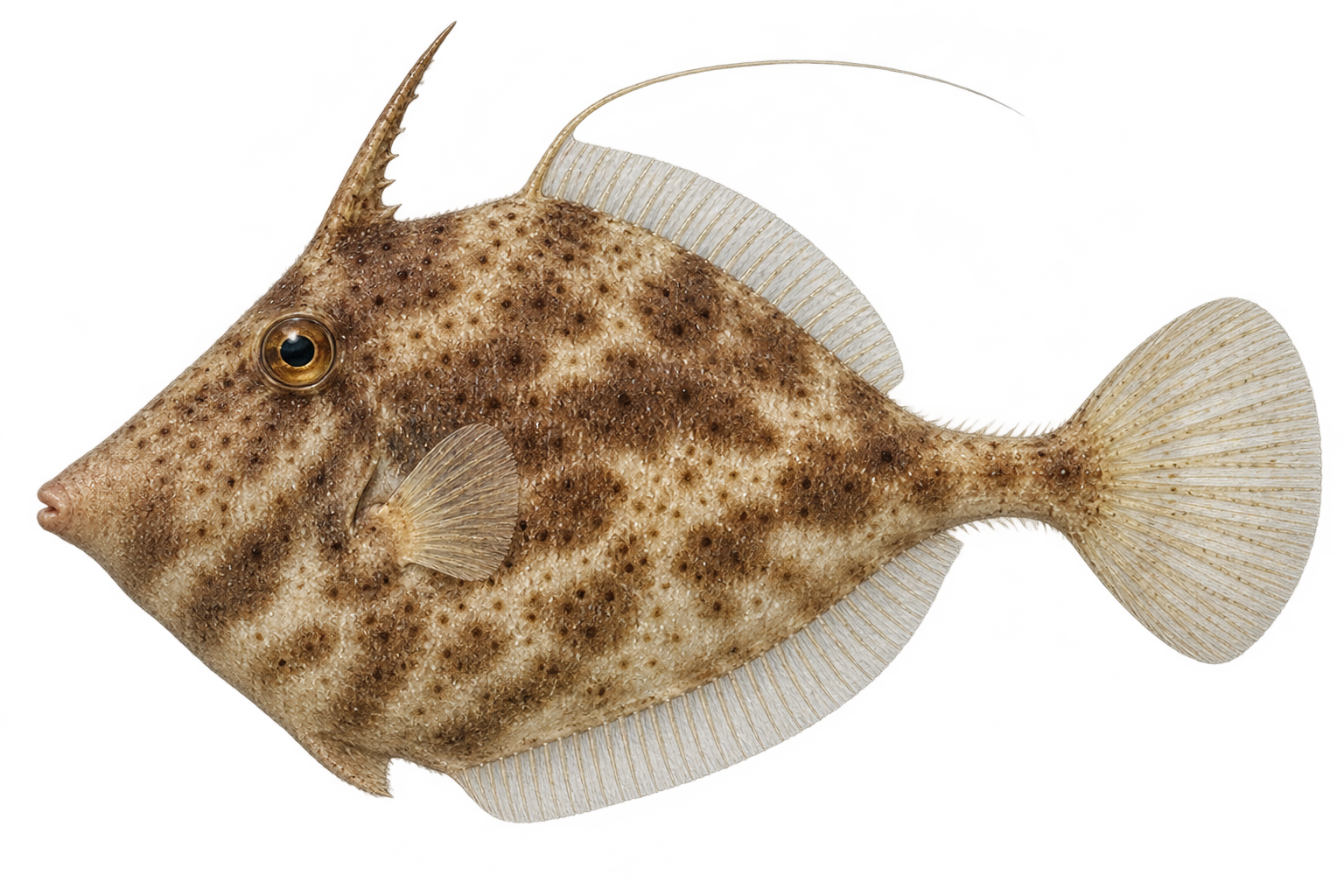
The planehead filefish has a deep, compressed body and a short pointed snout with a nearly straight sloping forehead. Irregular brown and tan mottling breaks up its outline. A strong dorsal spine rises above the rear half of the eye. Males can have a long filament on the second dorsal fin, but the belly flap is relatively small.
Size and life stages
Smithsonian reports a maximum length around 11 inches, or 27.5 centimeters. Male features include the elongated dorsal ray and a bristly area near the tail base; not every fish will display the same fin outline as the illustrated male. Small fish among floating vegetation can be difficult to distinguish from related filefishes without a clear side view.
Habitat and where to look
Seagrass, sandy bottoms, muddy bottoms and floating Sargassum are documented habitats. This is a fish to search for among broken patterns and vegetation, not just exposed coral. Its mottled coloration works especially well against those backgrounds. Move slowly enough to notice the tiny eye and erect dorsal spine before the rest of the outline becomes obvious.
Range and local context
Florida Museum explicitly verifies planehead filefish in Lake Worth Lagoon under Stephanolepis hispidus. Current catalog and Smithsonian pages use Stephanolepis hispida. Smithsonian cautions that planehead and pygmy filefish ranges overlap in southeastern Florida and that many Caribbean records need scrutiny. The verified lagoon entry supports local inclusion without resolving every photograph or guaranteeing an encounter.
What is on the menu?
Adults consume benthic invertebrates, and Smithsonian's broader feeding data include algae and other bottom-associated material. Small prey can be picked from the complex surfaces around grass, sand and attached growth. Do not assume that a fish beside a seagrass blade is eating the plant itself; it may be taking tiny animals living on or around it.
Daily habits and behavior
The association with floating Sargassum adds an offshore surface setting to its bottom habitats. Mottling varies, so individual fish need not match the exact arrangement of patches in an illustration. A male's thin dorsal filament can be difficult to see against the background. Behavior and camouflage are useful context, but neither substitutes for comparing structural features.
Mating and the next generation
Smithsonian lists benthic eggs and pelagic larvae. This indicates a change from bottom-associated eggs to drifting young rather than a wholly bottom-bound life cycle. The reviewed references do not establish a local spawning calendar or a distinctive courtship display for Palm Beach divers. Those details are left unspecified instead of borrowing them from another filefish species.
Look-alikes and identification traps
Fringed filefish have a larger belly flap and a distinct hump at the front of the second-dorsal base, without the male planehead's long dorsal filament. Pygmy filefish are a closer challenge and overlap geographically in southeastern Florida. A poor image may justify only Stephanolepis species; the guide's illustration is not a substitute for an expert examination of ambiguous records.
Observe without disturbing
Never pull apart seagrass or floating weed to expose a hidden filefish. Stay buoyant above the bottom and wait for it to move into view. Photograph the snout profile, dorsal spine and belly outline together. Record a doubtful identification honestly, particularly where the planehead–pygmy distinction cannot be resolved from the available view.
Harvest, protection and eating safety
Restricted marine life: live collection only; no spearing
Can it be hunted or harvested?
Only lawful live collection, not ordinary food harvest. This filefish falls under Florida recreational marine-life rules, with no listed species-specific size limit. The daily limit is five of this species within 20 marine-life organisms total per person; two-day possession is ten of this species within 40 total. A saltwater license is required unless exempt. Land and keep the animal alive with adequate circulation or aeration; recreational sale is prohibited.
Florida seasons and areas
No species-specific annual closed months are listed for this filefish in the recreational marine-life rules. Collection is prohibited within the designated Blue Heron Bridge dive-site boundary and throughout Biscayne National Park. Check other park, refuge and sanctuary boundaries before collecting. Florida marine-life rules also apply in adjacent federal waters. In John Pennekamp Coral Reef State Park, taking, killing or possessing this filefish is prohibited under the park’s triggerfish/filefish family rule.
Can it be speared?
No. Spears are not an authorized recreational method for this live-collection marine-life fish. Use only permitted live-collection gear and comply with the live-landing requirement. Do not confuse this species with the unicorn filefish exception. No taking, killing or possession is allowed in John Pennekamp Coral Reef State Park.
Is it safe to eat?
Not a food target under these live-collection rules. This guide does not certify the species or an individual fish as safe to eat. A report that filefish flesh is eaten elsewhere does not override Florida harvest restrictions or replace current Florida DOH fish-consumption advice.
Before you act: This recreational overview is not permission to collect or spear at your dive site. Confirm the species, date, management area, state or federal waters, gear, licenses and current local closures. Identification artwork cannot establish an identification or guarantee seafood safety.
Official rules and health guidance
- FWC recreational marine-life rules
- FWC Biscayne National Park exceptions
- Official Florida Administrative Code chapter index
- Florida DOH current fish-consumption advisory portal
- FWC saltwater recreational licensing
- Florida rule 68B-5.002(1)(rr): Pennekamp triggerfish/filefish prohibition (text mirror)
- Official FAC 68B-5.002 current-version index
Reviewed 2026-11-10. Rules and advisories can change; check the linked authorities before harvesting or eating.
Sources and review
Reviewed 2026-11-10.
Make your next dive happen
Dive With Us
Explore local charters and plan a dive suited to your experience.
View dive calendarTrain With Us
Build your fish identification, buoyancy and diving skills.
Explore trainingTravel With Us
Discover upcoming dive adventures and trip details.
Explore dive travelShop With Us
Browse equipment for your diving and ask our team for help choosing.
Explore dive gearReview current dates, availability, prices, inclusions and requirements on each listing before booking or buying.
Call us now
Ask about marine life identification
Marine Life Identification
Ask about dates, prerequisites or your next step. An inquiry does not reserve a place. Please provide your own contact details; do not include medical, payment or a child's personal information.
We use these details to respond to your inquiry. This form does not sign you up for marketing.
Explore more with Stuart Scuba
Open Water course options · Advanced Adventure training · Technical training · Professional training · All courses · Local dives · Dive trips · Facebook · Instagram · YouTube
Your surface-interval essentials
Questions for Stuart Scuba? info@stuartscuba.com
Check the Stuart Scuba Weather Center · Play scuba trivia
Weather and wildlife vary. Confirm current conditions, trip requirements and departure details with the operator.
Plan Your Next Dive with Stuart Scuba
Dive With Us
Explore upcoming local charters and choose a dive that fits your experience.
Before you book
Check the individual listing for departure time, requirements and availability.
Travel With Us
Find upcoming dive adventures and start planning your next trip.
Plan your trip
Review dates, inclusions and trip details on the travel calendar.
Stay Connected with Stuart Scuba
 Follow pageShare
YouTube
SubscribeWatch & shareFollow on InstagramView & share post
Follow company news, training updates, and dive stories.
Follow on LinkedInGoogle Reviews
See Stuart Scuba’s current Google rating and review count below. Open the listing in Google Maps to browse customer reviews.



