

Fish identification archive / Pink Shrimp
Pink Shrimp
Farfantepenaeus duorarum · Penaeidae
I saw this
Spotted this marine life? Share the guide with your dive buddies. Review your caption before posting.
For Instagram, copy the caption and link into your own post or message. Nothing is posted automatically and this does not record a verified sighting.
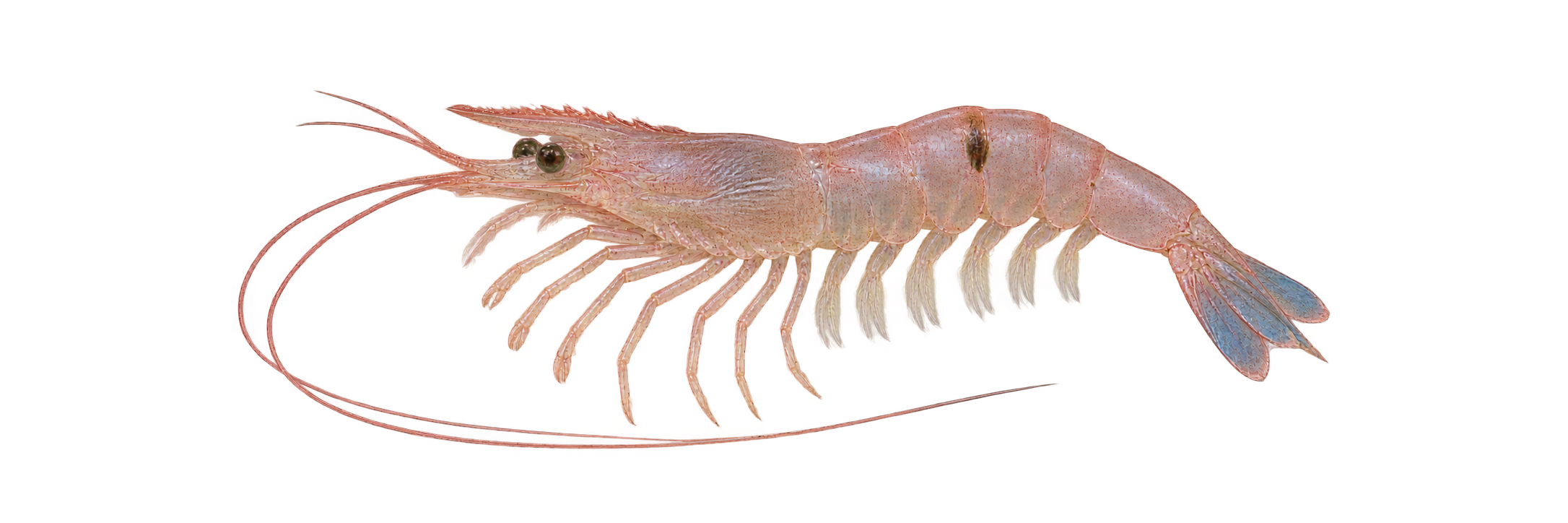
The pink shrimp, Farfantepenaeus duorarum, is not always an obvious shade of pink. A more useful clue is the dark spot usually present on each side near the boundary between the third and fourth abdominal segments. Its carapace is grooved, and a toothed rostrum projects forward near the eyes. The tail can show darker blue coloration.
Where it fits in Atlantic Florida
NOAA places its range from the southern Chesapeake Bay to the Florida Keys and around the Gulf. FWC specifically associates the species with clearer waters from west-central through southeast Florida. That supports a regional Atlantic Florida profile without making every seagrass bed or dive site a confirmed sighting location.
Young shrimp use protected nursery habitat, including vegetation in estuaries. As they grow, they move toward saltier coastal and offshore water. The important label is therefore bottom-associated shrimp with an estuary-to-offshore life cycle, not coral-reef cleaner shrimp. Record the actual habitat and depth whenever you document an encounter.
Feeding after dark
Pink shrimp feed on a mixture of small organisms, algae and decaying organic material. The young larval stages take plankton. Older animals can bury in the sediment during daylight and become active after dark. A shrimp that disappears into the bottom is using habitat rather than necessarily fleeing a predator.
Spawning takes place offshore, with eggs released near the seabed and fertilized as they enter the water. Early stages move toward nursery areas before later growth and migration back toward the coast or offshore bottom. Exact timing varies geographically, so a seasonal description from another state should not become a local Florida prediction.
Separate it from similar shrimp
Brown shrimp share the grooved-carapace appearance but generally lack the characteristic dark side spot. White shrimp have a smoother, ungrooved carapace and much longer antennae. Use several features together; color and body size alone are weak evidence. A partially hidden shrimp may deserve only a general penaeid-shrimp identification.
Make a useful observation
A side photograph can record the abdominal spot and rostrum, while an overhead view can help show shell grooves. Obtain those views only if the animal remains undisturbed. Do not dig through seagrass or chase a shrimp across the bottom for a better angle.
Florida shrimp rules differ by area and gear, and local protected waters may impose additional restrictions. Being sold as bait or seafood does not authorize taking an animal from a dive site. Check current official rules separately and keep habitat observation distinct from harvest advice.
Florida DEP’s 2014 St. Lucie Inlet Preserve animal inventory provides an additional dated local record.
References
Collection and seafood safety
FWC recreational shrimp rules include license requirements unless exempt, daily and vessel limits, gear rules and regional closures. A general regional season does not override local closed areas or protected-site restrictions. Check the exact location before any collection; this profile provides no seafood-safety clearance. Current FWC guidance. Guidance reviewed November 12, 2026. No location-specific harvest or sanitation clearance is given.
Make your next dive happen
Dive With Us
Explore local charters and plan a dive suited to your experience.
View dive calendarTrain With Us
Build your fish identification, buoyancy and diving skills.
Explore trainingTravel With Us
Discover upcoming dive adventures and trip details.
Explore dive travelShop With Us
Browse equipment for your diving and ask our team for help choosing.
Explore dive gearReview current dates, availability, prices, inclusions and requirements on each listing before booking or buying.
Call us now
Ask about fish identification training
Reef Fish Identification
Ask about dates, prerequisites or your next step. An inquiry does not reserve a place. Please provide your own contact details; do not include medical, payment or a child's personal information.
We use these details to respond to your inquiry. This form does not sign you up for marketing.
Explore more with Stuart Scuba
Open Water course options · Advanced Adventure training · Technical training · Professional training · All courses · Local dives · Dive trips · Facebook · Instagram · YouTube
Your surface-interval essentials
Questions for Stuart Scuba? info@stuartscuba.com
Check the Stuart Scuba Weather Center · Play scuba trivia
Weather and wildlife vary. Confirm current conditions, trip requirements and departure details with the operator.
Plan Your Next Dive with Stuart Scuba
Dive With Us
Explore upcoming local charters and choose a dive that fits your experience.
Before you book
Check the individual listing for departure time, requirements and availability.
Travel With Us
Find upcoming dive adventures and start planning your next trip.
Plan your trip
Review dates, inclusions and trip details on the travel calendar.
Stay Connected with Stuart Scuba
 Follow pageShare
YouTube
SubscribeWatch & shareFollow on InstagramView & share post
Follow company news, training updates, and dive stories.
Follow on LinkedInGoogle Reviews
See Stuart Scuba’s current Google rating and review count below. Open the listing in Google Maps to browse customer reviews.



