

Fish identification archive / Permit
Permit
Trachinotus falcatus
I saw this
Spotted this fish? Share the guide with your dive buddies. Review your caption before posting.
For Instagram, copy the caption and link into your own post or message. Nothing is posted automatically and this does not record a verified sighting.
Fun facts for your next surface interval
- Despite its association with flats, a permit can also turn up around a wreck.
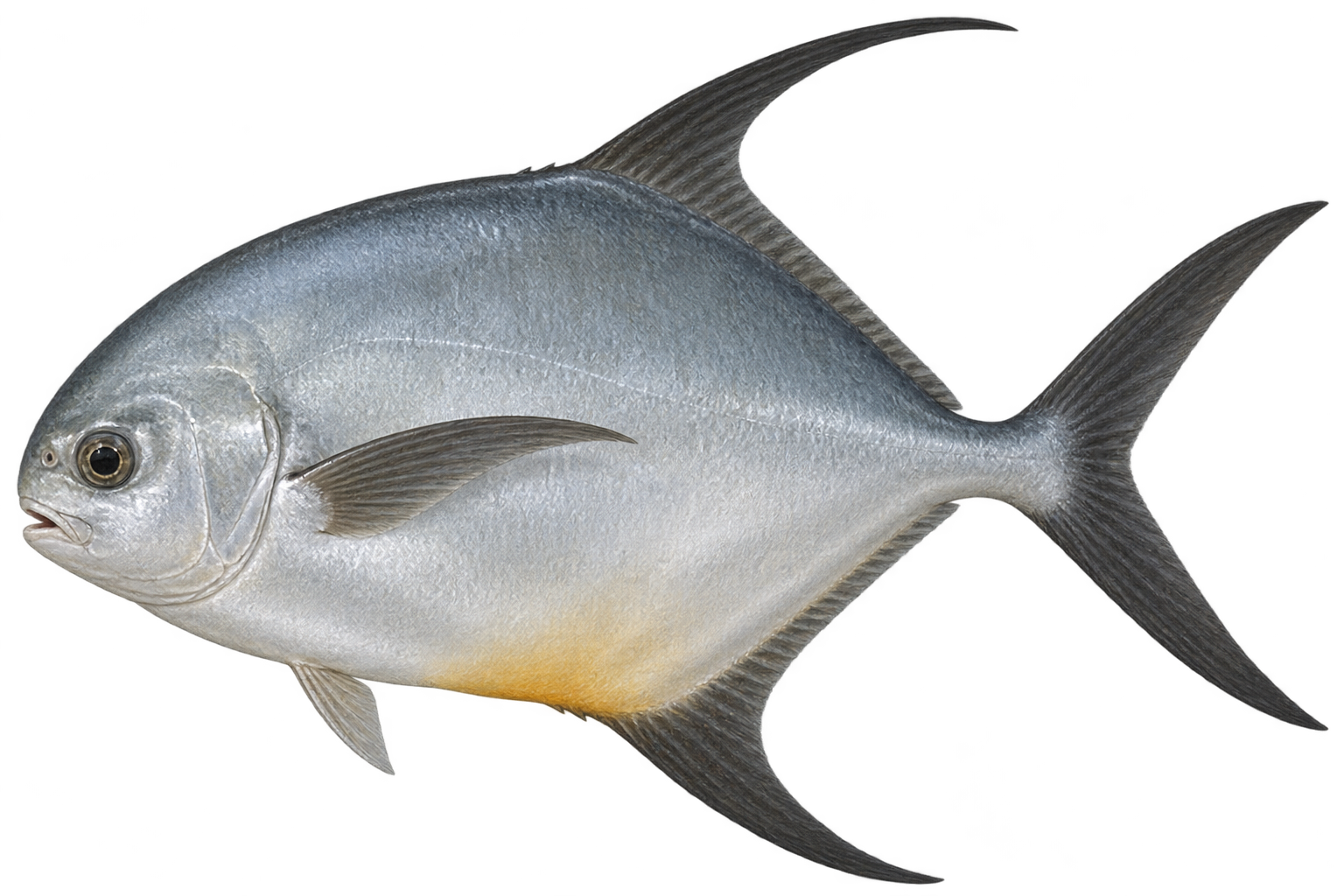
- Its long curved fins supply a ready-made silhouette: this fish brings its own dramatic outline.
- Shellfish are not an obstacle when your dining equipment includes crushing structures.
Palm Beach connection
Lake Worth Lagoon / Blue Heron Bridge, Palm Beach County: Verified species row (x).
Documented regional presence is not a guarantee of an encounter or a measure of how common this fish is at your dive site.
How to recognize this fish
Look for a deep silver body with strikingly long, dark leading lobes on the dorsal and anal fins. These curved fins and the deeply forked tail create a strong silhouette. The underside may show yellow or orange. An adult is more elongated than a small juvenile, but still distinctly deeper-bodied than many cruising jacks.
Size and life stages
Permit can grow into large fish, with exceptional reported lengths approaching 1.2 meters. References use both total and fork length, so numbers should not be treated as interchangeable measurements. For a dive log, an approximate size category is often more honest than a precise estimate. A juvenile’s rounded proportions also differ from the large adult illustration.
Habitat and where to look
Permit occupy sandy flats, channels, reef surroundings and deeper structures, including wrecks. A species famous for very shallow water can therefore also appear on a scuba dive. Look around the edge of structure and over adjacent sand. Keep the dive within its planned depth and current limits rather than following a fish toward a distant channel.
Range and local context
The western Atlantic range extends from the northeastern United States through Florida and the Caribbean toward southeastern Brazil. A verified Lake Worth Lagoon record supplies the local connection. This is evidence of regional presence, not an estimate of how often divers encounter permit. Habitat, tide and the movements of individual fish all affect what a dive reveals.
What is on the menu?
Crabs, mollusks, shrimp and other small animals form much of the diet. Permit can root for bottom prey and crush hard food with specialized mouth and throat structures. Watch for deliberate searching near the substrate. Do not place a crab in the fish’s path or disturb a patch of sand to encourage a feeding photograph.
Daily habits and behavior
Permit may swim alone, in small groups or in larger gatherings. Young fish can form schools along sandy shores. Observe whether the fish are traveling, searching the bottom or lingering around structure; those are useful distinctions that a still image may miss. A large group is interesting in its own right without assigning an unobserved reason for gathering.
Mating and the next generation
Spawning occurs offshore, including around reef structures. The timing varies within the species’ range, and information from the Florida Keys should not be presented as an exact Palm Beach calendar. A group seen over a wreck is not automatically spawning. Record the actual behavior, and avoid approaching so closely that the gathering changes direction or breaks apart.
Look-alikes and identification traps
Florida pompano is an important comparison, especially when fish are young. Permit become deeper-bodied and develop strongly elongated, dark dorsal and anal lobes. A lookdown has a much steeper forehead and a more blade-like profile. Use several features together; silver color and a forked tail alone identify neither species reliably in a fleeting view.
Observe without disturbing
Give passing fish an unobstructed route around the reef or wreck. Do not chase, feed, corral or touch them, and avoid creating a wall of divers between the fish and open water. A broad photograph that includes the fin outline can be more useful than a close crop. Note uncertainty in a juvenile identification rather than disguising it.
Harvest, protection and eating safety
Regulated harvest; seasonal southern zone
Can it be hunted or harvested?
Outside the Special Permit Zone, including Palm Beach, the recreational slot is 11–22 inches fork length and the limit is two fish per person daily. One fish over 22 inches may be included per person, with no more than two oversized fish per vessel. Inside the southern zone, the minimum is 22 inches fork length, with one fish per person daily and two per vessel.
Florida seasons and areas
Outside the Special Permit Zone, FWC lists year-round harvest. Inside it, harvest is closed April 1–July 31. The zone includes state and adjacent federal waters south of the Cape Florida eastward line at 25°40′N, Biscayne Bay south of Rickenbacker Causeway, and the Cape Sable westward line at 25°09′N. Check the official map and Biscayne National Park exceptions.
Can it be speared?
Florida state waters: hook-and-line only; spearing prohibited. Adjacent federal waters: FWC allows hook-and-line and spearing, subject to local restrictions and the same applicable zone/season limits.
Is it safe to eat?
A legal permit may be kept for food, but no species-wide safety guarantee applies. Check Florida DOH location-specific advice, particularly for children and pregnancy. Keep the fish chilled and cook thoroughly. Do not use Florida pompano’s consumption advice as though it were permit-specific.
Before you act: This recreational overview is not permission to collect or spear at your dive site. Confirm the species, date, management area, state or federal waters, gear, licenses and current local closures. A fish illustration cannot establish an identification or guarantee seafood safety.
Official rules and health guidance
- FWC permit regulations
- FWC spearfishing restrictions
- Florida DOH eating healthy seafood
- Florida DOH local fish advisory search
- FDA safe seafood handling
Reviewed 2026-11-10. Rules and advisories can change; check the linked authorities before harvesting or eating.
Sources and review
Reviewed 2026-11-10.
Make your next dive happen
Dive With Us
Explore local charters and plan a dive suited to your experience.
View dive calendarTrain With Us
Build your fish identification, buoyancy and diving skills.
Explore trainingTravel With Us
Discover upcoming dive adventures and trip details.
Explore dive travelShop With Us
Browse equipment for your diving and ask our team for help choosing.
Explore dive gearReview current dates, availability, prices, inclusions and requirements on each listing before booking or buying.
Call us now
Ask about fish identification training
Reef Fish Identification
Ask about dates, prerequisites or your next step. An inquiry does not reserve a place. Please provide your own contact details; do not include medical, payment or a child's personal information.
We use these details to respond to your inquiry. This form does not sign you up for marketing.
Explore more with Stuart Scuba
Open Water course options · Advanced Adventure training · Technical training · Professional training · All courses · Local dives · Dive trips · Facebook · Instagram · YouTube
Your surface-interval essentials
Questions for Stuart Scuba? info@stuartscuba.com
Check the Stuart Scuba Weather Center · Play scuba trivia
Weather and wildlife vary. Confirm current conditions, trip requirements and departure details with the operator.
Plan Your Next Dive with Stuart Scuba
Dive With Us
Explore upcoming local charters and choose a dive that fits your experience.
Before you book
Check the individual listing for departure time, requirements and availability.
Travel With Us
Find upcoming dive adventures and start planning your next trip.
Plan your trip
Review dates, inclusions and trip details on the travel calendar.
Stay Connected with Stuart Scuba
 Follow pageShare
YouTube
SubscribeWatch & shareFollow on InstagramView & share post
Follow company news, training updates, and dive stories.
Follow on LinkedInGoogle Reviews
See Stuart Scuba’s current Google rating and review count below. Open the listing in Google Maps to browse customer reviews.



