

Fish identification archive / Pederson Cleaner Shrimp
Pederson Cleaner Shrimp
Ancylomenes pedersoni
I saw this
Spotted this marine animal? Share the guide with your dive buddies. Review your caption before posting.
For Instagram, copy the caption and link into your own post or message. Nothing is posted automatically and this does not record a verified sighting.
Fun facts for your next surface interval
- Its mostly transparent body gives the impression of a shrimp assembled from antennae and colored dots.
- A sea anemone can serve as the address of a busy cleaning station.
- A fish visiting this tiny shrimp may be looking for parasite removal rather than lunch.
Florida and local context
Palm Beach, Florida: Location-labelled photograph documents Palm Beach occurrence.
Documented regional presence is not a guarantee of an encounter or a measure of how common this animal is at your dive site.
How to recognize this animal
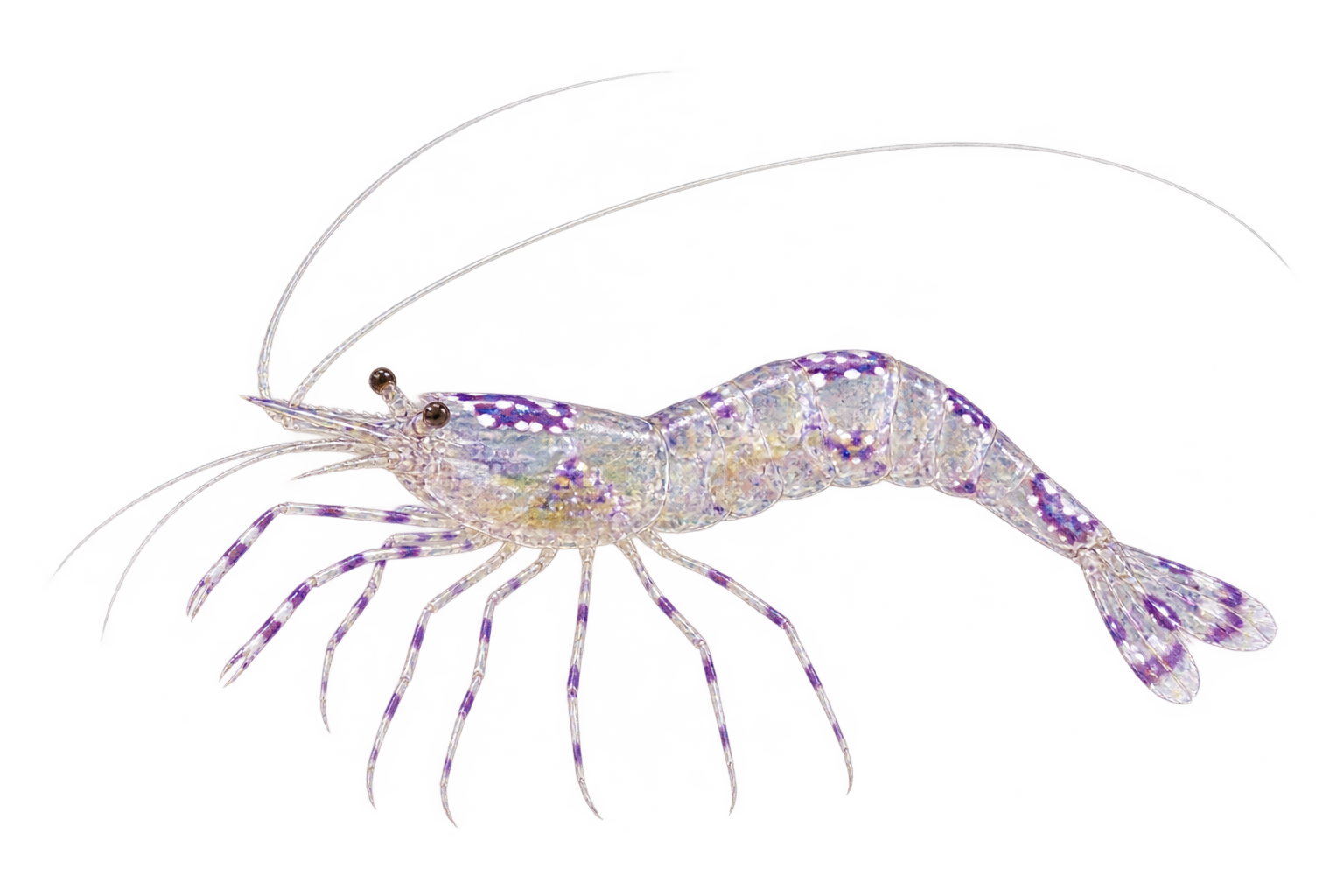
A nearly transparent body carries delicate blue, violet and white markings, with long white antennae extending forward. This small shrimp is easy to overlook against an anemone. Look for the outline and the fine leg movements rather than expecting a solid block of color.
Size and life stages
Body length is only about 2–3 centimeters, and the antennae add considerable apparent reach. That makes it a small-subject observation even when a photograph fills the screen.
Habitat and where to look
Pederson cleaner shrimp associate with sea anemones on tropical western Atlantic reefs. The host provides a recognizable place for fishes to approach for cleaning. A cleaning station is a repeated meeting place, not a built structure. The anemone and its shrimp form a recognizable landmark for visiting fishes, while the shrimp obtain food through the interaction. The relationship links a tiny crustacean with much larger mobile animals. Counting only the shrimp would miss the activity and ecological connections surrounding the host.
Range and local context
Florida lies within the species’ regional distribution, and a Palm Beach photograph supplies direct local evidence. Research on Florida Keys animals contributes additional biological information. Neither source promises that an anemone at a familiar dive site will retain the same shrimp indefinitely.
What is on the menu?
These shrimp remove external parasites and other material from visiting fishes. The feeding relationship can benefit both participants, but the interaction depends on context and cooperation.
Daily habits and behavior
Long antennae and body movements are part of the visual activity around a cleaning station. Several shrimp may associate with a host, and visitors can wait nearby. A still observer can watch this small-scale traffic without interrupting it by repeatedly moving the camera closer.
Mating and the next generation
Females hold eggs beneath the abdomen. Laboratory research found that isolated females could produce eggs without those eggs beginning normal development, illustrating the difference between egg production and successful fertilization. Reproduction therefore depends on more than simply seeing an egg-bearing shrimp. Studies of these tiny animals distinguish growing eggs in the ovaries from a brood already carried outside the body.
Look-alikes and identification traps
Other small anemone-associated shrimp occur in Florida. Compare the translucent body, colored markings and antennae carefully; anemone association alone does not identify the species. Older literature may call this animal Periclimenes pedersoni, a former genus combination rather than a separate local shrimp.
Observe without disturbing
Keep the camera housing far enough away that a change in surge will not contact the shrimp or host. Observe the whole station from a little distance first; the surrounding visitors may be as revealing as a close view of the shrimp. Let fish approach naturally instead of chasing one toward the anemone to create a cleaning scene. Do not handle a shrimp to verify a suspected egg mass. Never touch the host anemone, remove its shrimp or offer fingers for cleaning. Avoid resting a pointer stick or camera on the surrounding bottom. Leave room for fish visitors to enter and exit, and move on if your presence stops the normal interaction. Dive with Stuart Scuba to explore Florida marine life with an emphasis on careful observation. Ask about current conditions and an appropriate dive plan; wildlife sightings remain unpredictable.
Harvest, protection and eating safety
Restricted marine life: live collection only; Blue Heron Bridge closed
Can it be hunted or harvested?
Pederson cleaner shrimp falls within regulated tropical ornamental marine life (cleaner shrimp in genus Ancylomenes). Where collection is legal, take no more than five of this species per person per day within the combined twenty-organism marine-life daily limit. The two-day possession limit is forty total organisms, no more than ten of one species. Animals must be landed and kept alive with adequately sized circulation, aeration or oxygenation. Hand collection and specified nets are allowed; no sale of recreational catch. A recreational saltwater fishing license is required unless exempt; a shoreline-only license does not cover collecting while diving.
Florida seasons and areas
No statewide recreational closed months are listed for this marine-life category. Collection is prohibited inside the designated Blue Heron Bridge Special Marine Life Area, which includes Phil Foster County Park and the waters bounded in FAC 68B-42.0036. This is not a blanket closure of all Palm Beach County waters. Possession there is also restricted, with narrowly defined motor-vessel transit and landing exceptions for animals lawfully collected elsewhere. The marine-life recreational bag rules also apply in adjacent federal waters in the absence of federal regulations for the species. Park, refuge and Florida Keys sanctuary zones can prohibit collection even where general state rules allow it. Check the exact site and current boundaries before any take.
Can it be speared?
No. This is a live-collection category: use the lawful nonlethal marine-life methods, not a spear. Do not break reef substrate or remove protected live rock to reach an animal.
Is it safe to eat?
Not recommended as a food target. These rules require live landing and continued live holding, not a food fishery. No species-specific safe-to-eat finding is made here. For any seafood, correct identity, legal sourcing, current health advisories and safe handling matter; cooking cannot remove all toxins.
Before you act: This recreational overview is not permission to collect or spear at your dive site. Confirm the species, date, management area, state or federal waters, gear, licenses and current local closures. Identification artwork cannot establish an identification or guarantee seafood safety.
Official rules and health guidance
- FWC: Recreational Marine Life
- Florida Administrative Code: Marine Life, Chapter 68B-42
- FAC 68B-42.001: restricted-species definitions (LII reproduction; current effective date checked against official FAC index)
- FWC: Saltwater Recreational Licenses and Permits
- NOAA: Florida Keys Sanctuary Marine Zones
- FDA: Selecting and Serving Seafood Safely
- Florida Department of Health: Seafood Poisoning
- FAC 68B-42.0036: Blue Heron Bridge boundaries and exceptions (LII reproduction)
- FAC 68B-42.005: marine-life recreational limits (LII reproduction)
Reviewed 2026-11-10. Rules and advisories can change; check the linked authorities before harvesting or eating.
Sources and review
Reviewed 2026-11-10.
Make your next dive happen
Dive With Us
Explore local charters and plan a dive suited to your experience.
View dive calendarTrain With Us
Build your fish identification, buoyancy and diving skills.
Explore trainingTravel With Us
Discover upcoming dive adventures and trip details.
Explore dive travelShop With Us
Browse equipment for your diving and ask our team for help choosing.
Explore dive gearReview current dates, availability, prices, inclusions and requirements on each listing before booking or buying.
Call us now
Ask about marine life identification
Marine Life Identification
Ask about dates, prerequisites or your next step. An inquiry does not reserve a place. Please provide your own contact details; do not include medical, payment or a child's personal information.
We use these details to respond to your inquiry. This form does not sign you up for marketing.
Explore more with Stuart Scuba
Open Water course options · Advanced Adventure training · Technical training · Professional training · All courses · Local dives · Dive trips · Facebook · Instagram · YouTube
Your surface-interval essentials
Questions for Stuart Scuba? info@stuartscuba.com
Check the Stuart Scuba Weather Center · Play scuba trivia
Weather and wildlife vary. Confirm current conditions, trip requirements and departure details with the operator.
Plan Your Next Dive with Stuart Scuba
Dive With Us
Explore upcoming local charters and choose a dive that fits your experience.
Before you book
Check the individual listing for departure time, requirements and availability.
Travel With Us
Find upcoming dive adventures and start planning your next trip.
Plan your trip
Review dates, inclusions and trip details on the travel calendar.
Stay Connected with Stuart Scuba
 Follow pageShare
YouTube
SubscribeWatch & shareFollow on InstagramView & share post
Follow company news, training updates, and dive stories.
Follow on LinkedInGoogle Reviews
See Stuart Scuba’s current Google rating and review count below. Open the listing in Google Maps to browse customer reviews.



