

Fish identification archive / Peacock Flounder
Peacock Flounder
Bothus lunatus
Fun facts for your next surface interval
Florida and local context
Bothus lunatus is a species-level row in the Blue Heron Bridge (WPB), Phil Foster Park report. This is cumulative citizen-science evidence, not an independently reidentified voucher or a guarantee of a current sighting.
A documented past record does not establish present abundance or guarantee an encounter.
Sources: REEF: named-site cumulative diver survey supplied with reservation
How to recognize this animal
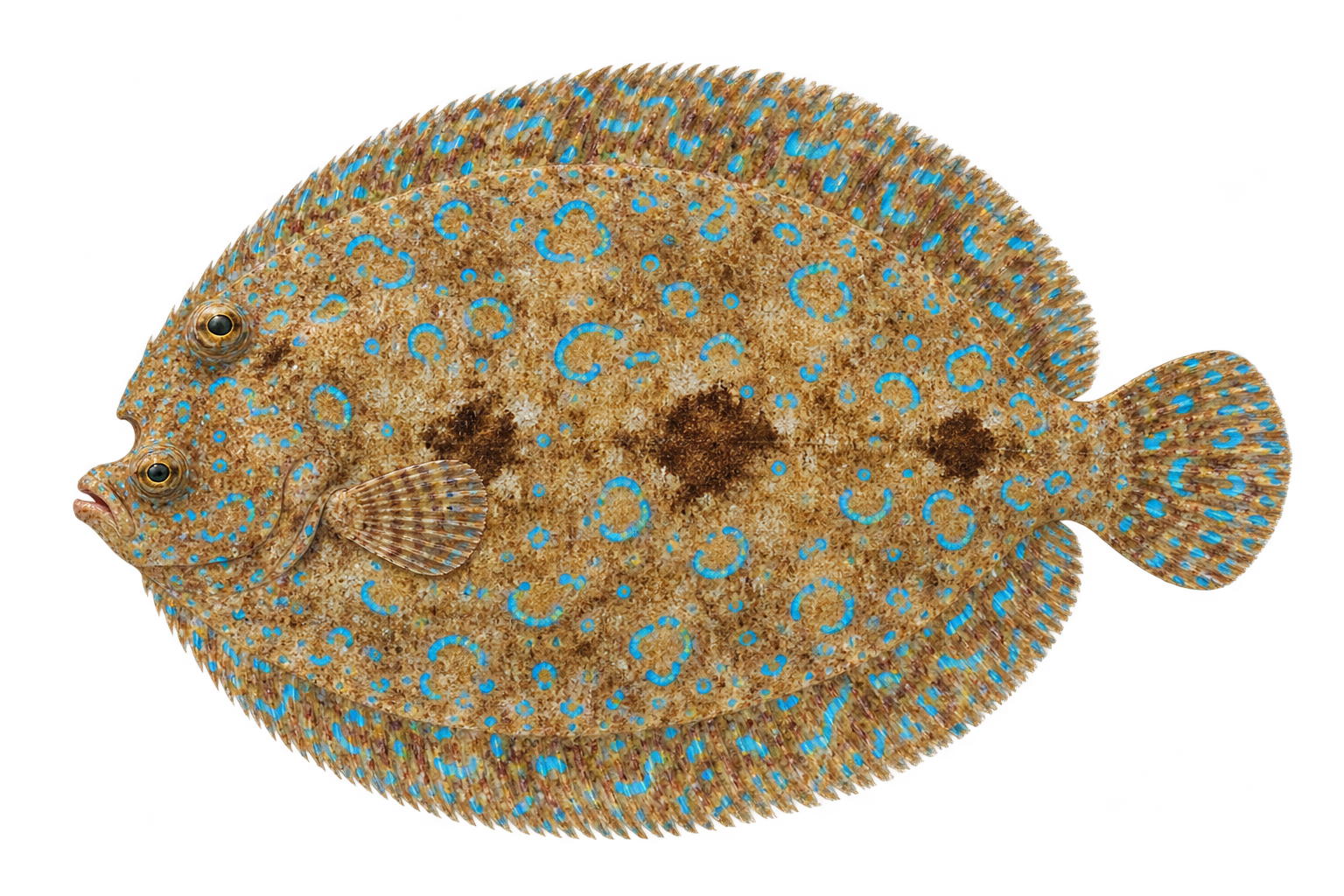
A broad, flattened fish with blue circles and curved marks on its upper side. Its eyes are on the left side, with the lower eye farther forward. Capture body pattern and head arrangement together.
Sources: Smithsonian Tropical Research Institute: Peacock Flounder; Florida Museum: Atlantic peacock flounder
Size and life stages
Smithsonian gives 45 cm and the Florida Museum gives 46 cm as maxima, both about 18 inches. These close but different summaries are retained rather than converted into a precise local expectation.
Sources: Smithsonian Tropical Research Institute: Peacock Flounder; Florida Museum: Atlantic peacock flounder
Habitat and where to look
Found on sand and around seagrass, mangroves, rock and coral. Search the visible surface without stirring sediment or touching an apparently empty patch.
Sources: Smithsonian Tropical Research Institute: Peacock Flounder
Range and local context
The regional account extends from North Carolina to Brazil and includes parts of the eastern Atlantic. Only the supplied Blue Heron Bridge survey supports this profile’s local occurrence statement.
Sources: Smithsonian Tropical Research Institute: Peacock Flounder; REEF: named-site cumulative diver survey supplied with reservation
What is on the menu?
The Florida Museum describes a predator of small fishes, with crustaceans and octopuses also taken. Let an undisturbed feeding event tell the story instead of introducing prey.
Daily habits and behavior
It can change color to blend with its surroundings and may rest partly buried. The Florida Museum describes daytime ambush feeding. Never force a camouflage demonstration by relocating the fish.
Mating and the next generation
Pairs rise off the bottom while releasing eggs and sperm. Larvae begin with an eye on each side; during development the right eye shifts toward the left. A photograph cannot establish a local spawning season.
Look-alikes and identification traps
Other Bothus flounders can share spots and an oval outline. Compare blue rings, eye spacing and complete shape. Use the scientific name Bothus lunatus when saving photographs so an ambiguous common name does not become the only identification.
Sources: Smithsonian Tropical Research Institute: Peacock Flounder
Observe without disturbing
Hover clear of the sand and avoid kneeling beside the fish. Do not fan away sediment or prod it into swimming. Leave a settled animal settled and label uncertain photographs honestly.
Sources: Smithsonian Tropical Research Institute: Peacock Flounder
Harvest, protection and eating safety
Unknown: exact harvest rules need verification
The neutral gray status means the rules or scope have not been fully verified. The word flounder is not a sufficient legal taxon match. Exact-species harvest and season clearance remains unresolved, so this profile does not recommend take.
This color is a qualified summary, not permission to collect or a guarantee that a particular animal is safe to eat.
Can it be hunted or harvested?
Peacock flounder is Bothus lunatus. Florida’s reviewed flounder definition names gulf, southern and summer Paralichthys flounders and fringed flounder Etropus crossotus, not Bothus lunatus. Do not automatically assign this species their minimum length, bag or October 15–November 30 closure. A complete alternative exact-species allowance has not been established here.
Florida seasons and areas
No affirmative all-year season clearance was established for this species. An omitted closed season is not evidence of an unrestricted season. Check the exact site, not just the county. Florida Keys Sanctuary Preservation Areas prohibit fishing and collection, subject to specifically stated exceptions; the Key Largo Management Area separately prohibits tropical-fish take and spearfishing. Biscayne National Park has additional rules, including a mapped March 1–May 31 fishing closure effective in 2026. These are not whole-county bans.
Can it be speared?
This review does not clear a specific spearfishing trip or location. Location restrictions still apply: spearfishing is prohibited in Monroe state waters from Long Key, including Long Key, north to the Miami-Dade line. This state-water restriction is separate from the Key Largo Management Area prohibition. Florida also restricts spearfishing around swimming beaches, fishing piers/bridges, jetties and state parks; federal water alone is not permission to spear in a closed sanctuary zone.
Is it safe to eat?
A harvest allowance is not a food-safety clearance. Check current Florida Department of Health advice for the capture location, species and person eating the fish. This review establishes no meal frequency and no local restaurant menu match.
This review covers the Vero Beach–Key Largo Atlantic corridor: Indian River, St. Lucie, Martin, Palm Beach, Broward, Miami-Dade and Monroe counties. Florida Atlantic state waters and South Atlantic federal waters are distinct jurisdictions. Do not extend a state-water season tag to federal waters or transfer Atlantic rules to Gulf-side Keys waters. Park and sanctuary boundaries can override a species allowance.
Before you act: Confirm the species, date, exact management area, state or federal waters, gear, licenses and current local closures. A local occurrence record never grants permission to take an animal.
Official rules and health guidance
- Florida rule 68B-48.002: flounder definition, effective September 2013
- Florida Register: four-species flounder definition; historical adoption context
- FWC: default recreational rules, explicitly including pinfish
- FWC: species and location spearing restrictions
- NOAA: Monroe state-water spearing boundaries
- NOAA: current Florida Keys sanctuary zone guide
- NOAA: Key Largo Management Area tropical-fish and spearing restrictions
- NOAA: Sanctuary Preservation Area fishing and collecting restrictions
- FWC: Biscayne National Park aggregate limits and mapped seasonal closure
- Florida Department of Health: seafood toxins
- Florida Department of Health: local consumption advisories
Reviewed 2026-11-11. Rules and advisories can change; check the linked authorities before acting.
Identification and source cautions
- The local evidence is a cumulative citizen-science record supplied in the reservation, not an independently reidentified voucher or a current encounter probability.
- Broad range and habitat accounts do not establish presence at every site between Vero Beach and Key Largo.
- Maximum length is a reported upper size, not a typical local encounter size.
- Size summaries differ slightly: 45 cm in Smithsonian and 46 cm in Florida Museum.
Sources and review
Biology and taxonomy reviewed 2026-11-11. Photographs on cited sites are reference material and are not reproduced here.
Make your next dive happen
Dive With Us
Explore local charters and plan a dive suited to your experience.
View dive calendarTrain With Us
Build your fish identification, buoyancy and diving skills.
Explore trainingTravel With Us
Discover upcoming dive adventures and trip details.
Explore dive travelShop With Us
Browse equipment for your diving and ask our team for help choosing.
Explore dive gearReview current dates, availability, prices, inclusions and requirements on each listing before booking or buying.
Call us now
Ask about marine life identification
Marine Life Identification
Ask about dates, prerequisites or your next step. An inquiry does not reserve a place. Please provide your own contact details; do not include medical, payment or a child's personal information.
We use these details to respond to your inquiry. This form does not sign you up for marketing.
Explore more with Stuart Scuba
Open Water course options · Advanced Adventure training · Technical training · Professional training · All courses · Local dives · Dive trips · Facebook · Instagram · YouTube
Your surface-interval essentials
Questions for Stuart Scuba? info@stuartscuba.com
Check the Stuart Scuba Weather Center · Play scuba trivia
Weather and wildlife vary. Confirm current conditions, trip requirements and departure details with the operator.
Plan Your Next Dive with Stuart Scuba
Dive With Us
Explore upcoming local charters and choose a dive that fits your experience.
Before you book
Check the individual listing for departure time, requirements and availability.
Travel With Us
Find upcoming dive adventures and start planning your next trip.
Plan your trip
Review dates, inclusions and trip details on the travel calendar.
Stay Connected with Stuart Scuba
 Follow pageShare
YouTube
SubscribeWatch & shareFollow on InstagramView & share post
Follow company news, training updates, and dive stories.
Follow on LinkedInGoogle Reviews
See Stuart Scuba’s current Google rating and review count below. Open the listing in Google Maps to browse customer reviews.



