

Fish identification archive / Orangespotted Filefish
Orangespotted Filefish
Cantherhines pullus
I saw this
Spotted this marine animal? Share the guide with your dive buddies. Review your caption before posting.
For Instagram, copy the caption and link into your own post or message. Nothing is posted automatically and this does not record a verified sighting.
Fun facts for your next surface interval
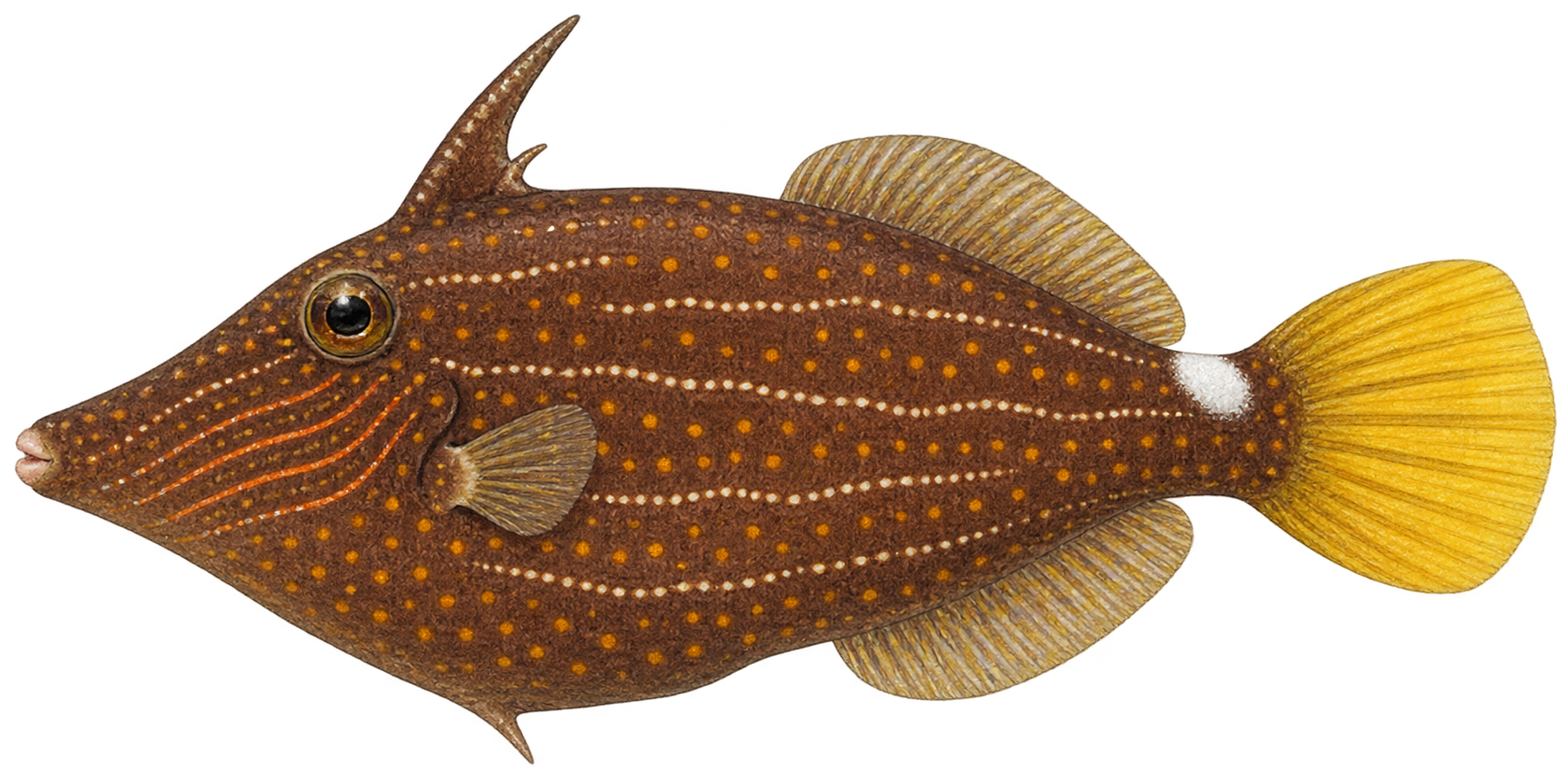
- The easiest clue may be white: look for the pale blotch above the tail base.
- Adult males can carry a small brushlike patch of hairs near the tail.
- Its upright dorsal spine comes with a much smaller locking partner.
Florida and local context
Florida marine waters; broader Florida scope: The NOAA-hosted Distribution and Sighting Frequency of Reef Fishes in Florida lists Cantherhines pullus. Florida-wide scope; no Palm Beach frequency is inferred.
Documented regional presence is not a guarantee of an encounter or a measure of how common this animal is at your dive site.
How to recognize this animal
Look for a small brown filefish with orange-yellow spots, fine lines on the cheek and a clear white blotch on top of the tail base. That pale tail-base mark is especially useful. The body is deep and flattened, the snout pointed, and the mouth tiny. A stout leading dorsal spine rises near the eye; the tail is rounded or nearly straight.
Size and life stages
The species reaches about 8 inches, or 20 centimeters, in total length. Its compact size helps separate an adult from a large scrawled filefish, but size alone cannot identify a juvenile. Include the tail base in photographs rather than cropping to the face. The white blotch is often a more dependable clue than how orange the small spots look underwater.
Habitat and where to look
Coral and rocky reefs are its principal habitat. Its small mouth and deliberate movements suit close inspection of surfaces with attached growth. Watch the margins of crevices and patches of reef from outside the structure. A fish can retreat into cover quickly even if its normal movements appear slow, so leave a clear route to shelter.
Range and local context
Orangespotted filefish occur on both sides of the Atlantic, with Florida within the western Atlantic range. This profile uses a Florida-wide geographic scope. Florida Museum's Lake Worth Lagoon checklist includes the species but does not mark it verified. Accordingly, the listing is not presented here as a documented Palm Beach sighting or evidence that the fish is common locally.
What is on the menu?
Its food includes algae and attached invertebrates such as sponges, tunicates and hydroids, with other small bottom-associated items also reported. An apparent nibble at coral-covered rock does not establish exactly what was eaten. For a helpful observation, record the surface and the feeding motion. There is no need to move reef growth or attract the animal with food.
Daily habits and behavior
The first dorsal spine can be held upright with a smaller locking spine behind it. The rest of the fish's movement is often controlled by the soft fins while the body remains relatively steady. Adult males can have a brushlike patch of hairs on the tail base. These small anatomical details are best studied in photographs rather than pursued by handling.
Mating and the next generation
The species has bottom-associated eggs followed by a pelagic larval stage. That combination means a reef-based reproductive start can still lead into a period in the water column. The sources used here do not provide a dependable local spawning calendar. Avoid assigning a nest or reproductive role solely because two fish occupy the same small part of a reef.
Look-alikes and identification traps
The similarly named orangespotted filefish should not be confused with the orange filefish, Aluterus schoepfii. Scrawled filefish have longer bodies and tails with blue scribbles; whitespotted filefish can also show pale markings but differ in proportions and tail-base features. Start with the distinct white upper tail-base blotch, then check shape, size and the small orange spotting together.
Observe without disturbing
Keep hands away from the spine and do not force the fish out of a refuge. Hold a camera position that allows it to move freely rather than surrounding it with divers. A sharp side image showing the white mark and snout is ideal. If those features are missing, preserve a tentative filefish identification until a stronger comparison is possible.
Harvest, protection and eating safety
Restricted marine life: live collection only; no spearing
Can it be hunted or harvested?
Orangespotted Filefish (Cantherhines pullus) is restricted tropical ornamental marine life, not an ordinary food-fishing species or a blanket no-take species. Where collection is lawful, a saltwater fishing license is required unless exempt. Land and keep the fish alive with adequate circulation or aeration. No species-specific size limit is listed. Daily limit: five of this species within 20 marine-life organisms total per person. Two-day possession maximum: ten of this species within 40 organisms total. Recreational sale is prohibited.
Florida seasons and areas
No annual recreational closed months are listed for this marine-life species. Collection is prohibited within the designated Blue Heron Bridge dive-site boundary and throughout Biscayne National Park. Florida marine-life rules also apply in adjacent federal waters on both coasts. Check the exact sanctuary, park and refuge zone before collecting. Western Dry Rocks’ designated one-square-mile area is closed to all fishing April 1–July 31 annually.
Can it be speared?
No. Spears are not authorized recreational gear for this regulated tropical marine-life fish. Use only lawful live-collection methods, such as permitted hand-held, barrier or drop nets or a slurp gun, and comply with the live-landing requirement.
Is it safe to eat?
Not recommended as a food target. This species is regulated for live collection, and this guide does not certify it as safe to eat. Check Florida DOH guidance before eating any locally caught fish. Cooking does not remove all marine toxins, and legal collection is not evidence of food safety.
Before you act: This recreational overview is not permission to collect or spear at your dive site. Confirm the species, date, management area, state or federal waters, gear, licenses and current local closures. Identification artwork cannot establish an identification or guarantee seafood safety.
Official rules and health guidance
- FWC recreational marine-life rules
- FWC recreational saltwater licenses and exemptions
- FWC Biscayne National Park limits and closed areas
- NOAA Florida Keys sanctuary zones
- Florida Administrative Code 68B-42.007: marine-life gear
- Florida DOH seafood-consumption guidance
- Florida DOH ciguatera and other seafood poisoning
- FWC Western Dry Rocks seasonal closure
Reviewed 2026-11-10. Rules and advisories can change; check the linked authorities before harvesting or eating.
Sources and review
Reviewed 2026-11-10.
Make your next dive happen
Dive With Us
Explore local charters and plan a dive suited to your experience.
View dive calendarTrain With Us
Build your fish identification, buoyancy and diving skills.
Explore trainingTravel With Us
Discover upcoming dive adventures and trip details.
Explore dive travelShop With Us
Browse equipment for your diving and ask our team for help choosing.
Explore dive gearReview current dates, availability, prices, inclusions and requirements on each listing before booking or buying.
Call us now
Ask about marine life identification
Marine Life Identification
Ask about dates, prerequisites or your next step. An inquiry does not reserve a place. Please provide your own contact details; do not include medical, payment or a child's personal information.
We use these details to respond to your inquiry. This form does not sign you up for marketing.
Explore more with Stuart Scuba
Open Water course options · Advanced Adventure training · Technical training · Professional training · All courses · Local dives · Dive trips · Facebook · Instagram · YouTube
Your surface-interval essentials
Questions for Stuart Scuba? info@stuartscuba.com
Check the Stuart Scuba Weather Center · Play scuba trivia
Weather and wildlife vary. Confirm current conditions, trip requirements and departure details with the operator.
Plan Your Next Dive with Stuart Scuba
Dive With Us
Explore upcoming local charters and choose a dive that fits your experience.
Before you book
Check the individual listing for departure time, requirements and availability.
Travel With Us
Find upcoming dive adventures and start planning your next trip.
Plan your trip
Review dates, inclusions and trip details on the travel calendar.
Stay Connected with Stuart Scuba
 Follow pageShare
YouTube
SubscribeWatch & shareFollow on InstagramView & share post
Follow company news, training updates, and dive stories.
Follow on LinkedInGoogle Reviews
See Stuart Scuba’s current Google rating and review count below. Open the listing in Google Maps to browse customer reviews.



