

Fish identification archive / Ocean Surgeonfish
Ocean Surgeonfish
Acanthurus tractus
I saw this
Spotted this marine animal? Share the guide with your dive buddies. Review your caption before posting.
For Instagram, copy the caption and link into your own post or message. Nothing is posted automatically and this does not record a verified sighting.
Fun facts for your next surface interval
- A thirty-something grazer: Smithsonian records lifespans of at least 32 years.
- A vegetarian with a scalpel: the tail-base spine is defensive equipment, not dining cutlery.
- An old name got a second shift: Acanthurus tractus was restored for the northern species in 2011.
Florida and local context
Florida, including historical Key West and Panama City records: Original taxonomic study recognizes northern A. tractus, discusses Florida records and synonym type locality; older lagoon listing uses pre-split A. bahianus.
Documented regional presence is not a guarantee of an encounter or a measure of how common this animal is at your dive site.
How to recognize this animal
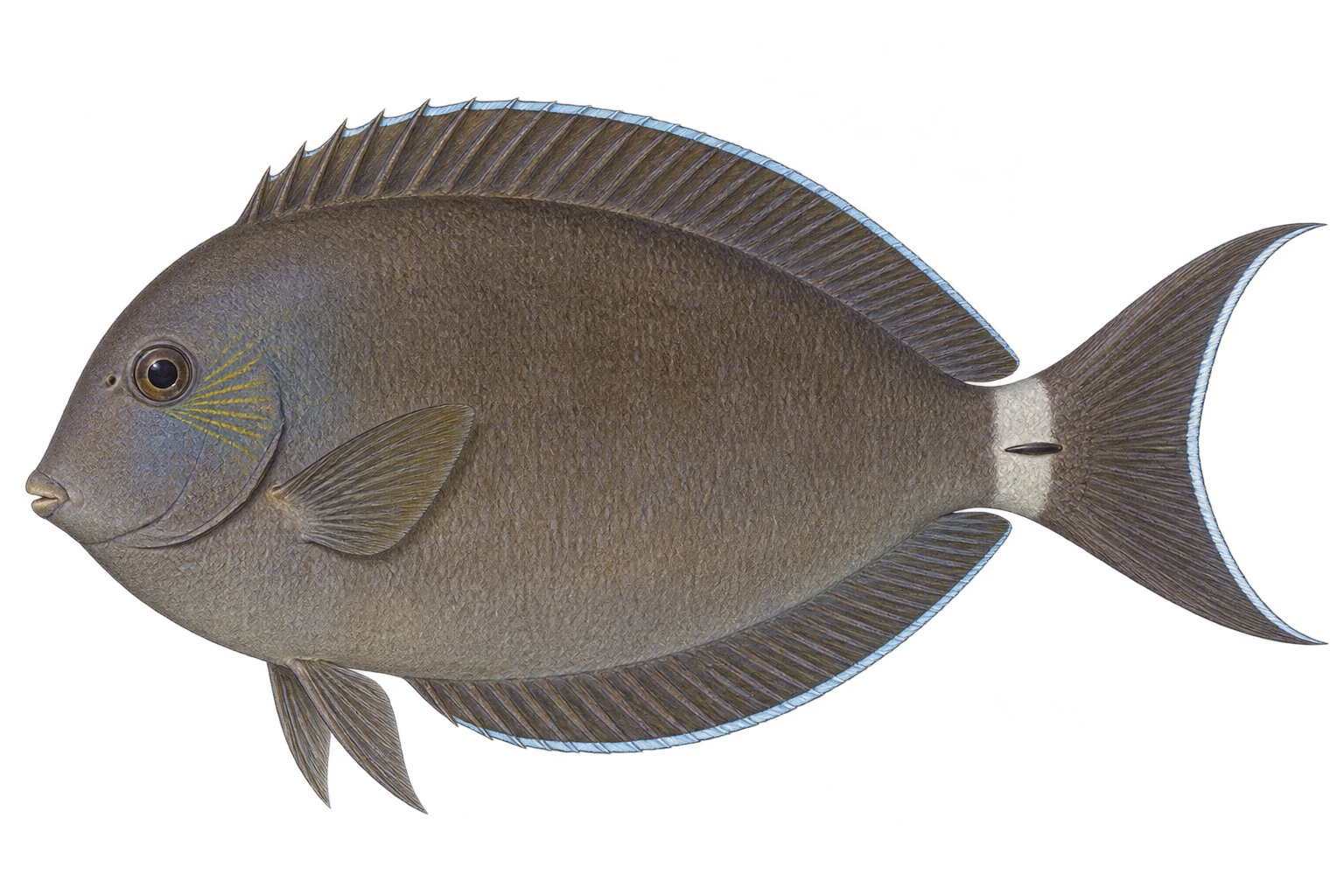
An adult Ocean Surgeonfish is a flattened, elongated oval with a steep forehead and a little mouth set low on the face. Look for the pale band at the tail base and the white to pale-blue trailing tail edge. The tail is distinctly concave, with pointed tips. Unlike Doctorfish, the sides lack a row of narrow dark vertical bars.
Size and life stages
Smithsonian reports a maximum of 35 cm and longevity of at least 32 years. Most encounters will involve smaller fish. Size alone will not separate this species from other surgeonfishes, particularly when several ages travel together. Estimate length from a comfortable distance rather than swimming closer to compare a fish with your hand or equipment.
Habitat and where to look
Rocky and coral reefs provide grazing surfaces, while nearby seagrass beds are also used. Search the boundary between hard bottom and sand, not just the most colorful coral formations. A plain brown fish working steadily over a rock may be more informative than a bright fish passing overhead. Watch several feeding movements before moving on.
Range and local context
This is the northern western Atlantic species, including Florida, the Gulf of Mexico and the Caribbean. The 2011 taxonomic study discusses Florida records and separates it from the southern Acanthurus bahianus. Older Florida sources often use that older name. This guide follows A. tractus and does not turn a historical name into a second Florida species or a guaranteed Palm Beach sighting.
What is on the menu?
Bottom-growing algae are central to its diet. Small, close-set teeth help crop food from surfaces, and feeding can include seagrass habitat. The fish is browsing, not biting pieces off every coral it passes. To interpret a photograph, look at the actual contact point: a mouth near a coral head may be reaching an algal film on neighboring rock.
Daily habits and behavior
Ocean surgeonfishes can feed in groups and mix with other surgeonfishes. A school need not contain only one species, so inspect more than the nearest fish before naming the whole group. Their relatively subdued colors reward a second look: the tail outline and fin edging can be clearer clues than the overall brown or gray shade.
Mating and the next generation
Smithsonian lists pelagic eggs and larvae, meaning early development occurs in open water rather than in a guarded nest on the reef. A cluster of adults is not automatically a spawning aggregation. Without observing reproductive behavior, describe it simply as a group. A broad species account also cannot establish the spawning dates for a particular Florida dive site.
Look-alikes and identification traps
Doctorfish have narrow side bars and a blunter tail outline. Adult Blue Tangs have a different blue-toned appearance, although underwater light can complicate color judgments. Southern Ocean Surgeonfish, A. bahianus, require special care in old references: the original taxonomic comparison emphasizes orange-yellow rather than blue-white fin margins. A scientific name is especially useful when comparing records across years.
Observe without disturbing
Allow feeding fish an unobstructed route across the reef. Keep fingers away from the sharp spine beside the tail, and never handle a fish to expose it for identification. Photograph the full side and tail without chasing. During a Stuart Scuba dive, ask your guide about the habitat you are seeing and keep any uncertain identification provisional.
Harvest, protection and eating safety
Restricted marine life: live collection only; spearing prohibited
Can it be hunted or harvested?
Ocean Surgeonfish is regulated ornamental marine life, not an ordinary food-fishing target. Recreational collection requires the appropriate saltwater license unless exempt, lawful marine-life gear, and landing and keeping the fish alive in adequately aerated or circulating water. Maximum 9 inches fork length. The daily limit is five of this species within 20 marine-life organisms total; the two-day possession limit is ten of this species within 40 total. Recreational sale is prohibited.
Florida seasons and areas
No species-specific recreational closed months are listed in the reviewed marine-life rules. This is not permission to collect anywhere: the designated Blue Heron Bridge dive site is closed to marine-life harvest. Florida marine-life rules also apply in adjacent federal waters. Check sanctuary zones, parks, refuges and current local closures before any collection.
Can it be speared?
Prohibited. FWC expressly includes surgeonfish among ornamental reef fishes that may not be harvested by spearing. Live ornamental collection is a separate, restricted activity, not an exception allowing a spear.
Is it safe to eat?
No species-specific Florida consumption-safety clearance was verified. Do not treat live-collection status as permission or evidence that this fish is safe to eat. Ciguatoxin cannot be removed by cooking or freezing. FDA/EPA mercury-based meal advice is not a ciguatera clearance for an individual reef fish.
Before you act: This recreational overview is not permission to collect or spear at your dive site. Confirm the species, date, management area, state or federal waters, gear, licenses and current local closures. Identification artwork cannot establish an identification or guarantee seafood safety.
Official rules and health guidance
- FWC: Recreational Marine Life
- FWC: Spearing
- Florida Administrative Code: Marine Life Chapter 68B-42
- NOAA: Florida Keys Sanctuary Marine Zones
- Florida Department of Health: Seafood Poisoning
- FDA/EPA: Advice about Eating Fish
Reviewed 2026-11-10. Rules and advisories can change; check the linked authorities before harvesting or eating.
Sources and review
Reviewed 2026-11-10.
Make your next dive happen
Dive With Us
Explore local charters and plan a dive suited to your experience.
View dive calendarTrain With Us
Build your fish identification, buoyancy and diving skills.
Explore trainingTravel With Us
Discover upcoming dive adventures and trip details.
Explore dive travelShop With Us
Browse equipment for your diving and ask our team for help choosing.
Explore dive gearReview current dates, availability, prices, inclusions and requirements on each listing before booking or buying.
Call us now
Ask about marine life identification
Marine Life Identification
Ask about dates, prerequisites or your next step. An inquiry does not reserve a place. Please provide your own contact details; do not include medical, payment or a child's personal information.
We use these details to respond to your inquiry. This form does not sign you up for marketing.
Explore more with Stuart Scuba
Open Water course options · Advanced Adventure training · Technical training · Professional training · All courses · Local dives · Dive trips · Facebook · Instagram · YouTube
Your surface-interval essentials
Questions for Stuart Scuba? info@stuartscuba.com
Check the Stuart Scuba Weather Center · Play scuba trivia
Weather and wildlife vary. Confirm current conditions, trip requirements and departure details with the operator.
Plan Your Next Dive with Stuart Scuba
Dive With Us
Explore upcoming local charters and choose a dive that fits your experience.
Before you book
Check the individual listing for departure time, requirements and availability.
Travel With Us
Find upcoming dive adventures and start planning your next trip.
Plan your trip
Review dates, inclusions and trip details on the travel calendar.
Stay Connected with Stuart Scuba
 Follow pageShare
YouTube
SubscribeWatch & shareFollow on InstagramView & share post
Follow company news, training updates, and dive stories.
Follow on LinkedInGoogle Reviews
See Stuart Scuba’s current Google rating and review count below. Open the listing in Google Maps to browse customer reviews.



