

Fish identification archive / Northern Quahog
Northern Quahog
Mercenaria mercenaria · Veneridae
I saw this
Spotted this marine life? Share the guide with your dive buddies. Review your caption before posting.
For Instagram, copy the caption and link into your own post or message. Nothing is posted automatically and this does not record a verified sighting.
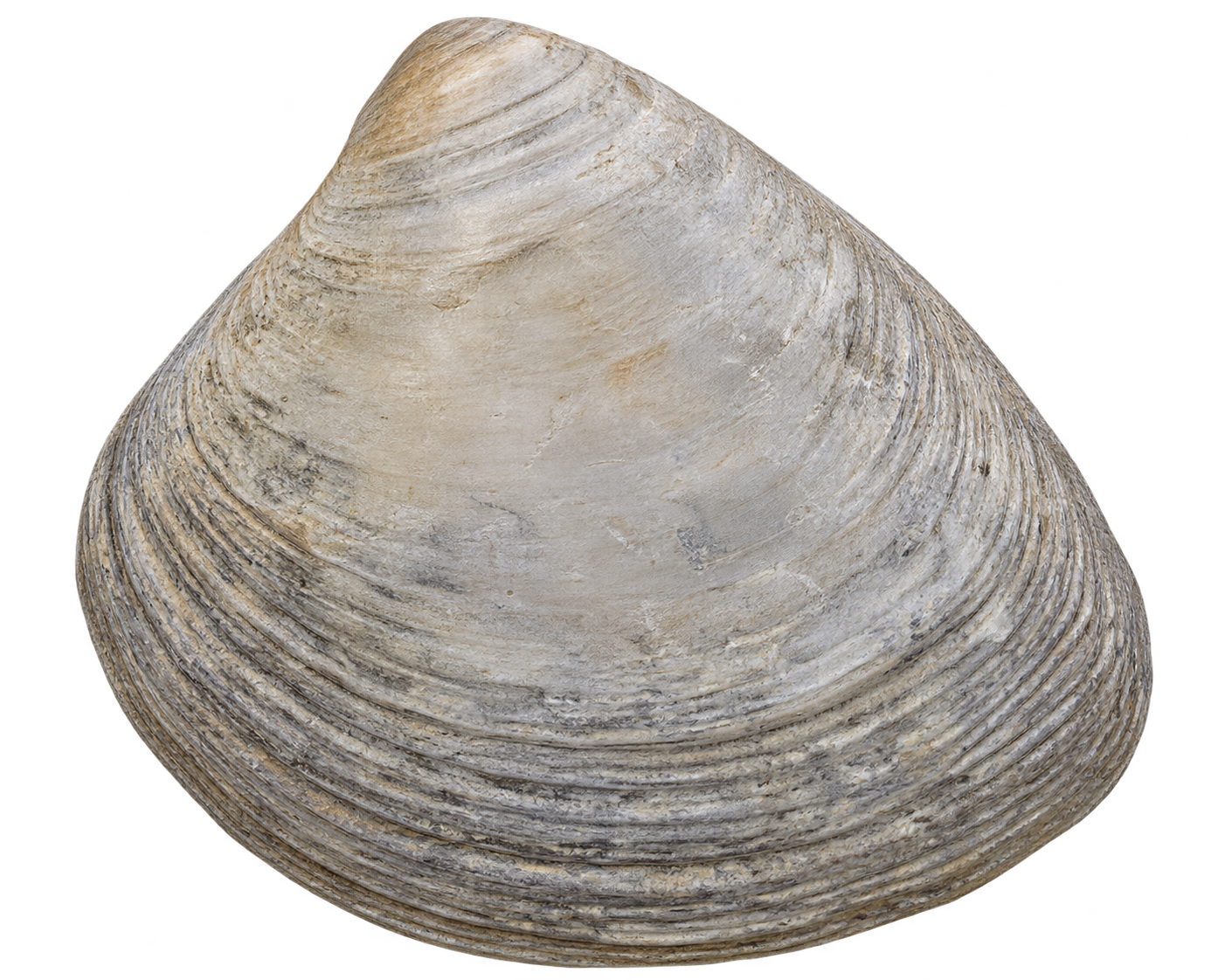
The northern quahog, Mercenaria mercenaria, is easy to overlook while alive because much of its shell remains below the bottom. This is a hard clam of sediment and estuarine habitat, not a colorful animal displayed on an exposed coral head. Its thick, rounded-triangular valves bear concentric growth sculpture; the ridges are commonly less prominent toward the center than those of the southern quahog.
Florida range and habitat
Despite its name, this species belongs in an Atlantic Florida guide. UF/IFAS places its native range along the Atlantic coast and explicitly records both northern and southern hard clams in the Indian River Lagoon. Northern hard clams have also been moved into Florida Gulf waters for aquaculture. Those introductions should not be confused with proof that every Florida population has the same origin.
For the Vero Beach–Key Largo coast, the important distinction is habitat: a documented lagoon clam is not automatically a reef-dive species. A buried animal or a pair of siphons may provide a less obvious encounter than an empty shell. Avoid digging simply to produce a recognizable photograph.
How it feeds and reproduces
A clam draws water through an inhalant siphon and passes it across its feeding structures, removing microscopic algae and other useful particles. Water leaves through a separate outlet. Its muscular foot helps it burrow rather than chase prey. This quiet feeding connects the water column to the sediment beneath it.
Spawning releases eggs and sperm into the water. NOAA describes very high egg production, while only a fraction of young clams survives to adulthood. Northern quahogs can live for decades, so a large individual represents much more than a season’s growth. Size alone is not a dependable age estimate.
The southern-quahog comparison
Purple coloration inside a shell and relatively low exterior ridges are helpful clues, but they are not guarantees. The two Florida Mercenaria species hybridize, and UF/IFAS cautions that shell traits alone cannot reliably establish every individual’s identity. Use “hard clam” or Mercenaria species when the available photograph does not justify a narrower label.
Responsible observation
Leave live clams buried and leave restoration areas undisturbed. A shellfish species being edible does not mean that an arbitrary lagoon is an approved harvest area. Check current FWC and shellfish-area rules before collecting. For identification, photograph a naturally exposed or already empty shell from several angles, and record whether it was alive, empty or occupied by another animal.
References
Collection and shellfish safety
FWC regulates hard-clam harvest, including size, gear and bag requirements. Live clams may be taken only from designated approved or conditionally approved shellfish areas that are currently open. Check the exact location and current closure status before any collection. Neither this illustration nor identification of a clam establishes that it is safe to eat. FWC live-shell collection guidance and FWC hard-clam and oyster rules. Official guidance reviewed November 12, 2026; no location-specific harvest or sanitation clearance is given.
Make your next dive happen
Dive With Us
Explore local charters and plan a dive suited to your experience.
View dive calendarTrain With Us
Build your fish identification, buoyancy and diving skills.
Explore trainingTravel With Us
Discover upcoming dive adventures and trip details.
Explore dive travelShop With Us
Browse equipment for your diving and ask our team for help choosing.
Explore dive gearReview current dates, availability, prices, inclusions and requirements on each listing before booking or buying.
Call us now
Ask about fish identification training
Reef Fish Identification
Ask about dates, prerequisites or your next step. An inquiry does not reserve a place. Please provide your own contact details; do not include medical, payment or a child's personal information.
We use these details to respond to your inquiry. This form does not sign you up for marketing.
Explore more with Stuart Scuba
Open Water course options · Advanced Adventure training · Technical training · Professional training · All courses · Local dives · Dive trips · Facebook · Instagram · YouTube
Your surface-interval essentials
Questions for Stuart Scuba? info@stuartscuba.com
Check the Stuart Scuba Weather Center · Play scuba trivia
Weather and wildlife vary. Confirm current conditions, trip requirements and departure details with the operator.
Plan Your Next Dive with Stuart Scuba
Dive With Us
Explore upcoming local charters and choose a dive that fits your experience.
Before you book
Check the individual listing for departure time, requirements and availability.
Travel With Us
Find upcoming dive adventures and start planning your next trip.
Plan your trip
Review dates, inclusions and trip details on the travel calendar.
Stay Connected with Stuart Scuba
 Follow pageShare
YouTube
SubscribeWatch & shareFollow on InstagramView & share post
Follow company news, training updates, and dive stories.
Follow on LinkedInGoogle Reviews
See Stuart Scuba’s current Google rating and review count below. Open the listing in Google Maps to browse customer reviews.



