

Fish identification archive / Nassau Grouper
Nassau Grouper
Epinephelus striatus
Fun facts for your next surface interval
- Quick-change artist: A Nassau grouper can change its color pattern within minutes.
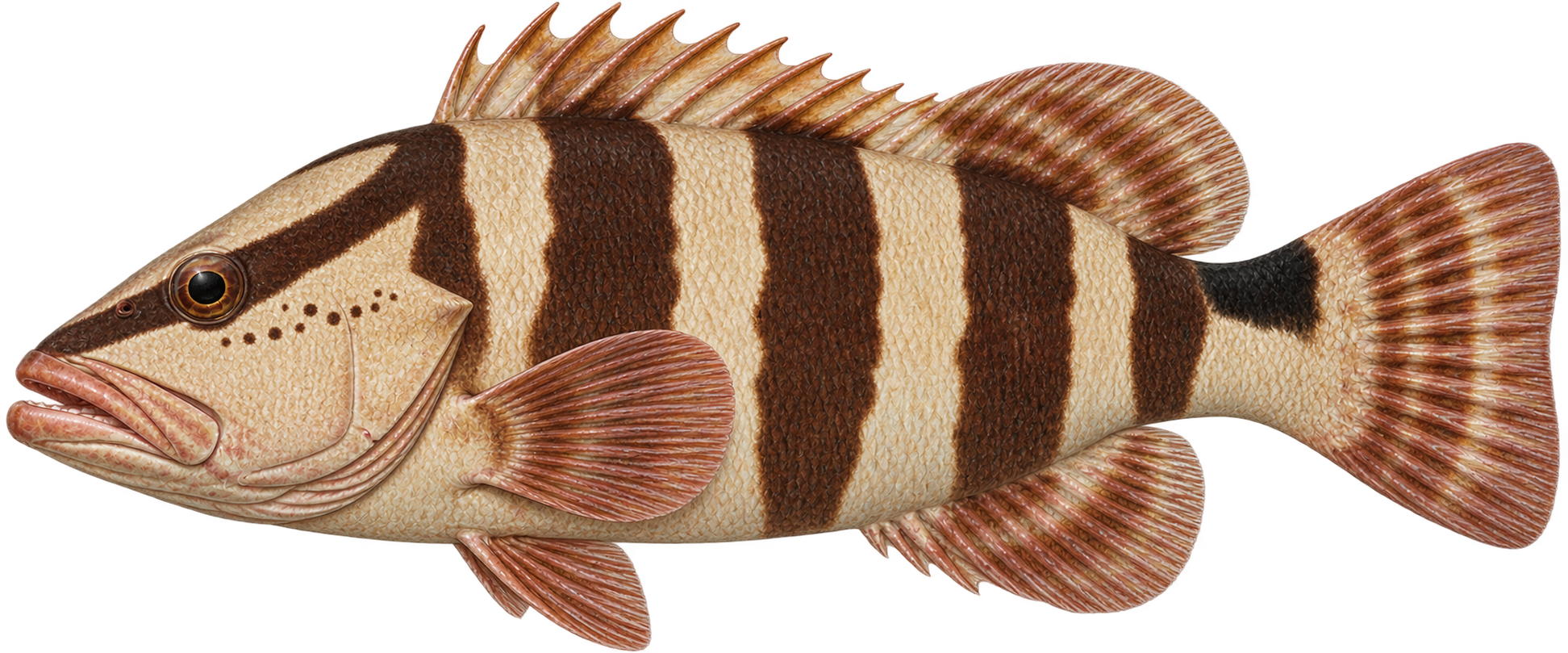
- A musical-looking forehead: Its head markings form a tuning-fork shape when viewed from above.
- A grouper exception: NOAA has not confirmed natural sex change in adult Nassau grouper, despite that behavior occurring in other grouper species.
Florida and local context
Reported in REEF diver surveys at Blue Heron Bridge (WPB), Phil Foster Park. Cumulative survey records document occurrence, not a guaranteed encounter or present-day abundance.
Source: REEF diver surveys: Blue Heron Bridge (WPB), Phil Foster Park. Cumulative report period: 1993-01-01 through 2026-09-29.
Documented regional presence is not a guarantee of an encounter or a measure of how common this animal is at your dive site.
How to recognize this animal
A normally patterned Nassau grouper is beige to pale brown with five broad dark vertical bars. A black saddle crosses the top of the tail base. Dark lines around the head form a tuning-fork pattern when seen from above, and dark marks continue below and behind the eyes. The robust body and large mouth are grouper features, but the bars, head pattern and tail saddle together make this species recognizable.
Size and life stages
NOAA reports that most fish reach reproductive maturity near 20 inches, roughly 51 cm, and four to five years old. This is a maturity benchmark, not a maximum length or a reliable way to age a photographed fish. Individuals can live up to 29 years. Young fish broadly resemble the barred adult pattern, although color can change greatly with behavior.
Habitat and where to look
Adults favor structurally complex coral and rocky reefs, including natural and artificial structure. Larger fish tend to occupy deeper, higher-relief habitat. Elsewhere in the range, early juveniles use shallow macroalgal and seagrass areas before shifting onto reefs. NOAA cautions that small juveniles and larvae have not been documented in Florida in the same way, with shoreline sampling also limited. Do not turn a general nursery description into a verified local nursery claim.
Range and local context
NOAA includes South Florida within a wider Caribbean and western North Atlantic range, including the Bahamas and Bermuda. The species is uncommon in U.S. waters. Its regional presence must not be described as an ordinary or guaranteed sighting. REEF cumulative diver surveys document this species at Blue Heron Bridge (WPB); that record does not establish present-day abundance.
What is on the menu?
Nassau grouper are ambush predators. Their protruding mouth creates suction that helps draw prey inward, and prey are swallowed whole. NOAA describes adults feeding on fish, with younger individuals also taking shrimp, crabs and other invertebrates. Dawn and dusk can offer feeding opportunities when day-active and night-active reef animals are changing their routines.
Daily habits and behavior
Adults are relatively solitary outside the breeding season and spend considerable time around favored reef structure. Their colors can change within minutes, becoming pale, dark or two-toned. A bicolored fish is therefore not automatically a different species. Such patterns can occur during interactions and at spawning gatherings, but a color change by itself does not prove spawning.
Mating and the next generation
Nassau grouper reproduce in spawning aggregations, often associated with full moons in the winter season. Adults may travel substantial distances to gathering sites. Eggs are buoyant, and larvae develop in the plankton before settling. Unlike several familiar groupers, natural adult sex change has not been confirmed for this species: NOAA describes juveniles developing directly into males or females after an early bisexual phase.
Look-alikes and identification traps
Other barred groupers can cause confusion, especially if the tail base is hidden. Look for the five broad bars together with the distinct black saddle and head markings. Tiger grouper's narrow pale oblique lines over dense spots are different from Nassau's broad dark bars. Allow for rapid color changes and avoid demanding that every photograph match one standard beige illustration.
Observe without disturbing
Treat an encounter as an opportunity for quiet observation. Do not feed, touch, surround or disturb the fish, and leave aggregations and their travel routes undisturbed. NOAA identifies Nassau grouper as protected and prohibits U.S. harvest. Photograph without pursuit and keep the conservation context prominent; this profile is not a food-fish or harvest-permitted listing.
Harvest, protection and eating safety
Protected: all harvest prohibited; ESA threatened
Red means no food harvest, full prohibition, or present closed season; read the specific reason, not an edibility score.
This color is a qualified summary, not permission to collect or a guarantee that a particular catch is safe to eat. Read the current rules and health guidance below.
Can it be hunted or harvested?
Do not hunt, target, take or keep Nassau grouper. Harvest and possession are prohibited in U.S. waters; no aquarium or food-harvest exception is provided here.
Florida seasons and areas
There is no open recreational harvest season for Nassau grouper in Florida Atlantic, Gulf or federal waters. General fishing seasons and area transit exceptions do not authorize harvest or possession of this protected fish. Observe without pursuing, spearing, capturing or disturbing it.
Can it be speared?
No. Nassau grouper is expressly prohibited from spearing and harvest.
Is it safe to eat?
Do not harvest for food. Protection and possession prohibitions apply regardless of edibility. No blanket safe-to-eat assurance. Consult current Florida DOH advice for the exact fish, capture water and consumer, particularly pregnancy, nursing and children. This guide provides no species-specific safe meal allowance. Legal harvest and normal appearance do not establish food safety.
Before you act: This recreational overview is not permission to collect or spear at your dive site. Confirm the species, date, management area, state or federal waters, gear, licenses and current local closures. Identification artwork cannot establish an identification or guarantee seafood safety.
Official rules and health guidance
- NOAA Nassau grouper protected species
- FWC recreational grouper rules
- NOAA Keys sanctuary zones
- FWC Western Dry Rocks closure
- FWC Biscayne National Park regulations
- FWC spearing restrictions
- Florida DOH fish consumption guidance
- Florida DOH seafood poisoning
Reviewed 2026-11-11. Rules and advisories can change; check the linked authorities before harvesting or eating.
Sources and review
Reviewed 2026-11-11.
Make your next dive happen
Dive With Us
Explore local charters and plan a dive suited to your experience.
View dive calendarTrain With Us
Build your fish identification, buoyancy and diving skills.
Explore trainingTravel With Us
Discover upcoming dive adventures and trip details.
Explore dive travelShop With Us
Browse equipment for your diving and ask our team for help choosing.
Explore dive gearReview current dates, availability, prices, inclusions and requirements on each listing before booking or buying.
Call us now
Ask about marine life identification
Marine Life Identification
Ask about dates, prerequisites or your next step. An inquiry does not reserve a place. Please provide your own contact details; do not include medical, payment or a child's personal information.
We use these details to respond to your inquiry. This form does not sign you up for marketing.
Explore more with Stuart Scuba
Open Water course options · Advanced Adventure training · Technical training · Professional training · All courses · Local dives · Dive trips · Facebook · Instagram · YouTube
Your surface-interval essentials
Questions for Stuart Scuba? info@stuartscuba.com
Check the Stuart Scuba Weather Center · Play scuba trivia
Weather and wildlife vary. Confirm current conditions, trip requirements and departure details with the operator.
Plan Your Next Dive with Stuart Scuba
Dive With Us
Explore upcoming local charters and choose a dive that fits your experience.
Before you book
Check the individual listing for departure time, requirements and availability.
Travel With Us
Find upcoming dive adventures and start planning your next trip.
Plan your trip
Review dates, inclusions and trip details on the travel calendar.
Stay Connected with Stuart Scuba
 Follow pageShare
YouTube
SubscribeWatch & shareFollow on InstagramView & share post
Follow company news, training updates, and dive stories.
Follow on LinkedInGoogle Reviews
See Stuart Scuba’s current Google rating and review count below. Open the listing in Google Maps to browse customer reviews.



